



When To Use a VSD on a Rotary Screw Air Compressor
January 21, 2026
Lowering Compressed Air Costs: Three Key Metrics to Watch
February 4, 2026Measuring For Air Compressor Energy Efficiency: What to Track, Why It Matters, What to Do Next
By John Schmitt, Product Marketing Manager| January 28, 2026 | Uncategorized

Compressed air requires significant amounts of electrical power to keep the wheels turning in your facility.
If you’re responsible for keeping a plant running, you already know that compressed air is a necessity. One of those “always-on” utilities that can quietly become one of the biggest line items on your electric bill.
That’s why measuring air compressor energy efficiency matters. When you track the right performance numbers, you stop guessing. You can compare apples to apples, spot waste that’s hiding in plain sight and make upgrades that show up as real savings.
Plus, compressed air energy efficiency is rarely one big fix. It’s usually a handful of smaller decisions: selecting the right compressor, setting the correct header pressure, properly controlling multiple machines and avoiding oversizing “just to be safe.”
The good news? Those are all things you can measure and manage.
Let’s start with the performance metrics that tell you what a compressor is really doing with your energy: isentropic ratings and specific power.
| Metric | Key Idea |
|---|---|
| 1. Isentropic Energy Rating | A rating that measures how close a unit comes to the ideal of having no mechanical losses or heat generation. |
| 2. Specific Power | The power a compressor consumes to make a given amount of air. |
| 3. Header Pressure | Setting header pressure as low as possible is a significant energy saver. |
| 4. Compressor Sizing | Oversizing your compressor usually increases costs and maintenance issues. |
Start With the Numbers That Matter: Isentropic Energy Ratings and Specific Power
When you’re comparing compressors, the fastest way to be misled is to look at nameplate horsepower alone. Two compressors can both be 200 HP and deliver very different real-world air compressor energy efficiency. What you want is a measure of how effectively the compressor turns electric power into delivered air at your required pressure.
The two terms used most frequently in describing a compressor’s energy efficiency are:
- Specific power: The established standard, typically expressed as kW per 100 CFM (or similar), tells you how much electrical power a compressor consumes to make a unit of air.
- Isentropic efficiency/energy rating: The new standardized way to evaluate compressor performance, with a 100% rating indicating no mechanical losses or heat generation.
Manufacturers began voluntarily publishing IE results after the U.S. Department of Energy finalized the rules in 2020. (The new rules are summarized in a presentation titled “Air Compressors—DOE’s Current Regulations.”)
Isentropic efficiency has now become the new benchmark for compressor energy savings and is especially important when comparing machines and configurations. No one currently reaches that 100% ideal, and probably never will. But we’re all trying.
As a result, many government agencies and utility companies are adopting the new standards to determine eligibility for rebates.
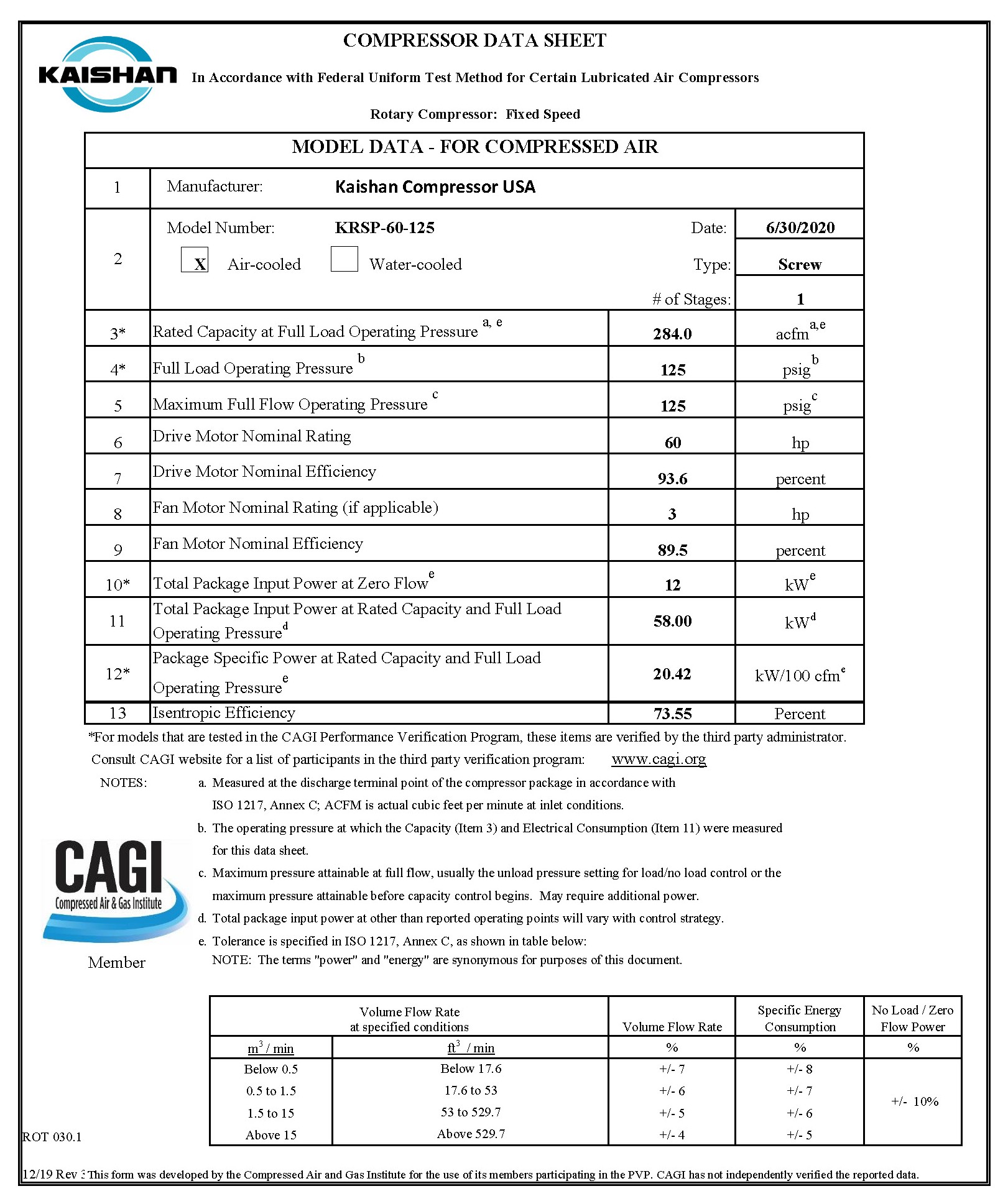
CAGI’s new compressor data sheet shows the original specific power rating (line 12) and the new isentropic efficiency rating (line 13).
Find more details on these energy measurements in our blog post, “A Beginner’s Guide to Reading Rotary Screw Compressor Performance Curves.”
What’s Your Header Pressure? The “Small” Setting That Can Create Big Energy Waste
A stable header pressure is critical in delivering the even flows of compressed air you need. Especially in the semiconductor, healthcare, pharmaceuticals and electronics industries.
- Set your header pressure too low, and your end-use applications will suffer.
- Set your header pressure too high, and you’ll sacrifice air compressor energy efficiency, also reducing reliability and damaging machinery. And increasing the amount of air rushing out of leaks in your system.
Because your end users will quickly complain when the pressure’s too low, the primary concern is setting it too high:
- Maybe you're cranking up the pressure on your compressor because your end users are complaining they’re not getting enough.
- You might run your compressors at 125 PSIG or more to ensure everyone has enough juice. You don’t want your end users complaining, after all.
- You might use regulators at the lower-pressure end uses to prevent over-pressurization (and damage) to end-use equipment.
- You might set all your compressors at the same pressure to share the load equally.
In any of these situations, you’re wasting energy. Higher-than-needed pressure forces your compressor to work harder and causes more pressure loss through leaks. You can end up paying several times over: more energy per CFM, more CFM consumed and more leaks.
As a result, setting the header pressure as low as possible is crucial to operating your compressed air system. We walk through the questions you should be asking in Five Questions You Need To Answer To Get Compressed Air Header Pressure Right.
The next step is to make sure your compressors are sized to match the demand shown in your trend lines.
Compressor Sizing: Why “Bigger Just in Case” Usually Costs You More
Sizing may be the most crucial decision you make when you’re buying a new air compressor. It’s more important than the type of machine or your decision about the drive system. Even more important than whether it’s equipped with a variable-speed drive.
The reason? Time and again, experience has shown that the most serious air compressor problems stem from sizing or application errors.
With rotary screw air compressors, especially, that means oversizing. Or over-buying. Trying to add more “muscle” to your system or anticipate future needs.
It may seem counterintuitive, but with rotary screw air compressors, “too much” is almost as bad as “not enough.” So, it’s essential that you don’t oversize your system.
Here’s why. Rotary screw compressors are designed for a 100% duty cycle. Run them significantly less than that, and you’ll waste electricity.
More importantly, oversizing is the leading cause of rapid cycling, which causes maintenance nightmares, equipment failures and downtime.
Centrifugal air compressors offer high efficiency at full load but face drawbacks with fluctuating loads. They can safely reduce capacity using inlet guide vanes, but they lose efficiency when they have to blow off excess air at turndowns above 25%-35%.
They are also more expensive. They are most cost-effective for full-load, 24/7 use above 500 HP.
For practical sizing considerations, download our white paper, Demystifying Air Compressor Sizing. We cover sizing of centrifugal equipment in “Centrifugal Air Compressor Sizing.”
Next, let’s review three system-level changes that keep pressure stable while using the least energy possible.
Solution 1: Use A Multiple-Compressor System
If your plant has varying air demand, a single compressor may not be the most efficient option. That’s where a smart multi-compressor strategy shines.
We’ve had many successful applications where we improved energy efficiency with the following approach:
- A centrifugal air compressor as the lead to handle steady base load efficiently, especially in larger applications.
- A rotary screw compressor as the trim to cover swings and peaks smoothly. It is often equipped with a variable-speed drive.
- A backup compressor as the lifesaving support you need when a lead or trim compressor fails or needs service.
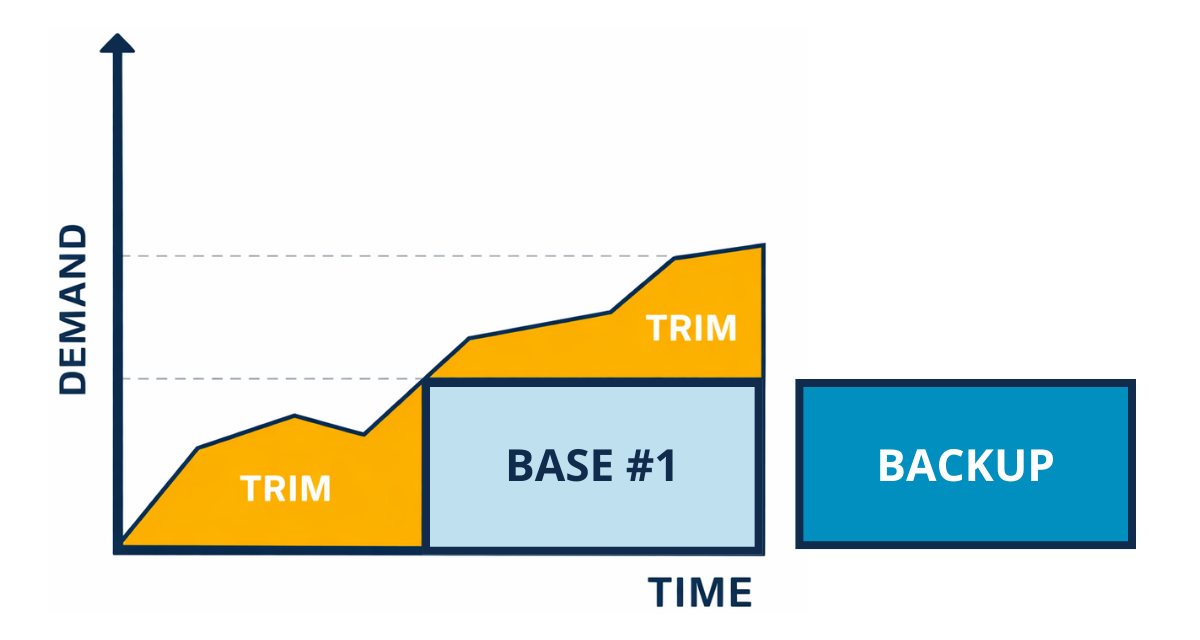
In a multi-compressor system, the trim compressor on the left handles the load on weekends or holidays, or during a limited third shift. In the center, when operating at normal levels, the base unit, often a centrifugal air compressor for high-demand applications, comes on and immediately reaches full capacity. If demand exceeds the base load, the trim unit kicks in to handle fluctuations above base demand. An additional backup unit is in place in case one of the other units requires service or fails.
This setup helps you avoid running a large machine inefficiently at part load. It helps keep your header pressure steadier because the trim unit responds quickly. And because you have a reliable backup waiting in the wings, your compressed air service is rock-solid.
We explore compatibility and what to watch for in “Can Centrifugal and Rotary Screw Air Compressors Play Nice Together?”
Multi-compressor systems work best when the machines are coordinated, which brings us to controls.
Solution 2: Add a Master Controller to Coordinate the Whole Compressor Room
If you have more than one compressor, controls can make or break your compressed air energy efficiency. Without coordination, machines may fight each other: one loads, another unloads, pressure bounces, power spikes and you end up paying for air you do not need.
A master controller helps by:
- Sequencing machines efficiently
- Maintaining stable header pressure with fewer swings
- Reducing unload time and inefficient part-load operation
- Managing trim response
For more details on controls, read Everything You Need To Know About Compressed Air Controls.
Once your system is coordinated, our next solution is to improve compressor efficiency.
Solution 3: Consider a Two-Stage Rotary Screw Compressor for Better Efficiency
If you’re running a rotary screw compressor for significant hours, stage design matters.
A two-stage air compressor like the KRSP2 premium rotary screw air compressor splits the workload into two separate stages. The specifics:
- A single-stage compressor like Kaishan’s KRSP premium rotary screw air compressor [Link to: https://kaishanusa.com/krsp-premium-air-compressors/] generates a compression ratio of 5 to 11 to create 100 PSIG of pressure.
- A two-stage compressor divides that work into a first stage of 2, followed by a second stage of 4.5 to create 125 PSIG of pressure. Plus, before the second stage, the air passes through an interstage cooling step, removing some of the heat of compression and adding efficiency.
By building on the pressure generated in the first stage, the KRSP2 generates more compressed air for less energy. The bottom line? A two-stage air compressor generates up to 15 to 20% more flow than a single-stage compressor of the same size (HP). Paybacks on energy costs alone may be less than two to three years.
We break it down in detail in Five Critical Differences Between a Single-Stage and a Two-Stage Air Compressor.
Spotlight: The KRSP2 Two-Stage Rotary Screw Compressor
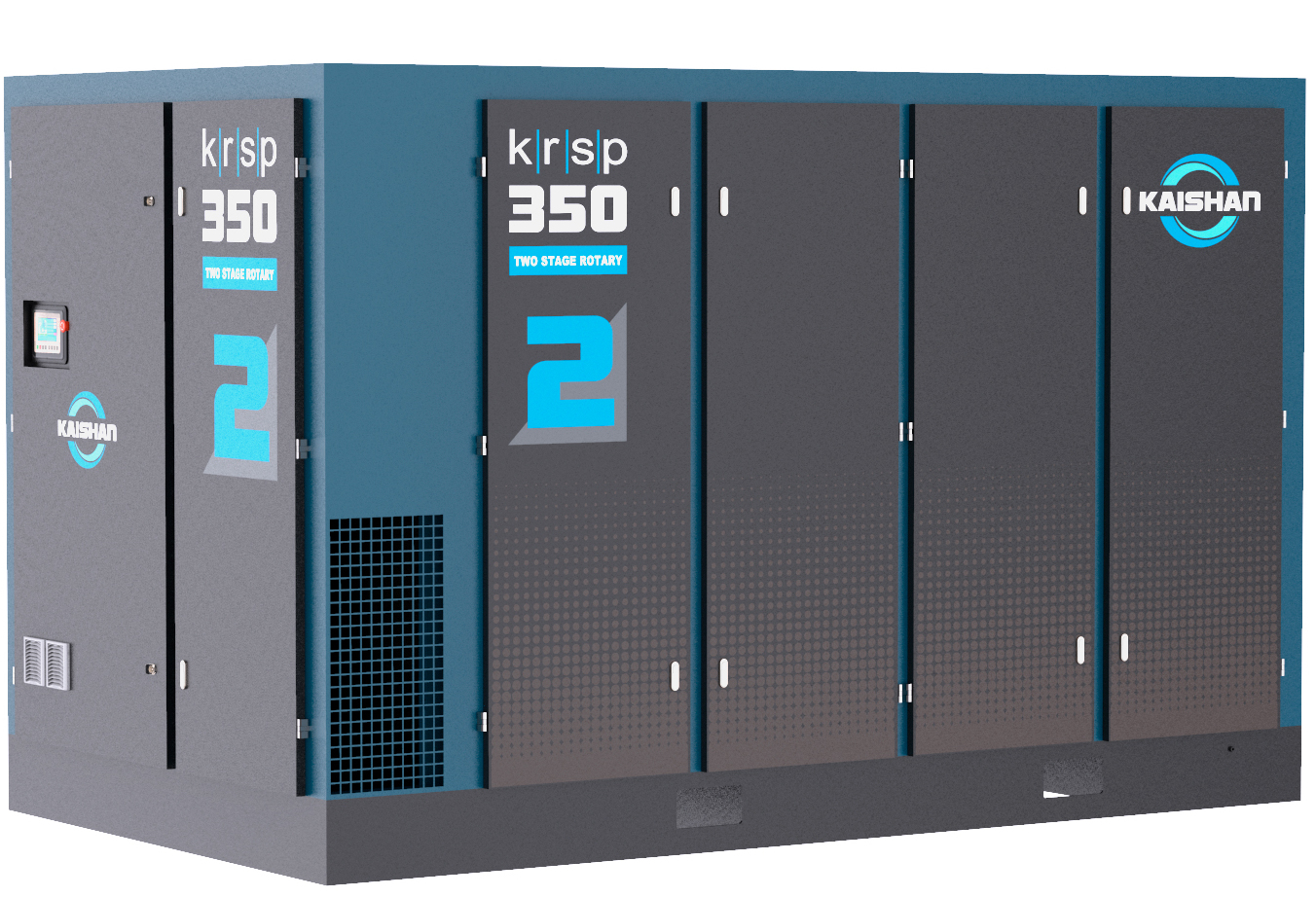
A two-stage rotary screw air compressor, like our KRSP2, can reduce the cost of air when run hours are high.
The Kaishan KRSP2 is a two-stage rotary screw air compressor that delivers high flow rates while consuming less power—up to 15-20% more flow than a comparably sized single-stage compressor. It is one of the most efficient solutions available today, ideal for demanding applications where peak operating efficiency is essential.
Because Kaishan USA maintains a robust inventory of highly efficient rotary screw air compressors, we offer unmatched lead times, strong after-sales support and uninterrupted parts availability.
And, by manufacturing units as small as 30 HP, Kaishan makes two-stage air compressors cost-effective for a much larger universe of industrial users.
For more information, visit the KRSP2 product page or watch the video.
With our extended warranties (provided at no additional cost), Kaishan’s KRSP and KRSP2 screw compressors are backed by a lifetime warranty on the airend. For more on warranties, download our white paper, “Eight Dirty Little Secrets About Air Compressor Warranties.”
Of course, the fastest way to get the sizing, pressure and controls right is to have your system audited by an expert.
Do Not Guess: Get a Compressed Air Audit by a Qualified Expert
If you only take one action from this article, make it this: get help in establishing your needs before you buy. An audit does a deep dive into your system’s energy consumption, recording critical parameters such as air flow, pressure drops, humidity, temperature and energy consumption.
Best of all, an air compressor audit can pay for itself by cutting energy consumption, leaks and maintenance costs. To learn all the benefits you can gain from an audit, read our white paper, “How an Air Compressor Audit Can Help You Build Competitive Advantage.” And, for more on energy savings in general, see our blog post, “Your Gameplan for Optimizing Rotary Screw Air Compressors for Maximum Energy Savings.”
Help in Getting Your Compressed Air System Running at Max Compressed Air Energy Efficiency
If you’re trying to cut energy costs, stabilize pressure and keep reliability high, you do not have to tackle it alone.
We work with a nationwide network of independent distributors, who can help you measure your current performance, interpret what the data is telling you and map out the right solution, whether that’s better controls, a lead-trim strategy, a two-stage upgrade like the Kaishan KRSP2 or a full system optimization.
Kaishan USA partners with independent, local distributors because it's the best way to serve you. There's none of the red tape you find with large corporate suppliers.
Our distributors don't just sell compressors, they build relationships. That means you get the right system, reliable service and quick access to parts when you need them most. They offer expert guidance, faster response times and personalized support tailored to your needs.
With factory-trained technicians and a deep understanding of industrial applications, they help maximize efficiency and minimize downtime. So, when you buy from Kaishan, you're getting more than a product, you're getting a local partner who cares about your business and wants to see it succeed.
Key Takeaways
- Metric No. 1: Isentropic energy ratings. Helping you compare compressor performance in a way that relates to your electric bill.
- Metric No. 2: Specific power. Measuring the electrical power your compressor consumes to produce a unit of compressed air.
- Metric No. 3: Header pressure. Setting it as low as possible is a significant energy saver.
- Metric No. 4: Compressor sizing. Oversizing your compressor usually increases costs and maintenance issues.
Let Us Help
Focusing on key energy-efficiency metrics will help you optimize the operation of your compressed air system and the processes that rely on it. If you need help setting up these measurements, get in touch with the experts at Kaishan. Contact us today.
Frequently Asked Questions
Listen to the Podcast Version



Why Compressor Energy Measurement Matters More Than Nameplate HP
Alright, welcome back to The Big Dog Podcast—where we cut through the hot air and just talk rotary screw compressors, no nonsense. I’m Jason Reed, and with me, as always, is Lisa Saunders.Hey, welcome back! You’re listening to The Big Dog Podcast. I’m Jason Reed, and today we’re talking about that sneaky line item on your power bill that nobody wants to own: compressed air.
And I’m Lisa Saunders. Jason, you call compressed air the “silent budget killer,” which is dramatic, but… you’re not actually wrong.
Yeah, look, if you’re running a plant, you know this already: compressed air is treated like oxygen. It’s just there, always on, 24/7. And anything that’s always on can quietly turn into one of the largest electrical consumers in the building.
That “always on” part is what makes it dangerous, right? Because production screams when the air goes down, but nobody screams when the power bill creeps up month after month.
Exactly. You’ll have folks fighting over LED lights or turning thermostats up two degrees, meanwhile the compressor room is burning kW all day because nobody’s measuring the right stuff.
Which brings us to the sacred cow in compressor land: nameplate horsepower. You see “200 HP” and think you know what that machine costs to run. But that doesn’t really tell you anything about energy efficiency, does it?
Not a thing. Two “200 HP” compressors can have completely different power draws and deliver very different amounts of usable air. HP is just the size of the motor. What you actually care about is: how many kilowatts is this thing pulling to make the CFM I need at the pressure I actually run?
So instead of staring at the sticker on the side of the motor, we should be asking: “How many kW per 100 CFM am I paying for?” That’s specific power.
Yeah. Specific power is the old reliable metric. It’s usually expressed as kW per 100 CFM, sometimes a similar flavor. Lower number is better. If one machine is 18 kW per 100 CFM and another is 22, that’s a direct hit to your bill every hour that thing runs.
But now there’s this newer term we’re seeing on data sheets: isentropic efficiency, or isentropic energy rating. Can you break that down in plain English?
Yeah, let’s keep the thermodynamics textbooks on the shelf. Isentropic is basically “perfect, no-loss compression” in theory. So, isentropic efficiency is asking: how close does this real compressor get to that perfect world where there’s no mechanical loss, no heat, no friction?
So a 100 percent isentropic rating would mean a magical, loss-free compressor, which nobody’s actually hitting, but it gives us a yardstick.
Right. The Department of Energy put rules in place around 2020 to standardize how manufacturers test and report this stuff. So now you’re starting to see isentropic ratings on CAGI data sheets, along with specific power. Same test methods, same conditions. That’s what finally lets you compare machines apples-to-apples instead of marketing spin versus marketing spin.
And utilities and some government programs are starting to look at those isentropic numbers when they decide if you get a rebate, right?
Yeah, because it ties directly back to energy performance, which ties back to your bill. So, bottom line for this first chunk: don’t get hypnotized by horsepower. If you’re a maintenance or plant manager, the money is in how efficiently that motor turns kW into CFM at your pressure. That’s specific power and isentropic efficiency.
So if you remember nothing else from this chapter: HP is just the engine size. Your wallet cares about kW per 100 CFM and how close that compressor is to ideal, loss-free compression. Those are the numbers worth fighting over when you spec new equipment.
The Four Levers of Compressed Air Energy Efficiency
Alright, so let’s get into what you can actually pull on in the plant. There are four big levers we wanna hit: isentropic rating, specific power, header pressure, and compressor sizing.Yeah. Lever one: isentropic rating. Think of it as your “how good is the machine, really?” score. Higher isentropic efficiency means the machine is doing a better job of turning electrical power into compressed air instead of heat and losses.
And lever two is specific power, which is where most people start. If you’ve got two 200 HP screws on a quote, and one needs, say, fewer kW per 100 CFM to do the same job at 110 PSIG, that’s the one that will usually be cheaper to run.
Exactly. On the plant floor, this is the difference between, “This feels efficient,” and “We can show finance we’re saving real dollars per year.” And now that DOE pushed for standardized testing, CAGI performance sheets actually mean something. You can line up specific power and isentropic efficiency side by side from different brands and know they were tested under the same rules.
So if you’re listening and you don’t know what your compressors’ specific power or isentropic ratings are, that’s homework number one: pull the CAGI sheets or spec sheets and find those lines.
Lever three: header pressure. This is where I see a lot of self-inflicted pain. You set the system at 125, 130 PSIG “just in case,” because someone on third shift once complained that a tool starved at 100 PSI.
And once you crank it up, nobody wants to be the one to turn it back down. But running higher pressure is like agreeing to pay more per CFM, all day, every day.
Yeah, you pay for it three ways. One: higher pressure means the compressor works harder, so more kW for the same flow. Two: many end uses just take whatever pressure you give them, so consumption actually goes up. Three: every leak in the plant gets worse. More air screaming out of the same holes.
So you think you’re “playing it safe,” but really you’re just turning up the volume on every leak and inefficiency in the system.
Exactly. The real game is finding the lowest header pressure that still keeps all the end uses happy. That takes data and a little courage, but it’s one of the cheapest energy savings moves you can make.
Alright, lever four: compressor sizing. This is a big one. In the rotary screw world especially, people love to oversize. “Let’s buy more muscle for the future,” or, “I never wanna be short on air again.”
Yeah, and then they run that big machine at part load most of its life. Rotary screws are built for a 100 percent duty cycle, but when you oversize them, you get into rapid cycling—load, unload, load, unload. That’s wasted electricity and it beats the machine up. Maintenance headaches, failures, nuisance shutdowns.
And when you pair an oversized compressor with high header pressure “just in case,” you’ve basically created a kWh bonfire in your compressor room.
Exactly. Now, contrast that with centrifugal compressors. They’re incredibly efficient at full load, steady conditions, especially above roughly 500 HP. But they do not like chasing big swings. When they have to blow off excess air at part load, their efficiency tanks.
So for centrifugals, you want that big, steady base load. For screws, you want them sized and controlled so they’re not short-cycling themselves to death. Both can be efficient, but only when they’re applied right.
So those are your four levers: choose machines with good isentropic ratings and specific power, don’t run pressure higher than you need, and don’t oversize the compressors “just because.” And use those DOE/CAGI data sheets as your truth source when you’re arguing with vendors or planning upgrades.
If you treat those four as dials you can tune instead of fixed facts of life, you stop guessing and start managing compressed air like the expensive utility it actually is.
Turning Numbers Into Action in the Compressor Room
Okay, so you’ve got the numbers, or at least you know which ones you should go find. How do you turn that into action in the compressor room?You start by watching what’s really happening over time. Trend data and audits. Not just a snapshot with a gauge and a clipboard. A proper compressed air audit logs flow, pressure, power, sometimes temperature, humidity, and it shows you how demand actually moves through the day and the week.
And that’s what lets you design a smarter system, right? Like base/trim/backup instead of one giant machine doing everything badly.
Exactly. A common high-efficiency setup is: a centrifugal compressor as your base unit for that steady chunk of demand; a rotary screw as the trim compressor, usually with a VSD, to chase the swings; and then a backup unit sitting there for when something’s down for service or you’ve got an upset.
So in a typical week: weekends or a light third shift, the trim screw might carry most or all of the load. When you’re in full production, the centrifugal snaps to full output as the base, and the trim screw floats up and down above that.
Yeah, and the beauty is you’re not forcing a big centrifugal to run way off its sweet spot, blowing off air. And you’re not forcing a rotary screw to sit there unloaded half the time. You match each machine to what it’s good at.
But that only really works if the machines are coordinated. Otherwise they fight each other… one loads, another unloads, pressure swings around, and you’re back to wasting energy.
That’s where a master controller earns its keep. Once you have more than one compressor, a master control can sequence who comes on first, who trims, who sits in reserve. It keeps header pressure tight and cuts the amount of time machines spend unloaded but still spinning and drawing power.
So if you’re looking at a room with three or four compressors all running on their own local controls, and your pressure graph looks like a heart monitor, a master controller is probably near the top of your list.
Yeah, especially if your power rates are ugly. It’s not just about comfort—it’s a real kWh saver. Now, let’s talk two-stage rotary screws for a second.
Yeah, because people hear “two-stage” and think, “Nice, but probably overkill for my plant.” When does it actually pay off?
It pays off when you’re running a lot of hours and typically at higher pressures. A single-stage screw might do a compression ratio of, say, 5 to 11 to get you around 100 PSIG. A two-stage splits that work: first stage does a smaller ratio, air gets cooled, then the second stage finishes the job, maybe taking you up to around 125 PSIG.
So you’re sharing the work between two stages and knocking heat out in between, which makes the whole process more efficient.
Right. Designs like Kaishan’s KRSP2-type two-stage screws can deliver on the order of 15 to 20 percent more flow than a comparable single-stage at the same horsepower. If you’re running that machine hard—multiple shifts, high demand—that efficiency difference can pay back in a few years on energy alone.
But if you’re in a small plant with light hours and low pressure, it might not pencil out the same way. So again, it comes back to data: how many hours, what pressure, what demand profile?
Exactly. That’s why audits matter. They don’t just tell you “you’re inefficient,” they tell you whether a two-stage upgrade, a control upgrade, or a base/trim strategy is actually worth doing in your situation.
Alright, let’s land this with a simple checklist. If you’re a maintenance or plant engineer listening to this in the car, here’s what you can do next week.
Yeah, let’s keep it practical. One: find the data sheets for your existing compressors. Get the specific power and, if available, the isentropic efficiency for how you’re actually running—pressure and flow.
Two: look at your header pressure settings. Ask yourself, “Am I running 120, 125 PSIG just because someone once complained?” If so, plan a controlled test to ratchet that down and see where the real floor is.
Three: review sizing and run patterns. Are your screws short-cycling? Is a large machine barely working most of the time? That’s a red flag that sizing or control strategy is off.
Four: if you’ve got multiple compressors, check how they’re controlled. Is there a master controller, or is it just “whoever got turned on first?” If it’s the latter, that’s an opportunity.
Five: consider an audit. Especially if nobody’s ever done one, or it’s been years. A proper audit will log flow, pressure, power, and help you decide if you need new controls, a base/trim/backup plan, or maybe that two-stage upgrade for long-hour, high-pressure loads.
And remember, the goal isn’t to buy shiny gear. The goal is to stop treating compressed air like free oxygen and start treating it like the expensive utility it is.
Yeah. Measure it, understand it, then fix it. Do that, and the power bill stops being such a mystery. Lisa, this was a fun one.
It was. Thanks for hanging out with us in the compressor room today. We’ll dig into more compressed air topics next time.
I’m Jason Reed.
And I’m Lisa Saunders. Thanks for listening to The Big Dog Podcast. We’ll catch you on the next episode.