



Three Ways Compressed Air Optimizes Air Tool Performance Downstream
May 13, 2026It’s 4 a.m. Your Compressor Just Went Down. Now What?
By Israel Hearn, Senior Tech Support Representative | May 6, 2026 | Uncategorized

What happens when you get a late-night call that your compressed air system is down? Do you have a compressor emergency response plan?
It’s a facility manager’s worst nightmare. Your compressor is down. Your entire plant is stopped dead in its tracks. Workers on the late-night shift are standing around with nothing to do.
Worse yet, if you need to call in a tech, you’ll be paying double time. And then the day shift will be coming in with deadlines to meet, orders to fill. And no compressed air to power the operation. More standing around. More expense. More questions from the plant manager.
Should you call for a rental? Probably. But that’s expensive, too.
So, what should you do? We provide a compressor-down emergency response guide below.
Step 1. Investigate
Your first task is finding out what you’re dealing with. The good news is that most late-night calls can be remedied simply. Maybe even over the phone.
Here’s the immediate assessment checklist:
- Do you have power? Many late-night calls involve power interruptions, so check your power sources: Did someone accidentally push the emergency stop button? Did you trip a breaker or blow a fuse?
- Is there a fault code? Your compressor’s controller will display a fault code if key filters are blocked, the compressor is overheating, or it is out of oil. The key question to ask yourself is, “What is my compressor telling me?”
- Is there an oil leak? Look for any obvious oil leaks. Maybe someone checked the oil and left the cap off.
If you can’t simply reset a breaker or an emergency stop button, move on to the next item.
Common Failure Points
Centrifugal air compressors and rotary screw compressors are some of the most resilient machines in today’s industrial landscape.
However, they have a few common points of failure, many related to inadequate maintenance, including the following:
- Cooling issues, caused by the accumulation of airborne dust and dirt on heat exchangers
- Poor ventilation, occurring when there is not enough airflow in the room. That’s especially common in the summer months.
- Clogged condensate traps or drains, allowing moisture to pass downstream.
- Oil leaks, leading to high-temperature faults.
- Clogged filters or air separators, also triggering high-temperature faults.
Step 2. Assess
At this stage, you want to quickly determine whether the problem is something you can deal with.
If it’s a routine power problem, you may be good to go. Just reset the breaker or emergency stop button. Or clean out a filter, or open a clogged drain.
Those steps should get you through until your regular maintenance crew comes in during the day and can do a more thorough check.
But they may be raising some red flags:
- Why is your compressor overheating?
- Why is it out of oil?
- Why did it trip a breaker?
- Are your pressure settings correct?
Those issues may be worth examining a little more fully in the light of day. You don’t want to get another call at 4 a.m.
The good news is that even if the quick fixes get you through the night, they may merit closer examination the next day. At least you won’t be paying emergency rates for tech support.
If none of them work, it’s probably time to call for help.
Step 3. Ask for Help
If there’s humming or vibration, that’s a good reason to call someone in. Same thing for system-related issues, such as control sequencing problems or excessive pressure demand. We’ve even had compressors shut down because they were getting low voltage from their power company.
Don’t hesitate to call, especially if your gut is telling you that attempting to operate your system could do more damage.
That’s especially true if the problem appears to be with your system’s electronics, specifically, if there’s a variable-speed drive.
Here’s why: VSDs use DC power and have a DC power bus that can hold a charge for as long as 30 minutes. It may not be much. But 50 volts of DC can put you in the ground.
How Your Compressed Air Expert Will Troubleshoot
They’ll probably start with your compressor’s logs and fault history, trying to see if there’s a pattern to the problems you’re having.
The good news is that compressors nowadays collect so much information that a good service tech will put to good use, shortening the time required.
And make compressed air system failure troubleshooting much easier.
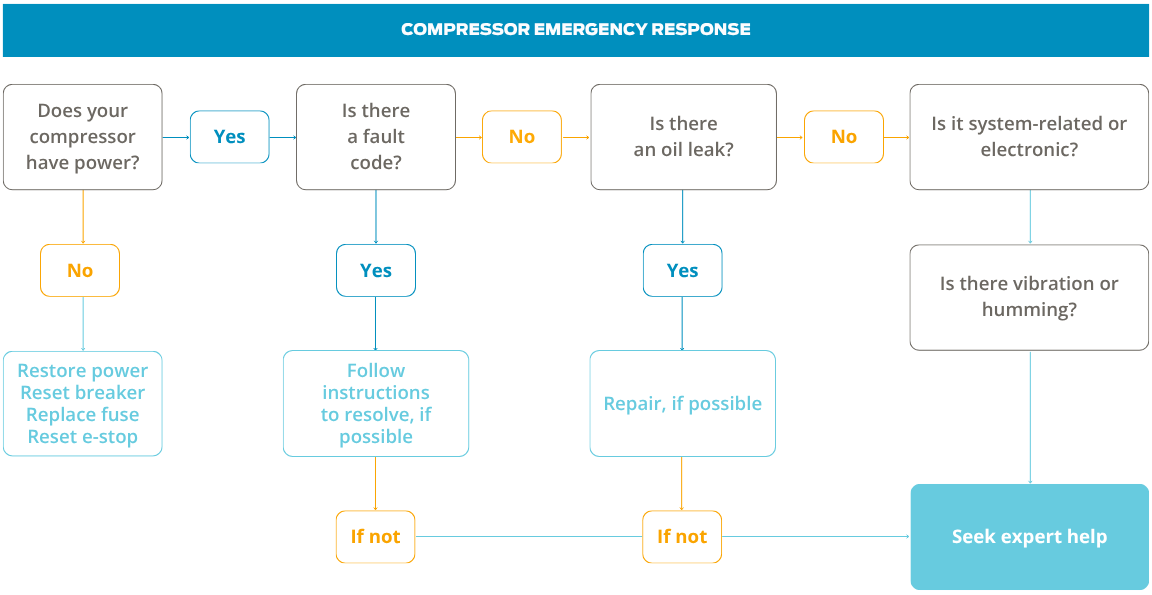
You can resolve a compressor down emergency by following these steps.
Industrial Compressor Downtime Prevention
One clear way to put an end to late-night calls is industrial compressor downtime prevention—building redundancy into your system.
Compressed air system redundancy design involves installing a backup compressor that automatically kicks in when your main compressor fails.
We often propose multi-compressor systems featuring base-load, trim and backup compressors, operating in rotation, working within their most efficient ranges, tested under load, with hours balanced across the fleet. Usually, each unit is sized to carry the load on its own.
Having this kind of system in place delivers true redundancy, also reducing maintenance costs, saving electricity, avoiding emergency service, maintaining pressure stability and extending equipment life.
Redundancy planning is especially crucial when you have mission-critical functions that rely on compressed air. The level of redundancy in your system should reflect how critical it is to your production process.

If you’re in the automotive industry, where an hour of downtime costs $2.3 million, according to Siemens, industrial compressor downtime prevention is critical.
And while a multi-compressor configuration may have a higher initial cost, our customers find the additional outlay can pay for itself by avoiding a day of downtime. Or even an hour.
So, pull the trigger and get that backup. And if your operation lives or dies on compressed air, you could also install an easy-to-use camlock connector to hook up an electric portable, like our KPE Portable Electric Air Compressor.
We discuss multiple compressor configurations in greater detail in our blog post, “How a Multi-Compressor System Can Help You Reduce Compressor Downtime.”
A Partner You Can Count On
Nobody calls a compressed air tech at 4 a.m. to tell them what a great job they did in fixing or maintaining their compressor. A late-night call is never good news for a tech.
But you’ll want a local partner you can rely on when problems arise.
An experienced tech can save you time and money, especially if they know your system and have your confidence. They’ll identify the root cause of your problem much faster than a non-pro. Or even a pro who doesn’t know your system.
The choices you make in choosing a compressed air expert could well determine your company’s success in achieving broader objectives such as reliability, energy efficiency and cost efficiency.
That’s why we work with a nationwide network of independent distributors, who can provide on-site help and consultation as needed and respond to a compressor service emergency 24/7. They have factory-trained air compression experts with the experience to troubleshoot any problem and resolve it quickly. Plus, they can identify issues and fix them proactively. So, you don’t get that 4 a.m. call.
Plus, our distributors carry large inventories of parts. And even the components they don’t stock are available from our Loxley, AL headquarters in the shortest lead times in the industry.
We take training very seriously, conducting regular training updates to ensure they are the best in your area. And they have 24/7 access to all our training materials and manuals.
Find the one closest to you. Or, feel free to contact us directly.
Key Takeaways
It’s 4 a.m. And you have a compressor down emergency. What steps should you take?
- Investigate. Your first task is to find out what you’re dealing with. The good news is that most late-night calls can be remedied simply. Maybe even over the phone.
- Assess. Quickly determine whether the problem is something you and your team can handle.
- Ask for help. If you’ve gone through the checklist and ruled out any obvious issues, you may need to call in expert help. Especially if the root cause is electrical.
- Have a backup. One clear way is to build redundancy into your system. One clear way to justify the cost? Calculating the price tag for an hour of downtime.
- Find a partner you can count on. You’ll want a local partner you can rely on when problems arise. An experienced tech can save you time and money by quickly identifying the root cause of your problem, especially if they know your system.
Further Reading
“How a Multi-Compressor System Can Help You Reduce Compressor Downtime.” We discuss the advantages of multiple compressor configurations in greater detail.
Frequently Asked Questions
- This depends entirely on your air receiver tank capacity and compressed air demand. If you have a large receiver tank and minimal air consumption, you might operate for 15–30 minutes on stored air alone. However, most industrial operations drain their tank pressure within 5–10 minutes under normal production demand.
- The real answer: not long enough to be comfortable. This is why system redundancy matters. If a single compressor failure results in a total shutdown, you have a design problem, not just an equipment problem. Consider building backup capacity into your system, whether that’s a secondary compressor, portable rental unit or increased air storage—so one failure doesn’t stop production cold.
- Emergency service typically costs two or three times more than scheduled maintenance calls. You're paying for after-hours availability, rapid dispatch and technician overtime. A regular maintenance call during business hours might cost $150–$300. The same diagnostic visit at 2 a.m. could run $500–$800 or more, plus parts and repair labor on top of that.
- Beyond cost, there's also availability. Emergency service providers prioritize calls by urgency so that you might wait 1–2 hours for dispatch, even with 24/7 availability. This is another reason prevention is so valuable—regular maintenance prevents the expensive emergency calls in the first place.
- No. If your compressor shuts down and won't stay running—especially if it's tripping the thermal overload switch repeatedly—stop trying to restart it. Repeated restart attempts can cause additional damage and void warranties.
- Instead, document what's happening (how long it runs before shutting down, what temperature it reaches, any error codes), let it cool down completely and then call for service. Repeated thermal shutdowns indicate an overheating issue—blocked cooling fins, inadequate ventilation, faulty cooling fan or internal mechanical problems. None of these resolve themselves, and continuing to cycle the compressor on and off only makes things worse.
-
That depends on your downtime cost versus rental cost. Here’s the decision framework:
- High-downtime-cost facilities (manufacturing, data centers, hospitals): Renting a 185-CFM diesel portable compressor for $200–$400 per eight-hour day is worth it if downtime costs $5,000+ per hour (larger compressors used for longer time periods, of course, will cost more). You maintain production while repairs happen.
- Lower-downtime-cost facilities (light assembly, warehousing): Waiting for repairs might be more economical unless the repair timeline extends beyond 24 hours.
- The smart approach: make this decision before the crisis hits. Know the rental companies in your area, understand portable unit specifications and pre-negotiate emergency rental rates. Then, when your compressor fails, you can make a quick business decision instead of scrambling for options. And, as mentioned above, an even better long-term solution is to install an easy-to-use camlock connector to hook up an electric portable, like our KPE Portable Electric Air Compressor .
-
This varies based on compressor type, age and operating environment, but industry best practice is:
- Daily: Check fluid levels, pressure readings and listen for unusual sounds
- Monthly: Inspect filters, belts and visible hoses; check for leaks
- Quarterly: Professional filter changes and system pressure checks
- Annually: Full professional service, including internal inspection and calibration
-
That said, if your compressor runs continuously (many industrial operations do), you might need more frequent service. Conversely, compressors in light-duty applications might need less frequent attention.
The key is following your manufacturer's maintenance recommendations and adjusting based on your specific operating conditions. When in doubt, ask your service provider to audit your schedule.
-
Your emergency contact file should include:
- Primary service provider: Name, 24/7 emergency number, typical response time for your area, parts availability
- Secondary service provider: Backup option if primary is unavailable
- Equipment manufacturer: Direct line for technical support (not general customer service)
- Portable compressor rental companies: Contact info for emergency equipment rental
- Your compressor information: Make, model, serial number, age, warranty details
- System documentation: Compressed air demand, pressure requirements, tank capacity, distribution line layout
- Internal contacts: Key personnel to notify during downtime (production manager, shift supervisor, facility director)
- Keep this file physically accessible—not just in email or cloud storage. When your system is down and stress is high, you need information you can grab immediately.
-
Yes. Industry data show that facilities with solid preventive maintenance programs experience 60–80% fewer emergency failures than those using reactive maintenance approaches.
Here’s why:- Most compressor failures don’t happen suddenly—they develop over time as components wear, filters clog and seals degrade.
- Regular inspections catch these developing problems before they become catastrophic failures.
- You replace a worn belt before it breaks.
- You change a clogged filter before it restricts airflow and causes overheating.
- You identify an oil leak before the compressor runs dry.
- The math is simple: $2,000 in annual preventive maintenance prevents $50,000 in emergency repairs and production downtime. That’s not an exaggeration—it’s what facilities consistently report.
- The challenge is that preventive maintenance requires discipline and budget allocation when everything seems to be running fine—but the peace of mind knowing you’ve dramatically reduced your emergency risk is worth the investment.
Listen to the Podcast Version



The 4 A.M. Compressor Call
[matter-of-fact] Welcome to the show. It's 4:03 in the morning, your phone lights up, and the message is short: the compressor is DOWN. Not struggling. Not acting weird. Down. And in a lot of plants, that means the line goes quiet in, what, 5 to 10 minutes once the receiver tank bleeds off. Then you've got people standing there, production backing up, and everybody suddenly wants an answer RIGHT now.[curious] That 5-to-10-minute window is the part people underestimate. They hear "we've got a tank" and think they've got breathing room. But if normal production is pulling hard, that stored air disappears fast. So when that call comes in, what's the first thing you want somebody on site to check before they start doing the classic panic-button routine?
First thing is boring, and boring is good: do you actually have power? I mean that literally. Check if someone hit the emergency stop. Check the breaker. Check the fuse. A surprising number of "major failures" at 4 a.m. turn out to be an e-stop button somebody bumped, or a tripped breaker after a power event. If power is gone, restore power safely. If the breaker tripped, reset it once if your procedure allows it. If the e-stop is pushed, reset it. But don't turn one reset into six resets because now you're not troubleshooting -- you're gambling.
[questioning tone] "Reset it ONCE" is the line I want to underline. Because people do this all the time -- it trips, they hit reset, it trips again, they hit it again, and now they're basically arguing with a machine that's already telling them something. If it throws the same fault twice, that's not stubbornness. That's information.
Exactly. What is the compressor telling you? That's the next question: is there a fault code on the controller? Modern machines keep logs, fault history, all that. And those codes matter. A blocked filter, overheating, low oil, separator issues -- the controller is usually not being dramatic. It's reporting a condition. Same with an oil leak. Look for the obvious stuff. Puddle on the floor, residue around a fitting, cap left loose after somebody checked oil. Sometimes the clue is sitting right there in plain sight.
[skeptical] And this is where people get themselves in trouble, right? Because "obvious oil leak" somehow becomes "eh, top it off and send it." Or "high-temp fault" becomes "let's just let it cool and keep restarting it till day shift." I get why people do it -- they're trying to save production -- but those are not harmless choices.
No, they're not. If it shut down on high temperature, repeated restart attempts can make a bad situation worse. Same if it's tripping overload over and over. Let me put it simple: if the machine won't stay running, stop trying to force a relationship. [chuckles] Write down what it's doing. How long it runs before shutdown. What code it's showing. Whether temperature climbs first. That gives the morning crew -- or the service tech -- something useful instead of "we kept hitting start and it kept quitting."
[laughs] "Stop trying to force a relationship" is painfully accurate. But let me play plant manager for a second. If the night shift checks power, checks the e-stop, sees a clogged drain, maybe a dirty filter, maybe a simple thing... are you saying don't touch anything? Because sometimes you CAN get through the night, right?
Yeah, sometimes you can. If it's truly routine -- breaker reset, e-stop reset, opening a clogged condensate drain, cleaning out something that's clearly restricting airflow -- you may get the machine back online and survive till daylight. That's practical. What I don't want is people confusing "temporary recovery" with "problem solved." If it overheated, ask WHY it overheated. If it's low on oil, ask WHY it's low. If a breaker tripped, ask WHY it pulled that way. That question is what keeps you from getting the same phone call tomorrow at 4 a.m.
[reflective] That's the tension, isn't it? The right short-term move might be a reset. The wrong long-term move is pretending the reset was the repair. So the rule of thumb is: gather clues, do the obvious safe checks, don't ignore alarms, and don't keep hammering restart like you're trying to wear the machine down emotionally.
[deadpan] The machine will win that argument every time.
Know When to Stop Guessing
[calm] And once you've gotten past the first five minutes of chaos, the failure patterns are actually pretty familiar. It's usually not some mystery from outer space. Cooling problems are a big one -- dust and dirt loading up heat exchangers. Poor ventilation in the compressor room is another, especially when the weather turns hot and the room becomes an oven. Then you've got clogged condensate traps or drains letting moisture go downstream, oil leaks pushing you toward high-temperature faults, clogged filters, clogged separators... same cast of characters, over and over.[responds quickly] That "same cast of characters" line is right. People want a dramatic explanation, but a lot of downtime starts with basic neglect. Dirty cooler. No airflow in the room. Drain not draining. Filter plugged up. Separator loaded. And then the machine does exactly what it's supposed to do -- it protects itself and shuts down. The surprise isn't the shutdown. The surprise is that anybody was surprised.
Let me try to explain that back. So when somebody says, "the compressor just randomly overheated," your answer is basically: probably not random. More like a chain. Restricted cooling, bad ventilation, low oil, clogged filter -- something was building toward that fault.
Almost. I'd add one more thing: system issues can look like compressor issues. Bad control sequencing. Excessive pressure demand. Even low incoming voltage from the utility side. We've seen machines shut down because the voltage feeding them wasn't healthy. So if you hear humming, or feel unusual vibration, or the whole thing sounds rough -- that's your line in the sand. That's not "night shift improvisation" territory anymore.
[sharply] Humming and vibration -- those two words should get attention fast. Because that's not just a nuisance, that's mechanical or electrical stress announcing itself out loud. And the low-voltage piece matters too. If the power company is feeding you weak voltage, your compressor didn't suddenly become unreliable. It's reacting to bad input.
Right. And then there's electronics. If the suspected problem is in the controls or a variable-speed drive, stop guessing. Full stop. A VSD uses DC power, and that DC bus can hold a charge for as long as 30 minutes after shutdown. People hear "it's off" and think "it's safe." Not necessarily. Fifty volts DC can ruin your whole day permanently. That's expert-help territory, no debate.
[serious][pauses] The "30 minutes" is what sticks with me. Because that is exactly long enough for somebody to get overconfident. They shut it down, crack the panel, and think the danger left with the noise. It didn't. So if it's electronics, controls, VSD -- hands off unless you're trained for that equipment.
Yep. And this is where prevention beats heroics. If one compressor failure stops your whole facility cold, that's not just an equipment problem. That's a design problem. Redundancy matters. Backup capacity matters. A second compressor, a setup that can carry load if the main one drops, enough planning that you're not deciding from scratch in the dark. Even extra storage only buys a little time, but planned backup can save a shift.
[curious] And not everybody needs the same level of backup. If compressed air is mission-critical, that's one conversation. If downtime is inconvenient but survivable, that's another. But either way, you need an emergency contact plan before anything fails. Primary service number, backup service number, who handles rentals, equipment make and model, serial number, pressure requirements, tank capacity, internal contacts -- all of it in one place, not buried in somebody's inbox.
[matter-of-fact] Physically accessible, too. Paper copy. Binder. Something you can grab when people are tired and annoyed. Because at 4 a.m., nobody wants to hunt through email for a serial number. And the better your service partner knows your system, the faster they can use the logs and fault history to find patterns instead of starting cold every time.
[warmly] I think that's the real mindset shift. The goal isn't to become heroic at 4 a.m. The goal is to make 4 a.m. boring. Clear checks. Clear stop points. Backup capacity. Good maintenance. Good contacts. If your system is critical, build it like you actually believe that.
[short pause] That's it. Don't build a plant that only works when nothing goes wrong. [calm] Thanks for listening.
See you next time.