


Managing Your Compressed Air System as an Asset
April 29, 2026
Three Ways Compressed Air Optimizes Air Tool Performance Downstream
May 13, 2026Taking a Systems Approach to Compressed Air: The Whole Really Is More Than the Sum of Its Parts
By Israel Hearn, Senior Tech Support Representative | May 6, 2026 | Uncategorized

Blisters or “fisheyes” ruining a paint job? It could be a compressor problem. But maybe not. There are many other potential causes of moisture pass-through. And, most likely, you’ll keep having a problem until you get to the root cause. And that takes system thinking.
When facility managers call us and say they are having compressed air problems, more often than not, they immediately blame their compressor.
Whether they’re experiencing low pressure at their end uses, skyrocketing electricity costs or water or oil carryover, their compressors are the culprits, in their minds.
Admittedly, approximately 40% of compressed air problems do, in fact, originate with their compressors.
But that means 60% don’t.
So, if you immediately zero in on your compressor, there’s more than an even chance that you’ll miss the root cause of the problem.
That’s one of the major limitations of component thinking. You’re seeing the pieces and part of compressed air delivery separately. As if compressors are the only equipment involved in providing air. That’s not the case.
What you’re missing is that your compressor is part of a complete system. The largest, noisiest and most expensive part, perhaps. But delivering compressed air requires a host of other pieces, from dryers and storage tanks to controls and piping.
And, every day, companies expect more from their compressed air systems, largely to power the advanced electronics or robotics incorporated into their newer, more sophisticated equipment. That means cleaner air, free of oil mist and water. With lower particle counts.
As a result, compressed air systems are becoming more complex. And require more and better management. A systems approach to compressed air.
A Systems Approach to Compressed Air
Managing today’s compressed air systems requires considering all parts of the system. Here are just a few examples of why:
- Low pressure. Yes, your end uses may be starving for air. And, yes, your compressor may be set too low or even undersized. But more often than not, there are other issues, such as leaks. The average leak rate in the U.S. is 30% of system capacity, according to the Compressed Air & Gas Institute. And there are other possibilities, including dirty filters, clogged drains and piping issues. For more details on low-pressure problems, read our blog post, “What to Do When Your Air Compressor Is Not Building Pressure.”
- Water in the air. Your unit compresses the water that’s already in the air. But if you have moisture in your air, you may need dryers. Or maybe you need to clean out your drains. For more on the negative impacts of water, read our blog post, “How Water Gets into Your Compressed Air System. And What It Does When It Gets There.”
- Short cycling. Your compressor may be oversized, of course. But many compressed air systems do not have enough storage. For more on the dangers of short cycling, read our post, "How Often Should an Air Compressor Cycle?”
And those are just the most obvious problems. Which happen largely because you’re not seeing how all the parts fit together to produce compressed air.
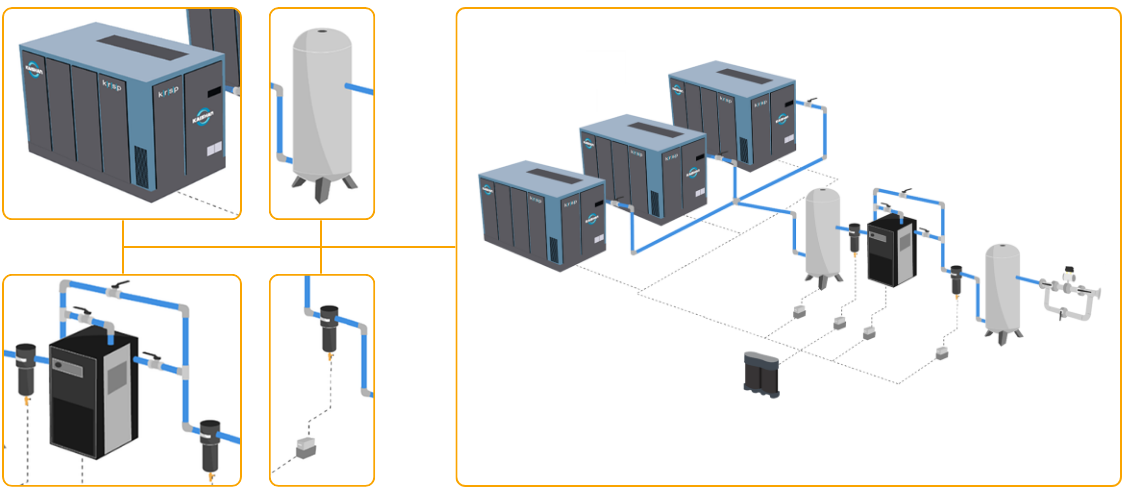
A “whole” compressed air system is more than the sum of its parts.
A Holistic Approach
To meet the needs for high-quality compressed air, all the parts of your system must be designed and specified to work together. Sized correctly, even matched:
- Not just a receiver tank, but one large enough to ensure your system has sufficient storage to maintain pressure and flow as one compressor starts up and another shuts down. CAGI says you need up to 10 gallons of storage per CFM of flow from the largest compressor.
- Not just a filter, but a filter sized for the purity you need, as well as the pressure and flow.
- Not just a piping system, but piping that doesn’t build pressure drop into your system through downsized piping, obstructions, poor piping material, sharp corners or unnecessary regulators. When you go from a two-inch pipe to a half-inch pipe, you really can’t blame the compressor for the resulting pressure drop.
You can’t just pick and choose your own best-of-breed approach. You need a system engineered to achieve your objectives efficiently.
Variable-speed drives are an obvious example.
Use of VSDs
When you’re adding a VSD air compressor, you need to evaluate storage levels, control sequencing, and demand variability.
Doing so will ensure that the VSDs save energy and money as intended. Without system controls and adequate storage to buffer load changes, VSDs may cause excessive cycling, which can be very costly and lead to equipment damage and downtime.
For more on the guidelines for properly applying VSDs, see our blog post, “When to Use a VSD on a Rotary Screw Air Compressor.”
Controls
Over the years, we’ve seen that a well-planned controls approach can be critical to optimizing the operation of your compressed air system, especially in coordinating the units in a multi-compressor system.
One common approach is to network all the compressors to automatically cycle through stop/start, load/no-load, modulation and variable-speed modes. One compressor is the lead unit, issuing instructions to the others in the system. The goal is to link all the compressors together and keep a consistently low pressure throughout the system. With third-party solutions, you can even network compressors from the different manufacturers.
Many compressed air users have turned to system master controls to network air compressors (even from different manufacturers) throughout their plants, operating them in a pre-programmed sequence.
Properly configured, these advanced controls can allow you to operate your compressed air supply within a relatively tight band, such as +/- 2 PSIG. And that’s great news both in operating costs and energy use.
For more information on controls, read our blog post, “Everything You Need to Know About Compressed Air Controls.”
System thinking also extends to maintenance.
System Thinking for Maintenance
Training your maintenance staff in system thinking will deliver benefits in both the short and long terms.
System thinking will enable your maintenance team to identify root causes of problems, rather than treating symptoms. Thereby reducing the recurrence of problems or the need for more extensive repairs. Perhaps even avoiding downtime or emergency calls.
Staying with component thinking locks you into a reactive posture that will cost you more money and trigger more emergency calls and downtime.
Finally, considering your compressed air system as a whole also includes planning for redundancy.
Redundancy Planning
A key part of system thinking is redundancy planning. We often propose multi-compressor systems featuring base-load, trim and backup compressors. A multi-compressor system also reduces maintenance costs, saves electricity, avoids emergency service, maintains pressure stability and extends equipment life.
Having an ironclad backup system in place delivers true redundancy, which can only come from multiple compressors operating in rotation, working within their most efficient ranges, tested under load, with hours balanced across the fleet. Usually, each unit is sized to carry the load on its own.
We discuss multiple compressor configurations in greater detail in our blog post, “How a Multi-Compressor System Can Help You Reduce Compressor Downtime.”
Transitioning to system thinking is easier with the support of a compressed air professional.
Making the Move to System Thinking
Your compressed air consultant can be a major help in your transition from reactive, component-level thinking to proactive system thinking. That’s why Kaishan USA works with a nationwide network of independent distributors, to provide on-site help and consultation as needed.
These independent distributors have expert technicians skilled in working with facilities like yours to identify persistent problems, identify root causes and develop solutions that cut energy costs, build in reliability and improve air quality.
Our distributors stock a wide inventory of parts. And the components they don’t have in-house are available from Kaishan with the shortest lead times in the industry.
Their people are factory-trained. We hold training sessions monthly to ensure they are up to speed on the latest developments. Plus, they are backed by our skilled support team, a force multiplier in solving difficult problems. The goal: getting you up and running as quickly as possible.
Plus, you have the opportunity to work with one of our distributors to customize a system-centered program that allows maximum use of your in-house resources, supplementing them as needed with our distributor’s external experts.
Key Takeaways
- When facility managers say they are having compressed air problems, they often blame their compressor, missing the root cause of the problem.
- Companies expect more from their compressed air systems, largely to power the advanced electronics or robotics incorporated into their newer equipment.
- To meet the needs for high-quality compressed air, all the parts of your system must be designed and specified to work together. And sized correctly, even matched.
- Training your maintenance staff in system thinking will deliver benefits in both the short and long terms.
- Having an ironclad backup system with multiple compressors operating in rotation delivers true redundancy.
Help in Transitioning to System Thinking
Adopting a system-thinking approach could well determine your company’s success in achieving broader objectives such as reliability, energy efficiency and cost efficiency.
It’s a great opportunity to develop a partnership with a compressed air professional who can help you find the most cost-effective and efficient ways to embrace the kind of system thinking that can turn your compressed air system from an expense into an asset.
Find a compressed air professional near you. Or contact us directly.
Further Reading
“When To Use a VSD on a Rotary Screw Air Compressor.” More on the guidelines for properly applying VSDs.
“Everything You Need to Know About Compressed Air Controls.” More information on the different types of compressed air controls.
“How a Multi-Compressor System Can Help You Reduce Compressor Downtime.” We discuss how the redundancy created by multi-compressor configurations reduces downtime.
“What to Do When Your Air Compressor Is Not Building Pressure.” More details on low-pressure problems.
“How Water Gets into Your Compressed Air System. And What It Does When It Gets There.” More on the negative impacts of water.
"How Often Should an Air Compressor Cycle?” More information on the dangers of short cycling,
Frequently Asked Questions
Listen to the Podcast Version



Why the Compressor Gets Blamed First
Welcome to the show! Lisa, I wanna start with the most common phone call in this business: “We’ve got water in the line, pressure’s dropping, power bill’s up -- the compressor’s bad.” And sometimes, sure, the compressor IS the problem. But only about 40% of compressed air problems start there. Which means roughly 60% start somewhere else in the system, and that’s the part people skip right over.That 60% is the part that sticks with me. Because if more than half the trouble is NOT the compressor, then a lot of plants are chasing the loudest, most expensive box in the room just because it’s obvious. It’s like blaming the engine when the real problem is a flat tire, a clogged fuel filter, or, I don’t know, somebody pinched the line shut downstream.
Exactly. The compressor gets blamed first because it’s big, it’s noisy, and everybody sees it. But compressed air is a system. Compressor, dryer, storage tank, filters, drains, controls, piping, end use -- all of it. If you’ve got low pressure at the far end of the plant, that could be an undersized machine... or it could be leaks. And leaks are a monster. The average leak rate people cite in the U.S. is around 30% of system capacity. Thirty. Percent. That means you may not have a compressor problem at all -- you may have a “we’re paying to make air we never use” problem.
Wait -- 30%? So if a plant thinks it’s short on air, there’s a decent chance they’re not short on production capacity, they’re short on discipline. They’re just bleeding it off through couplings, hoses, fittings, open blow-offs... all the usual suspects.
That’s a blunt way to put it, but yeah. And then they crank pressure up to compensate, which drives energy costs even higher. Same with dirty filters. A plugged filter adds restriction. Restriction adds pressure drop. Then somebody says, “This compressor won’t build pressure.” Well... maybe it can. Maybe the air just can’t get through the mess you haven’t changed.
And moisture’s a good example too, right? Because people see water carryover -- maybe they’re getting blisters or fisheyes in paint, maybe valves are getting wet, maybe tools are spitting water -- and they go straight to “bad compressor.” But the compressor is just compressing the moisture that was already in the ambient air. The real question is: where’s the dryer, what condition is it in, and are the drains actually draining?
Bingo. If drains are clogged, if separators aren’t working, if the dryer’s undersized or not doing its job, that water’s going downstream. And here’s another one people miss: piping. You can’t run most of the plant on a decent main and then neck it down from a two-inch line to a half-inch bottleneck and act surprised when pressure falls off. That pressure drop isn’t magic. It’s designed in -- usually by accident.
“Designed in by accident” is painfully accurate. And poor storage belongs in this conversation too. Because short cycling gets blamed on the compressor a lot -- “this thing keeps starting and stopping, it must be faulty” -- when the issue can be that the system doesn’t have enough receiver capacity to buffer demand swings.
Right. The machine may be responding to a bad setup. If demand jumps fast and you don’t have enough storage, the compressor’s forced to chase every little blip. That’s hard on equipment, inefficient, and it leads people to replace stuff that wasn’t the root cause in the first place. So the simple version is: symptoms show up at the compressor, but the cause may be leaks, filters, drains, piping, storage -- somewhere else entirely.
What System Thinking Actually Changes
So if blaming the compressor is the trap, system thinking is the fix. But let’s make that concrete. When people say “take a systems approach,” what actually changes on the plant floor? Because that phrase can sound a little... abstract.Fair. Here’s the non-fancy version: you stop looking at parts one by one and start asking whether they work together. The dryer has to match the air quality you need. The filters have to be sized for flow and pressure. The receiver has to be large enough to stabilize pressure and flow. The piping has to move air without building in a bunch of pressure drop. And the controls have to coordinate the compressors so they’re not fighting each other.
The receiver number is one I think people remember because it’s concrete. CAGI guidance says you may need up to 10 gallons of storage per CFM of flow from the largest compressor. Up to 10 gallons per CFM. That’s not “throw a tank in there and call it good.” That’s actual sizing.
Yeah, and storage matters even more when people start talking about VSDs -- variable-speed drives -- like they’re a magic fix. VSDs can absolutely save energy when demand swings around. At 50% load, a VSD unit can use roughly 50% of the energy of a fixed-speed machine. That sounds great. But if you drop a VSD into a system with lousy storage, bad controls, and erratic demand, it may hunt, cycle excessively, and spend its life reacting instead of running smoothly.
So the sales pitch is “buy the smart compressor,” but the smarter question is, “Is the system around it ready for one?” Because if storage is weak and sequencing is sloppy, the VSD doesn’t look smart -- it looks irritated.
That’s exactly it. A VSD should be applied to actual demand variability, not wishful thinking. Same story with multi-compressor systems. If you’ve got base-load, trim, and backup units, they need sequencing. One lead machine, the others following instructions, and ideally the whole setup operating inside a pretty tight pressure band. Properly configured master controls can keep that band around plus or minus 2 PSIG. And that matters because every extra pound of pressure you run “just to be safe” usually costs you money.
That plus-or-minus 2 PSIG number is the thing I’d circle. Because that’s the difference between a stable system and one that feels jumpy all day. And with controls now, you can network multiple compressors -- even from different manufacturers -- which is a big deal in real plants where nobody has a perfectly matched fleet.
Yep. And once you think that way, maintenance changes too. You stop treating symptoms. Instead of saying, “Drain failed again, replace it again,” you ask why moisture loading is high. Instead of “pressure’s low, turn it up,” you ask where the drop is happening. Instead of “compressor short cycles, must be bad,” you check storage and controls. That root-cause mindset cuts repeat failures, emergency calls, downtime -- all the expensive stuff that comes from being reactive.
And it changes the culture a little, too. Preventive maintenance is one thing -- change filters on schedule, inspect what needs inspecting. Useful, necessary. But when you start paying attention to pressure trends, temperature, energy use, cycling patterns, you move closer to predictive thinking. You’re not just servicing equipment because the calendar says so. You’re reading the behavior of the system.
Which is really the whole point. Compressed air gets expensive when you treat it like a collection of unrelated parts. It gets a lot more manageable when you treat it like one machine made out of many pieces. And honestly... once you see the system that way, it’s hard to unsee how many “compressor problems” were never compressor problems at all.
Yeah. And that’s the uncomfortable question to leave hanging: if your first instinct is always to blame the compressor, what else in the plant are you probably misdiagnosing the exact same way?