

The real estate industry has a golden rule—that the three most important features of a property are “location, location, location.”
That phrase is just as relevant when you’re installing an air compressor.
Location mistakes not only cause problems during air compressor installation. They may well plague you throughout the life of your compressor or until it fails. In fact, the worse the mistake, the sooner the failure.
So, let’s talk about the most common mistakes we’ve seen and offer some guidance on what a good air compressor location looks like.
We’ll start with a common problem with outside installations.
1. You Got Burned
In moderate climates, you can locate an air compressor outside. Putting it outside is a great way to reduce noise and ensure a supply of fresh, clean, cool air.
However, you’ll want to protect it from direct sunlight, especially in the morning or afternoon, to avoid damage to the compressor’s control panel and additional heating of the machine. Sunlight can also heat the metal, increasing the air temperature.
Even our rugged Kaishan KPE portable electric air compressor, built to withstand outdoor environments, will run better if it is in a shaded location.
You’ll also want to shelter your compressor from the elements, temperature extremes and prevailing winds, which typically blow west to east in much of the U.S. If your air compressor has a variable-speed drive, you’ll want to take special care to protect it from wind-blown dust, dirt, rain, moisture and extreme temperatures.

Because of these issues, indoor locations are preferable.
2. You’re Lost in the Crowd
Because air compressors run hot, they should not be in the same room as any device that generates heat, such as a boiler. You can place more than one compressor in the room, but make sure one compressor does not blow exhaust air onto another.
In a perfect world, your air compressor would be installed in a room of its own with a clean, dust-free, dry and oil-free area. The area would be relatively cool and adequately ventilated.
You’ll also want to consider future expansion plans. If your long-term business strategy will require more compressed air capacity, make sure you have enough space to add a compressor when needed. If you eventually have to add another unit and need to locate it a distance away, that may mean duplicating storage tanks, utilities and piping, all at a significant additional cost.
But remember, if your compressor room has too many units, you may not be getting enough fresh air intake, or the air may not circulate well.
In the worst-case scenario I’ve seen, a building was constructed around a compressor. So when it needed replacement, the compressor had to be demolished and removed piece by piece. The replacement was built in the factory, shipped to the distributor, disassembled, transported to an upper floor on the “human” elevator (there was no service elevator) and reassembled on site. You’ll want to avoid that scenario, if possible.
And make sure you have a drain in the room that can accept condensate. The U.S. Environmental Protection Agency has stepped up enforcement of these requirements.
3. You Can’t Take the Heat
The combination of air compressors and dryers generates a lot of heat. Compressors alone produce 2,546 BTU/hour for every 1 HP.
Removing all that heat is extremely important for the reliability and longevity of your compressor. Excessive heat will break down the oil in the compressor and reduce the oil’s ability to protect the system’s moving parts.
Ideally, your air compressor should be in a dry, well-lit, cool and dust-free room with a maximum ambient temperature of 104°F-115°F, taking into account any temperature rise from direct or indirect sunlight. Our units are designed with added cooling margin, so they run reliably at the upper end of this ambient range.
For temperatures below 45°F, you will need to take some steps described in our recent blog, “Using an Air Compressor in Cold Weather,” including purchasing a compressor equipped for low-ambient-temperature conditions.
4. You Cheaped Out
Bringing in high-quality air is one of the most critical considerations for the operation and longevity of your compressed air equipment. A few helpful hints:
- Start clean. You’ll want to get clean air into your compressor with no restrictions. You can use louvered vents or forced ventilation. Ducting discharge air out. Bringing clean air in. That’s the perfect combination for a compressor.
- Find the right place for air intake. Be careful where you place any remote air intake. You don’t want to suck in fumes that are caustic substances or paint fumes. Most air compressors take in air on the side and expel exhaust air out the top. Bringing in air that is as clean and cool as possible makes less work for your compressors.
- Install louvers. Install adjustable louvers on the room air intake and the exhaust outlet to keep cold air out when the system is not operating or is running at low load. We often recommend thermostatic controls for the louvers.
- Don’t undersize ducts. When connecting ductwork for thermal management, making your ductwork too small will overwork your cooler fans and force your compressor to work at a higher operating temperature, shortening the operating life of both.
- Provide enough overhead clearance. You should have at least five feet of clearance above your compressor. If the ceiling is lower than that, the air could circulate back into your compressor after it is discharged. If your compressor is located outside, make sure the roof isn’t so low that it would trap the hot exhaust air and keep it recirculating after it’s discharged from your compressor.
- Add ventilation hoods, if needed. Ventilation hoods can redirect the cooler discharge air flow and ensure that the exhaust air does not recirculate.
- Plan the air flow. You can use several possible configurations to move air through your equipment room. We walk through several different ventilation scenarios in our blog post, “How To Design And Prepare For an Industrial Air Compressor Installation.” Whatever configuration you adopt, be sure to follow your manufacturer’s requirements.
- Make sure you have enough ventilation. If you have more than one compressor in the area, combine all the ventilation requirements to determine the total ventilation needed. As a result, two 100 HP compressors will require the same ventilation as one 200 HP compressor since the heat generated will be similar. An alternative is to give each compressor its own air intake.
Heat Recovery
In addition, it’s possible to save significant amounts of energy in northern climates by recovering the heat removed from the compressed air system in the winter. After all, at least 80%-93% of the energy used to compress the air becomes waste heat, and 50%-90% of that can be recovered.
A damper directs the air toward an outside vent in the summer. In the winter, the air is directed toward space heating or preheating for other operations.
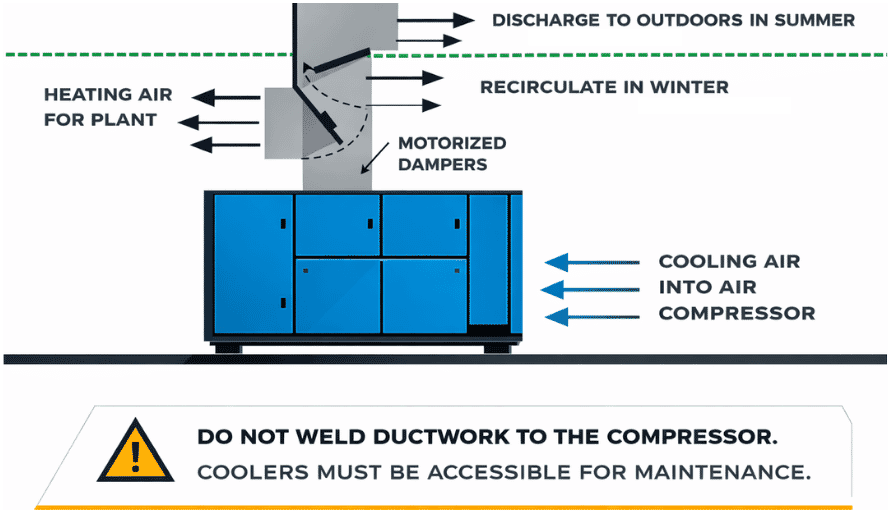
You can use that energy in other parts of your enterprise for space heating, preheating boiler water, water heating or even process heating (like drying).
In addition, you can use heat-of-compression dryers with oil-free units, keeping the dryer and the compressor as close as possible.
5. You Lost Your Cool
We’ve seen all too many end users who carefully reviewed compressor specifications but forgot about cooling, to their detriment. That’s why we encourage all our customers to make cooling capabilities an integral part of the design and installation of any industrial air compressor system.
If you’re using water for cooling, you’ll need to plan for water entering and exiting your compressor room. You may have to treat the water chemically to keep it clean. Especially if it is an open-loop system with a cooling tower.
Be careful running those water lines. I’ve seen more than one instance where water lines obstructed doors on the compressor, preventing access for maintenance.
You may also use remote cooling for a VSD unit or locate the VSD remotely. You will need to follow the manufacturer’s recommendations regarding the allowable distance, as electromagnetic interference can disrupt communication between the VSD and the compressor.
6. You Locked Yourself Out
Place your compressor at least four feet away from walls or other equipment to allow for maintenance and service.
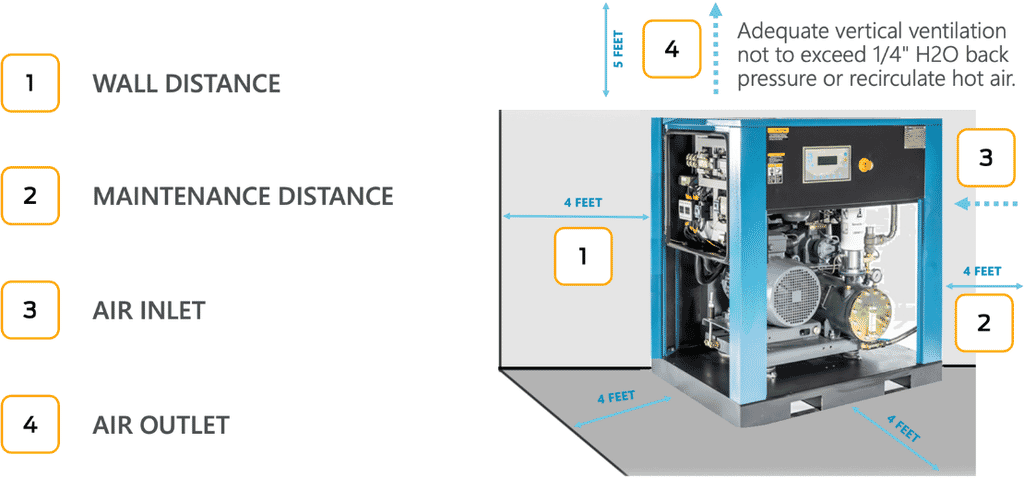
More than one company has had to disconnect a unit and move it out of the compressor room to complete service. In one case in our experience, a company had four units crammed into one room and had to remove all four to service the oldest (and first installed).
7. You Lost Your Superpower
It’s a mistake to assume you can tap into the old power supply with your new compressor.
As a result, before installing the compressor, make sure that your electrical service voltage matches the voltage on the compressor nameplate (located inside the electrical cabinet). If your compressor is a dual-voltage model, make sure it is internally wired for the proper voltage.
Most manufacturers recommend that each compressor have a dedicated electrical circuit and disconnect panel. Electrically operated air treatment equipment should be powered through a separate circuit. Especially if it’s a larger unit. We’ve had more than one customer caught off guard, and needed to pull new wires from the breaker box to the compressor room.
You’ll want to install an appropriately sized fused disconnect or circuit breaker between the compressor and main electric service and ensure all equipment is properly grounded.
8. You’re Off Center
Locating the unit centrally, as closely as possible to the tools it’s intended to service, reduces the amount of piping required. It also eliminates many leaks and pressure drops that sometimes occur in long piping runs.

Unfortunately, tying into your existing piping may be creating inefficiencies right out of the gate, especially if it has corrosion, turbulence or moisture buildup. In one recent case, we had a customer who upgraded a 125-HP compressor to a 200-HP unit but did not change the two-inch piping. The new unit had a three-inch discharge, which was choked by the connection to the smaller piping, resulting in a 50-PSIG pressure drop.
With diesel portables, you will want to locate them in your plant so that a refueling truck can access them easily. And, if you have several diesels in one area, you’ll want to be careful you’re not recirculating heat and exhaust fumes.
9. You Bolted
The compressor would rest on a flat, level concrete floor capable of supporting the unit’s static weight. If the floor surface is uneven or irregular, install it on a 5-mm to 15-mm pad made of rubber or other pliable material.
Most rotary screw compressors do not require special foundations, nor will you need to anchor them down. However, some reciprocating and centrifugal air compressors and some rotary screws do require special foundations.
Our rotary screw compressors are equipped with vibration isolators, and it is best not to bolt them to the floor. However, some localities may have regulations requiring that they be bolted down because of seismic activity.
Avoid the Mistakes!
Working with a compressed air professional can help you avoid the location problems mentioned above. They know about local temperatures and pressures. Ambient temperatures. Power requirements from your local utilities. And state or local regulations about seismic activity.
Key Takeaways: Nine Common Mistakes in Choosing an Air Compressor Location
1. You got burned, failing to protect your compressor from direct sunlight.
2. You’re lost in the crowd, putting too much equipment in one room.
3. You can’t take the heat, putting your compressor in a room that’s too hot.
4. You cheaped out, trying to save money on ventilation.
5. You lost your cool, forgetting about your compressor’s air- and liquid-cooling needs.
6. You locked yourself out, failing to leave room for maintenance access to your unit.
7. You lost your superpower, assuming your new compressor will use the same electricals as your old one.
8. You’re off center, failing to place your compressor centrally, near the tools it services.
9. You bolted, even though your compressor only needed a flat, level concrete floor.
Local Help in Finding the Right Location
Kaishan USA works with a nationwide network of independent distributors, who can provide on-site help and consultation in finding the right location for a compressor room.
In addition, these factory-trained air compression experts can help you maintain your air compressor system once it’s installed, maximizing efficiency and minimizing downtime.
We partner with independent, local distributors because it’s the best way to serve you. They offer expert guidance, faster response times and personalized support tailored to your needs. They don’t just sell compressors—they build relationships, ensuring you get the right system, reliable service and quick access to parts when you need them most.
So, when you buy through the Kaishan network, you’re getting more than a product—you’re getting a local partner who cares about your business and wants to see it succeed.
Find a compressed air professional near you or contact us directly.
Further Reading
“How To Design and Prepare For an Industrial Air Compressor Installation.” For more on finding the ideal location for a compressor.
“Air Compressor Cooling.” Find out more about the importance of compressor cooling.
“Compressor Room Design.” More on designing your compressor room.
“Hot Weather Impacts on Air Compressor Systems.” More details on the impact of high ambient temperatures on your compressed air system.
Frequently Asked Questions
As a general rule, plan for at least one-and-a-half times the equipment's footprint to allow safe access for maintenance and inspection. However, the exact space requirement depends on your specific compressor model and your maintenance needs. In our case, we recommend four feet on all sides.
Beyond the physical footprint, consider these space factors:
- Clearance on all sides: You'll want at least four feet of clearance around the compressor to access the cooler, motor, oil drain and other service points.
- Height clearance: Ensure there's enough vertical clearance to remove components such as coolers or motors without obstruction.
- Work area: Budget space for a maintenance technician to move around safely with tools and replacement parts.
- Future expansion: If you anticipate adding compressors later, plan your location strategy accordingly.
A cramped installation might save space today, but it'll cost you in maintenance time and accessibility issues down the road. When in doubt, err on the side of more space.
Ideally, your air compressor should have a dedicated space separate from production areas. However, dedicated rooms aren't always feasible, especially in smaller facilities or retrofit situations.
Here are your options:
- Dedicated compressor room: the gold standard. A separate room allows you to control temperature, ventilation and air quality while isolating noise and vibration from production areas.
- Isolated corner or section: If a separate room isn't possible, create an isolated space within your facility using barriers or enclosures. This solution isn't ideal, but it can work if properly designed.
- Outdoor installation: Some facilities place compressors outdoors under a weatherproof shelter. This setup works well for managing heat and noise, but you'll need to protect against weather and ensure adequate drainage.
- In line with production: Placing a compressor directly in a manufacturing area is not ideal, but it's sometimes unavoidable. If this setting is your situation, invest extra effort in noise and vibration control.
The key principle: the more you can isolate the compressor from your production environment, the better for both the equipment and your operations.
Overheating is one of the most common air compressor problems, and location plays a major role in prevention. Here's what you can do:
- Location strategy: Place your compressor in the coolest area of your facility. Avoid locations near heat-generating processes, south-facing walls or areas exposed to direct sunlight.
- Ventilation: Ensure air can flow freely through the compressor room. Don't seal it up for noise reduction at the expense of airflow. A proper ventilation system brings in cool, fresh air and exhausts hot air.
- Supplemental cooling: In extremely hot climates, consider installing an air conditioning system or evaporative cooler to maintain ambient temperatures between 50°F and 95°F.
- Thermal monitoring: Install temperature sensors and alerts so you know if the compressor is running too hot. This alarm gives you an early warning before thermal shutdown occurs.
- Maintenance: Keep cooler fins clean and ensure your cooling system is functioning properly. A dirty cooler can't dissipate heat effectively.
The investment in proper location and cooling infrastructure pays dividends in equipment longevity and energy efficiency.
Distance matters because of the pressure drop. Compressed air loses pressure as it travels through piping, and the farther it travels, the more pressure it loses. Here's what you need to know:
- General guideline: Most facilities aim to keep the distance between 300 and 500 feet, though this guideline isn't a hard rule.
- Pressure drop calculation: The exact impact depends on your piping size, flow rate and air pressure. A qualified compressed air system designer can calculate pressure drop for your specific setup.
- Economic impact: A 10 PSI pressure drop might not sound like much, but it forces your compressor to run longer and harder to deliver the pressure your equipment needs. Over time, this translates to higher energy bills: over time, that 10 PSI pressure drop can affect your power usage by up to 5%.
- Practical trade-off: Sometimes a location that's slightly farther from demand points but much better for the environment (cooler, better ventilation, easier maintenance) is still the right choice when you factor in overall operating costs.
The takeaway: distance is a factor to consider, but it shouldn't be the only factor. Balance distribution efficiency against other location criteria.
Limited space is a real constraint in many facilities. If you're stuck with a cramped location, here's how to make the best of it:
- Wall-mounted access panels: Design your layout so maintenance access points face outward, making it easier for technicians to service the unit.
- Modular maintenance: Work with your maintenance team to develop a procedure for accessing components in a confined space. It's slower, but it's manageable with planning.
- Remote monitoring: Install sensors and remote monitoring systems to catch problems early without frequent physical access to the equipment.
- Compensate elsewhere: If you can't optimize space, invest extra in environmental control (cooling, ventilation, air quality) to ensure the compressor operates efficiently.
- Relocation plan: Use this as a temporary solution and plan to relocate to a better location as soon as facility renovation or expansion allows.
A cramped location isn't ideal, but it's not insurmountable if you plan accordingly.
Outdoor installation is increasingly popular because it solves several location challenges at once. It works well in warmer climates, but is not recommended in colder climates. Here are the trade-offs:
Advantages:
- Heat management: Outdoor locations naturally stay cooler, reducing the risk of overheating.
- Noise isolation: Distance from production and office areas minimizes acoustic impact.
- Vibration isolation: Outdoor mounting prevents vibration from transmitting through your facility's structure.
- Space efficiency: Frees up valuable indoor facility space.
Disadvantages:
- Weather exposure: You need a weatherproof shelter to protect against rain, snow and extreme temperatures.
- Maintenance accessibility: Weather conditions can make winter maintenance unpleasant and dangerous.
- Piping complexity: Extended piping runs from outdoor compressors to indoor end-users increase pressure drop and require proper insulation and drainage.
- Freeze protection: In cold climates, you'll need strategies to prevent water condensation from freezing in your system.
- Noise still matters: Neighbors or adjacent buildings may be affected by outdoor noise, depending on your location.
Outdoor installation works well for many facilities, but it requires thoughtful design and weatherproofing investment. Some compressed air distributors offer rugged outdoor options, such as container systems.
Here are signs that your current location may be problematic:
Warning signs:
- Frequent overheating or thermal shutdowns: Your compressor regularly reaches dangerously high temperatures.
- Reduced efficiency: Your compressor runs longer than expected to deliver the required pressure, and you see climbing energy costs.
- Maintenance accessibility issues: Your team consistently struggles to access components or service the equipment.
- Noise complaints: Workers in surrounding areas complain about noise levels.
- Excessive condensation or moisture: Your compressed air system produces more water than expected, indicating humidity issues.
- Vibration and noise transmission: Nearby equipment vibrates, or the building structure transmits compressor noise to other areas.
Diagnosis steps:
- Conduct a facility audit: Document temperature, air quality, vibration, noise and maintenance accessibility at your current location.
- Monitor performance: Track energy consumption, maintenance frequency and downtime over several months.
- Consult professionals: Have a compressed air system specialist evaluate your setup.
Relocation decision: If multiple problems exist and impact operations significantly, relocation may be justified. Compare the cost of relocation against ongoing operational inefficiency and maintenance costs. Often, the investment in a proper location pays for itself within a few years through improved efficiency and reduced downtime.
Listen to the Podcast Version



The fastest way to shorten a compressor’s life is to put it in the wrong place
I- I was talking to a plant manager last week who told me they spent weeks comparing rotor profiles and motor efficiencies, only to shove the new machine into a damp, windowless corner of the basement next to their boilers. And, uh, I had to tell him, look, the- the absolute fastest way to kill a brand new compressor isn't running it hard, it's putting it in the wrong place. The worse the location mistake, the sooner the machine fails. Simple as that.Wait, seriously? You mean the physical spot in the facility is that critical? I always assumed as long as it has power and a pipe leading out, it's- it's fine. It's just a big box of metal, right?
Oh, absolutely not. It's- it's a breathing machine, Lisa. If you box it in, you're essentially suffocating it. There's this- this legendary horror story in the industry. A company literally built the walls of their facility around their main compressor. No way in, no way out. So, uh, when it finally died and needed replacement, they couldn't just slide it out on a pallet jack. They had to- they literally had to bring in a crew to demolish the old machine piece by piece inside the room.
No way. Demolish it inside? Like, sledgehammers and torches just to get it out of the room?
Exactly. And it gets worse. The new compressor was built in the factory, shipped to the local distributor, and then they had to disassemble the brand-new unit, carry the parts up to an upper floor using the human elevator—because there was no freight elevator—and then reassemble the entire thing on site. Can you imagine the- the labor costs on that?
Using the human elevator? Oh, that is wild. I'm just picturing technicians squished in there with massive rotary screw elements. But, I mean, it highlights the point, right? If you trap a compressor where access, heat, and dust stack up, you're not just making the initial installation a nightmare. You are- you are baking in years of extra maintenance costs and massive downtime because nobody can easily service it.
Right, right. If a tech has to crawl over three hot water lines and squeeze through a two-foot gap just to change an oil filter, guess what? That filter isn't getting changed on time. I once saw a shop where they crammed four units into one tight room. The oldest machine, the one right in the back corner, needed a major service. They actually had to temporarily disconnect and roll out the other three units just to reach the one in the back. It- it turned a half-day job into a multi-day logistical nightmare.
That is a complete waste of shop floor hours. So basically, if you lock yourself out of access, you're paying for it every single time the service tech visits.
What a good location actually looks like — and why cooling is the hidden test
It really is. And, uh, if we're talking about what a good location actually needs, it really comes down to three basic things. You need clean air coming in, plenty of- of ventilation, and a proper way to handle condensate. Actually, on the condensate side, the EPA has really stepped up enforcement lately under 40 CFR Part 403.5. You can't just dump that oily mixture down any floor drain anymore without treating it.Oh, wow, 40 CFR Part 403.5. So that is a massive compliance risk if you don't plan the drainage setup from day one. But let's go back to the ventilation. Why is heat such a massive issue? Is it just because the room gets uncomfortable for the workers?
No, it's the machine itself. Compressors generate an insane amount of heat. The math is- is pretty startling. A compressor produces about 2,546 BTU per hour for every single horsepower of the motor. Every single horsepower.
Wait, did you say 2,546 BTU per hour per horsepower? So, if my math is right, a standard 100-horsepower compressor is throwing off over a quarter-million BTUs of heat every hour? That's basically a massive industrial furnace just running constantly in your utility room!
Yeah, it- it really is. And if that heat can't escape, the ambient temperature in the room spikes. If it gets above, say, 104 to 115 degrees Fahrenheit, the oil in the machine starts breaking down rapidly. The lubricating film thins out, and you get metal-on-metal wear. That's why we recommend at least five feet of overhead clearance. If the ceiling is too low, that hot exhaust air just hits the roof, rolls back down, and gets sucked right back into the compressor's intake. It cooks itself.
So it's literally a breathing loop. Cool, fresh air in, hot exhaust directed out, and absolutely no recirculating. It- it sounds simple, but I guess when you start adding multiple machines, it gets tricky. What happens if you have, say, two 100-horsepower units side-by-side?
Well, that's where people cheap out and get burned. They think, oh, they're smaller units, we can get away with less ventilation. But two 100-horsepower compressors generate the exact same heat load as a single 200-horsepower unit. The total heat generated is the same, so you need the exact same massive airflow capacity to keep them cool. If you don't size the room's louvers and ductwork for the combined total, you're going to have thermal shutdowns all summer long.
That actually reminds me of a case where a company upgraded their old 125-horsepower compressor to a new 200-horsepower unit. They kept the old two-inch piping and the exact same small, unventilated closet. The new unit had a three-inch discharge, but they choked it down to fit the old pipe, and the lack of ventilation meant the room was constantly touching 120 degrees. They ended up with a massive 50 PSIG pressure drop and constant high-temperature alarms, all because they didn't think about the physical space around the larger machine.
Man, a 50 PSIG drop just from choking the discharge piping and overheating the space? That is- that is painful to even hear. That's a massive waste of energy. But, you know, you can actually turn that waste heat into a win. In colder climates, you can use dampers to redirect that 2,546 BTU per horsepower back into your plant for space heating during the winter. It- it saves a fortune on utility bills.
Oh, that's smart. Reclaim the waste heat in the winter, vent it outside in the summer. It all comes down to planning the layout before you bolt anything to the concrete floor. Well, actually, as you always say, maybe don't even bolt it down if you don't have to!
Exactly. Modern rotary screws have great vibration isolators. Unless you're in a high-seismic zone, keep it on a flat, level concrete pad and let it breathe. It'll save you a lot of headaches down the road.