
For companies that rely on compressed air to power critical services, air compressor reliability is a critical concern.
And while almost every compressor manufacturer touts the reliability of their machines, there’s no question that some types of compressors perform better than others in specific applications.
So, which type of compressor wins the compressed air reliability sweepstakes?
Unfortunately, we have to answer with a relatively wishy-washy “it depends.”
Here’s why there’s no single winner: There are compressors that are well-suited to certain jobs and poorly suited to others. Plus, there are a few design choices and operating practices that subtly influence whether your air system gives you 15 quiet years or 15 years of Monday-morning phone calls. And, as we’ll see, a lot depends on you. And on your application.
Let’s walk through the details, starting with a brief description illustrating how the design of each type of compressor impacts its reliability.
How Design Drives Air Compressor Reliability
We’ll focus on three compressor types that cover the bulk of industrial applications.
Reciprocating Compressors
Reciprocating compressors are also positive displacement, but they do the squeezing with a piston moving up and down in a cylinder, more or less the way a car engine works. They can hit very high pressures (200 PSIG and beyond), they’re relatively inexpensive and they shine in intermittent-duty shops like auto body shops and small fabrication plants. They vibrate more, they cycle on and off and they wear through piston rings, valves and bearings faster than rotary screws under continuous load—all of which impact reliability.
Rotary Screw Compressors
Rotary screw compressors are positive-displacement machines. Two helical rotors trap air and squeeze it into a smaller volume as they turn. The result is a steady, continuous flow of compressed air at moderate pressure, typically up to 150 PSIG in a standard unit, with two-stage designs reaching higher efficiencies (and, sometimes, higher pressures). They’re almost the default for general manufacturing because they’re efficient, quiet (around 70dB-80 dB) and built to run 24/7.
Centrifugal Compressors
Centrifugal air compressors take a completely different approach. Instead of squeezing air, an inlet guide vane pre-swirls it, an impeller spins it up to high speed, then a diffuser plate slows that air down and converts the velocity into pressure. As a result, there are no pistons and no rotors meshing, and very few parts physically touch during the compression process itself. The result is excellent longevity, low maintenance and the ability to handle very high volumes efficiently. Centrifugals are the go-to for chemical, petrochemical and automotive plants—anywhere you need a lot of clean air delivered steadily for long stretches.
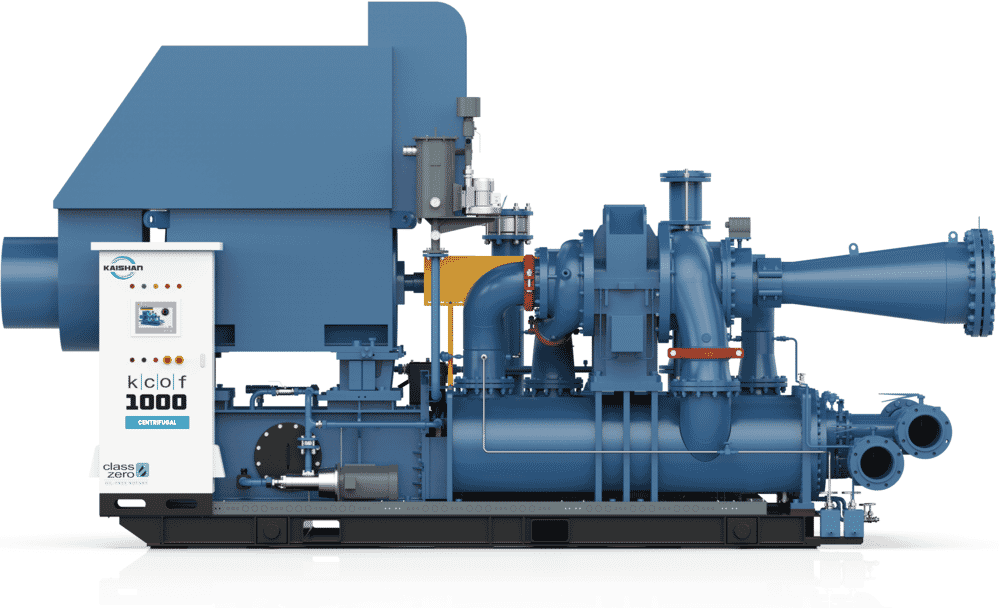
For most facilities managers, your decision will fall somewhere between rotary screw and reciprocating compressors, with centrifugals appearing at the larger end (above 400 HP).
And there’s a fourth type worth a quick mention.
A Quick Note on Scroll Compressors
Scroll compressors are worth mentioning because they’re often pitched as quiet and reliable, and they are, for the right application. Two interleaved scrolls compress air in small pockets, resulting in very low noise and a small footprint. The catch is the tip seal life. While the flanks of the scroll do not touch, the face of the scroll does. So, scrolls have a shorter overall lifespan than the other three types because their tip seals wear out and need frequent replacement. They’re great for point-of-use food, beverage, pharma and HVAC applications, but they’re not the workhorse most plants need.
Why Positive Displacement Compressors Wear Differently Than Dynamic Ones
Here’s the key difference between the three main types, and it matters more than any spec sheet.
Rotary screw and reciprocating compressors are both positive-displacement designs. They physically squeeze air into a smaller space. That squeezing means the internal parts actually come into contact with each other during compression. Rotors turn against rotors. Pistons ride up and down in cylinders. That contact is where wear happens. It’s also why both technologies depend heavily on lubricants (in oil-flooded designs) or on coatings and extremely tight tolerances (in oil-free designs) to keep wear under control.
Centrifugal compressors are dynamic. An impeller accelerates the air, and a diffuser slows it down, converting velocity into pressure. There are far fewer parts that touch each other to perform the actual compression work, which is why centrifugals tend to last so long with so little maintenance.
If you think about compressed air reliability as being closely related to the amount of wear surface a compressor has, the picture starts to clarify. More contact means more wear. And more wear means more maintenance over the unit’s life. Less contact means longer life. That’s the underlying physics, and it sets up an important nuance if, like most facilities managers, you are shopping for a rotary screw.
Special Variations That Change the Reliability Math
Within the rotary screw family, three variations move the reliability needle more than you’d expect.
Oil-Free Rotary Screw Compressors
Oil-free rotary screws like Kaishan’s KROF two-stage oil-free rotary screw air compressor are a special case worth understanding clearly. They run at much higher speeds than a standard oil-flooded unit, around 22,000 RPM compared to roughly 1,800 RPM for a normal rotary screw. That’s 12 times faster.

They also maintain much tighter tolerances between the rotors and operate at higher temperatures (though discharge temperature is about the same as an oil-flooded compressor, a critical issue when sizing downstream equipment).
Here’s what that means in practice: faster-moving parts, less clearance and more heat, all at the same time. As a result, the wear difference between an oil-free and an oil-flooded rotary screw is substantial, and so is the lifetime maintenance cost. That’s just Physics 101.
The honest guidance here is simple. Don’t select an oil-free rotary screw for reliability reasons. Select it because your application requires very high air purity (e.g., food, pharmaceutical or electronics) and you have no other practical choice. If you don’t need that level of air quality, an oil-flooded unit will be more reliable and cheaper to own over its lifetime.
Two-Stage Rotary Screw Compressors
Two-stage rotary screws split the compression work across two sets of rotors with an intercooler between them. By handling a lower pressure rise per stage, bearings absorb less axial thrust, operating temperatures stay lower and lubricant lasts longer.
That lower stress on every component adds up to longer airend life, especially in continuous-duty applications. A two-stage machine like the Kaishan KRSP2 is essentially built around the principle of lower stress, and it’s why two-stage designs tend to outlast single-stage units on heavy base-load work.

Variable-Speed Drive Compressors
VSD compressors adjust motor speed to match actual air demand. You can ramp up to full speed more gradually, avoiding the high inrush current (six times the standard operating current) that fixed-speed compressors draw during startup.
They also help address rapid cycling, where your compressor is damaged by turning on and off too frequently. A fixed-speed machine that is short cycling loads and unloads frequently, putting real stress on bearings, valves, contactors and the motor itself. A VSD unit, on the other hand, avoids most of that hammering by ramping up and down smoothly with demand. Everything is just gentler, with less wear on components. Exactly what compressed air reliability looks like in practice.
And while these variations subtly affect reliability, how and where you operate your compressor has the greatest impact.
The Biggest Factor in Air Compressor Reliability Is You
Here’s the part the brochures won’t tell you. The biggest factor in compressed air reliability isn’t the brand on the side of the machine. It’s how the unit was applied and how it’s being maintained. Get either one wrong, and even the most reliable compressor on the market will let you down.
Application Is Everything
I recently worked with a customer to troubleshoot a problem at a coastal facility. The unit had very low running hours, which should have meant it was in great shape. Instead, it was failing prematurely. The root cause was environmental.
High humidity meant the compressor was drawing in a lot of moisture, and because the machine was oversized relative to the actual demand, it was constantly cycling on and off.
As a result, it never generated enough heat to dissipate that moisture. The result was moisture entrained in the oil, accelerated wear and rapid cycling that shortened the airend’s life.
That’s a textbook case of misapplication. The right compressor in the wrong environment, or the wrong compressor in any environment, will eat your maintenance budget alive.
Maintenance Matters More Than You Think
The second half of the “you” factor is maintenance, done consistently, which is what separates a compressor that runs for 20 years from one that runs for six. Oil analysis, filter changes, separator inspections and leak audits are all non-negotiable if reliability is what you’re after.
That brings us to the part most people overlook entirely.
Your Local Expert Is the Real Reliability Upgrade
If you take only one practical step from this post, make it this: find a local compressed air professional who can help you identify the right type of compressor, size it correctly for your application and environment and build a maintenance program you can sustain.
Why an Independent Distributor Has Your Best Interests at Heart
Independent local distributors live or die on reputation in their territory. If they misapply a compressor, they have to live with that decision for the next 15 years. As a result, they’re going to be more conservative, more honest about trade-offs and more invested in making sure the equipment performs long after the invoice is paid.
A good local distributor brings three things you can’t get from a catalog: real-world experience in your local environment, the ability to size equipment based on actual demand (not assumed demand) and ongoing service support that doesn’t depend on a long-haul truck rolling in from the regional office.

Key Takeaways
- The simple answer to the “most reliable” question is that the right choice depends on your application and operating environment.
- Rotary screw and reciprocating compressors are positive-displacement machines in which parts physically touch during compression. That contact drives wear, especially under continuous load.
- Centrifugal compressors use an impeller and diffuser to move air, so fewer parts touch. That translates to longer life and lower maintenance.
- Scroll compressors are quiet and reliable for point-of-use applications, but their tip seals wear out faster than those of other technologies, so they’re usually not the right pick for plant-wide duty.
- Oil-free rotary screws run at roughly 22,000 RPM, with tighter tolerances and higher temperatures than oil-flooded units, so their lifetime maintenance costs are higher. Choose them only when air purity truly demands it.
- Two-stage designs and VSD operation both reduce mechanical stress on bearings, rotors, valves and motors, which is exactly what long airend life looks like in practice.
- The biggest factor in reliability isn’t the brand. It’s correct application, disciplined maintenance and a local compressed air professional who can help you get both right.
Let’s Talk
Compressed air reliability is built long before a compressor is ever installed. If you’re sizing a replacement, troubleshooting an existing system or just trying to figure out whether your current setup is the right fit for your operation, your local compressed air professional is the place to start.
That’s why Kaishan USA works with a nationwide network of independent distributors, who can provide on-site help and consultation as needed.
We partner with independent, local distributors because they offer expert guidance, faster response times and personalized support tailored to your needs. With factory-trained technicians and a deep understanding of industrial applications, they help maximize efficiency and minimize downtime.
The goal: ensuring you get the right system, reliable service and quick access to parts when you need them most. Buying through the Kaishan distributor network, you get more than a product—you get a local partner who cares about your business and wants to see it succeed.
Find a compressed air professional near you or contact us directly.
Further Reading
“Six Air Compressor Reliability Tips That Boost Uptime and Equipment Life.” Emphasizes the importance of maintenance in ensuring compressed air reliability.
“Air Compressor. Reliability: What Readings Should You Be Watching?” A review of the five key measurements you’ll want to track to ensure reliability.
“My Compressor is Rapid Cycling. Now What?“ More information on how VSDs can help avoid rapid cycling.
Frequently Asked Questions
Listen to the Podcast Version



Squeezing vs. Spinning: How Compressor Physics Decide Lifespan
So, I got this call, it was literally 4 AM on a Monday, and this plant manager, poor guy, he's standing on a cold floor staring at a thermal shutdown fault on a machine that had a pristine maintenance log. I mean, every single box was checked, Lisa. Every filter changed, every oil level perfect, but the metal just did not care. It- it failed anyway because, well, even the best checklist can't outrun bad physics.Right, because if you're asking a machine to do something its physical design was never built to handle, it's- it's just a ticking clock. I'm Lisa Saunders, by the way, and we are digging past the glossy marketing brochures on the Big Dog Podcast to look at what actually works when the rubber meets the road on the shop floor.
And I'm Jason Reed. No-nonsense, let's look at the metal. If you're relying on compressed air to keep your lines running, reliability isn't some abstract spec sheet number. It's- it's- it's what keeps you from getting those 4:00 AM phone calls. And it starts with how the machine actually handles the air. We are talking positive displacement versus dynamic. Squeezing versus spinning.
Okay, so let's unpack that. Squeezing is positive displacement, right? Like, you have actual physical parts, rotors or pistons, that trap the air and physically force it into a smaller space. There's contact. And where there's contact, there's- there's wear.
Exactly. Take reciprocating compressors. It's a piston going up and down in a cylinder, just like a car engine. It's cheap, hits high pressures, but it's got rings, valves, bearings all wearing down under continuous load. Or even a rotary screw—you've got two helical rotors meshing together. They're great, they run 24/7, but they absolutely depend on a solid oil film to manage that friction. And then, er, then you have scroll compressors.
Oh, the scroll. People love them because they're quiet, right? Like, whisper-quiet for point-of-use labs or dental offices.
Quiet, sure. But the physics are brutal if you try to run them hard. The flanks of those interleaved scrolls don't touch, but the faces do. They rely on these little tip seals to keep the air from leaking out. And those tip seals, they- they just wear out. Fast. If you try to run a scroll as a plant-wide workhorse, you're going to be replacing those seals constantly. It's just not built for heavy-duty workloads.
So that's the squeezing side. But what about spinning? You mentioned dynamic compressors—like centrifugals. How do they avoid that wear bottleneck?
Ah, centrifugals are a completely different animal. They don't squeeze the air. Instead, they pre-swirl it with these inlet guide vanes, then a high-speed impeller spins that air up to extreme velocity, and then a diffuser plate slows it back down. That slowing down is what converts the velocity into pressure. Think about it: no pistons, no meshing rotors. The actual parts doing the compression don't touch. Friction is- is almost zero. That's why in huge plants, we're talking 400 horsepower and up, centrifugals last for decades with very little mechanical wear.
Wow. So no contact means practically no wear. But most plants aren't running 400 horsepower monsters. They're looking at rotary screws. And a lot of them are tempted to go oil-free because, well, "oil-free" sounds cleaner and more reliable, right? No oil to carry over, no oil to change.
Yeah, and that is where a lot of folks walk right into a trap. They think oil-free means less maintenance, but the physics say the exact opposite. Take Kaishan's KROF two-stage oil-free screw, for example. It's a fantastic machine when you absolutely need zero oil risk, like in food or pharma. But to make that oil-free design work without air leaking backward through the rotors, you have to run it at insane speeds. We are talking up to 22,000 RPM.
Wait, 22,000? A standard oil-flooded rotary screw runs at what, like, 1,800 RPM?
Exactly. Roughly 1,800. So the oil-free unit is spinning twelve times faster. And because there's no oil to coat the rotors, the clearances have to be microscopic. Plus, you don't have oil absorbing the heat of compression, so the internal temperatures in those chambers skyrocket. High speed, tight clearances, and intense heat. That is a massive amount of mechanical stress on the bearings and the timing gears. It's Physics 101.
Right, so you're trading oil management for high-strung, high-speed mechanics. So the takeaway here is, don't buy oil-free because you think it's low-maintenance. You only buy it if your process, like electronics or food, absolutely demands high-purity air. Otherwise, an oil-flooded unit is going to be way more reliable and cheaper to run over its lifespan.
Spot on. If you don't need to prove zero oil to a regulator, stick with oil-flooded. It's just a gentler environment for the metal.
Control, Climate, and Community: Solving the Water-in-Oil Crisis
Okay, so if we are sticking with oil-flooded rotary screws for general manufacturing, how do we make them even more reliable? You mentioned earlier that two-stage designs change the stress math.They absolutely do. Look at something like the Kaishan KRSP2. It's a two-stage rotary screw, and the secret is how it splits the work. Instead of forcing one set of rotors to do all the squeezing from atmospheric pressure up to, say, 125 PSI, it shares the load. The first stage compresses the air halfway, then it goes through an intercooler to drop the temperature, and then the second stage finishes the job.
Ah, so by halving the pressure rise per stage, you're not pushing either rotor set to its limit. It's like- like two people carrying a couch instead of one guy throwing his back out.
Exactly! The operating temperatures stay much lower, the oil doesn't degrade as fast, and—crucially—the axial thrust on the bearings is drastically cut down. That lower stress is what gives you that legendary airend life on heavy, continuous-duty cycles. It's just a smarter way to handle the force.
And what about variable speed drives, VSDs? I know they save energy, but how do they impact reliability?
VSDs are huge for reliability because of how they handle the dreaded rapid cycling. You see, a standard fixed-speed machine, if it's oversized or the demand drops, it has to load and unload constantly. It's turning on, drawing six times its normal running current just to start, then unloading, then loading again. It's a constant hammering of the contactors, the motor, and the bearings. A VSD unit just ramps up and down smoothly. It matches the demand. It's- it's gentler.
But wait, can't VSDs get tripped up by the environment? I remember you telling me about a troubleshooting job at a coastal facility where a low-hour machine was failing. What happened there?
Oh, that was a classic. Beautiful facility, right on the water, but they had this oversized compressor that was constantly short-cycling. Now, coastal air is incredibly humid. Every time that compressor started up, it sucked in all that wet salt air. But because it was oversized and constantly unloading, the operating temperature never got hot enough. It was running way too cold—well below that critical 150-degree Fahrenheit threshold.
Oh, no. If it's running below 150 degrees, the water vapor in the air doesn't stay as steam. It condenses directly into the liquid oil inside the machine.
Bingo. You get water sitting in the bottom of the oil sump. And water is a terrible lubricant. It destroys the oil's properties, leads to high friction, drops the oil pressure, and eventually, it just eats the bearings. This pristine machine was destroying itself from the inside out because it couldn't get hot enough to boil off the water.
So how did you fix it?
Well, first, we had to get that operating temperature up into the sweet spot—around 180 degrees Fahrenheit—so the moisture would actually vaporize and vent out. Then we looked at the controls to prevent that cold short-cycling, and we got them on a strict oil sampling schedule every 2,000 hours. If you catch water in the oil early, you can change it before it destroys your bearings. But it proves the point: the environment dictates how your machine behaves.
Which is exactly why you can't just buy a compressor out of a generic corporate catalog and hope for the best. You need someone who actually knows your local climate.
Absolutely. A local independent distributor is your real reliability lifeline. They aren't just selling you a box; they live in your town. If they put the wrong machine in a humid coastal environment or a dusty desert shop, they have to deal with the warranty calls for the next fifteen years. They're going to make sure it's sized right, they have parts on hand, and they've got factory-trained techs who can get to you in hours, not days.
Yeah, because at the end of the day, reliability isn't a brand name printed on the metal. It's the physics of speed, heat, and friction, managed by smart controls and a partner who actually knows your shop floor.
Couldn't have said it better myself. Keep the metal running, keep the stress low, and we'll talk next time. See ya.
Thanks for listening, everyone. Catch you on the next episode.