
When evaluating a single stage vs. two stage air compressor, the choice goes well beyond price. The compression approach, the efficiency profile, and the operating cost over a 10-year lifespan are all fundamentally different. For industrial operations running compressed air at high hours and high demand, those differences can translate to hundreds of thousands of dollars in energy savings—or wasted spend. This guide breaks down exactly how each type works, where each excels, and how to determine which one is right for your specific application.
What Is a Single-Stage Air Compressor?
A single-stage air compressor compresses inlet air to full delivery pressure in a single compression step. In a rotary screw design like Kaishan’s KRSP, two interlocking helical rotors trap air and compress it in one continuous pass. The KRSP generates a compression ratio of 7.8:1 to deliver 100 PSIG of pressure. This approach is mechanically simple, cost-effective, and well-suited to applications where air demand is moderate and pressure requirements stay at or below 100–125 PSIG.
Single-stage rotary screw compressors can run at a 100% duty cycle—unlike reciprocating piston compressors, which require cool-down time. This makes them far more capable than their upfront cost might suggest, and an excellent fit for small- to mid-size industrial operations that don’t require continuous maximum output.

What Is a Two-Stage Air Compressor?
A two-stage air compressor divides the total compression work across two sequential stages, with an interstage cooling step in between. In Kaishan’s KRSP2, the first stage compresses air from atmospheric pressure to an intermediate pressure at a ratio of 2.8:1. The air then passes through an interstage cooler that removes heat of compression before it enters the second stage, which compresses the air to final delivery pressure at another 2.8:1 ratio.
The result is the same 100 PSIG output—but achieved in two smaller, lower-temperature steps rather than one large, heat-intensive step. This approach is at the core of why two-stage compressors are more energy-efficient and longer-lasting than their single-stage counterparts.
How the Interstage Cooler Works
The interstage cooler is the defining feature of a two-stage system. By reducing air temperature between stages, it lowers the volume of air entering the second stage—which means the second stage requires less work to complete the compression. Less work means less energy consumed per cubic foot of air delivered. It also means lower operating temperatures throughout the system, which reduces wear on bearings, seals, and the airend itself.

Single Stage vs. Two Stage Air Compressor: Side-by-Side Comparison
The table below summarizes the key differences at a glance. Detailed explanations of each factor follow.
| Factor | Single-Stage Compressor | Two-Stage Compressor |
|---|---|---|
| Compression steps | One stage (7.8:1 ratio) | Two stages (2.8:1 × 2) with interstage cooling |
| Typical pressure range | Up to 100–125 PSIG | Up to 125–175 PSIG |
| Energy efficiency | Baseline | Up to 15–20% more CFM per kW |
| Upfront cost | Lower | Higher (offset by efficiency gains) |
| Long-term operating cost | Higher (more energy, more wear) | Lower (energy, maintenance, parts) |
| Component life | Two discharge bearings carry full load | Seven bearings split load; longer service life |
| Noise level | Moderate | Lower (work split across two stages) |
| Best use case | Moderate demand, lower pressure apps | High run hours, base-load, industrial scale |
| Duty cycle | 100% (rotary screw) | 100% (rotary screw) |
1. Energy Efficiency: Two-Stage Delivers More CFM Per Kilowatt
Energy is the largest component of a compressor’s total lifetime cost—far outweighing the purchase price. The U.S. Department of Energy estimates that acquisition costs represent only 12% of the total cost of owning and operating an industrial compressed air system. The other 88% is energy and maintenance.
A two-stage compressor like the Kaishan KRSP2 generates up to 15–20% more compressed air flow than a single-stage unit of the same horsepower. This efficiency gain comes from splitting the compression work across two stages and removing heat between them. By building on the pressure achieved in the first stage rather than trying to achieve the full compression ratio in one pass, the KRSP2 does less thermodynamic work per unit of air delivered.
The practical implication: paybacks on energy costs alone may be less than two to three years. And because the KRSP2 produces more CFM for the same horsepower, you may be able to select a smaller model. A 250-HP two-stage KRSP2, for example, can often replace a 300-HP single-stage unit—narrowing the initial cost gap while delivering equal or better airflow. Adding a variable-speed drive amplifies this advantage further, particularly at partial loads.

2. Reliability and Component Life
Splitting the compression work across two stages does more than save energy—it extends the life of critical components. Because each stage operates at a lower compression ratio and lower temperature, less mechanical stress is placed on bearings, seals, and the airend rotors.
In a typical single-stage rotary screw compressor, two discharge bearings carry the entire thrust load. The Kaishan KRSP2 spreads that same load across seven bearings—four in the first stage, three in the second. Lower forces distributed across more bearing surfaces result in significantly longer service intervals and fewer unplanned failures. This is why Kaishan backs both the KRSP and KRSP2 with an industry-leading lifetime airend warranty.

3. Compressor Sizing: Two-Stage May Let You Go Smaller
Because a two-stage compressor delivers 15–20% more CFM than a comparable single-stage unit at the same horsepower, you may be able to specify a lower horsepower model while maintaining your required flow rate. For example, a facility currently running a 300-HP single-stage compressor may be able to replace it with a 250-HP KRSP2 and achieve the same or greater airflow—reducing both the initial capital cost and the ongoing electricity consumption.
This sizing-down opportunity can close the initial cost gap between single- and two-stage units significantly. Combined with the energy savings, it often makes the two-stage option the better economic choice from day one. Need help calculating your required flow rate? See our post on how many CFM you need for your application.
It’s worth noting that Kaishan is currently the only manufacturer offering two-stage rotary screw compressors as small as 30 HP—making the efficiency and longevity benefits of two-stage compression accessible to a much wider range of industrial users than was previously possible.
4. Operating Costs: The Full Picture
Lower electricity consumption is the headline benefit, but the operating cost advantage of a two-stage compressor extends to maintenance and parts as well. Because temperatures are lower and mechanical stress is distributed, service intervals are longer, and wear parts last longer. Fewer unplanned failures mean less downtime and lower emergency maintenance costs.
Consider the full cost picture over 10 years. The acquisition cost is a one-time event. The energy and maintenance costs recur every year for the life of the machine. According to the U.S. Department of Energy, energy costs alone account for roughly 76% of a compressed air system’s total lifetime cost. Optimizing for efficiency at purchase is the highest-leverage decision a plant engineer can make.

5. Total Cost of Ownership
When you add up the energy savings, the reduced maintenance expense, the potential to size down, and the longer component life, the total cost of ownership for a two-stage rotary screw compressor is lower than a single-stage unit in most industrial applications with high run hours. A higher initial price tag is a short-term consideration; TCO is the number that matters over the life of the asset.
Acquisition costs amount to only 12% of a compressor’s total cost of ownership, according to the U.S. Department of Energy. You pay that cost once. You’ll be paying energy and maintenance costs every year for 15 to 20 years. Optimizing for TCO rather than purchase price is the decision that separates high-performing compressed air operations from costly ones.
When to Choose a Two-Stage Rotary Screw Compressor
Two-stage rotary screw compressors like the Kaishan KRSP2 are the strongest choice in these situations:
- Base-load compressor in a multi-compressor configuration. When running at 100% full-load capacity for multiple shifts, the two-stage efficiency advantage pays back quickly in energy savings alone.
- High-hours operations. The higher the annual run hours, the faster the energy ROI. At 4,000+ hours per year, the 15–20% efficiency difference represents significant dollar savings.
- Mass production environments where reliability is critical. Industries such as automotive, food and beverage, aerospace, glass manufacturing, and semiconductor fabrication depend on continuous, uninterrupted compressed air. The KRSP2’s lower operating temperatures and distributed bearing load make it significantly more reliable over the long term.
- Facilities targeting sustainability and carbon footprint reduction. Generating 15–20% more compressed air per kilowatt means burning less electricity per unit of output—a direct reduction in energy consumption and associated emissions.
- Operations looking to right-size equipment. The KRSP2’s availability in sizes starting at 30 HP means the two-stage advantage is now accessible to small and mid-size facilities that previously couldn’t justify two-stage pricing.

Reliable, energy-efficient air is essential in many industries—especially those like medical device manufacturing. However, deciding whether to use a single stage vs 2 stage air compressor can greatly impact performance and cost.
When evaluating a single stage vs. two stage air compressor, the choice goes well beyond price. The compression approach, the efficiency profile, and the operating cost over a 10-year lifespan are all fundamentally different. For industrial operations running compressed air at high hours and high demand, those differences can translate to hundreds of thousands of dollars in energy savings—or wasted spend. This guide breaks down exactly how each type works, where each excels, and how to determine which one is right for your specific application.
What Is a Single-Stage Air Compressor?
A single-stage air compressor compresses inlet air to full delivery pressure in a single compression step. In a rotary screw design like Kaishan’s KRSP, two interlocking helical rotors trap air and compress it in one continuous pass. The KRSP generates a compression ratio of 7.8:1 to deliver 100 PSIG of pressure. This approach is mechanically simple, cost-effective, and well-suited to applications where air demand is moderate and pressure requirements stay at or below 100–125 PSIG.
Single-stage rotary screw compressors can run at a 100% duty cycle—unlike reciprocating piston compressors, which require cool-down time. This makes them far more capable than their upfront cost might suggest, and an excellent fit for small- to mid-size industrial operations that don’t require continuous maximum output.
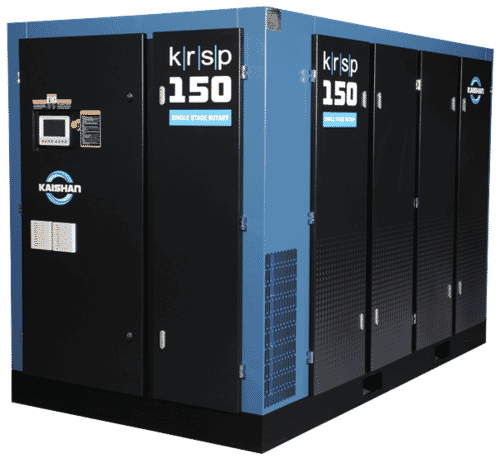
Kaishan’s KRSP single-stage rotary screw air compressors are among the most cost-effective options on the market.
What Is a Two-Stage Air Compressor?
A two-stage air compressor divides the total compression work across two sequential stages, with an interstage cooling step in between. In Kaishan’s KRSP2, the first stage compresses air from atmospheric pressure to an intermediate pressure at a ratio of 2.8:1. The air then passes through an interstage cooler that removes heat of compression before it enters the second stage, which compresses the air to final delivery pressure at another 2.8:1 ratio.
The result is the same 100 PSIG output—but achieved in two smaller, lower-temperature steps rather than one large, heat-intensive step. This approach is at the core of why two-stage compressors are more energy-efficient and longer-lasting than their single-stage counterparts.
How the Interstage Cooler Works
The interstage cooler is the defining feature of a two-stage system. By reducing air temperature between stages, it lowers the volume of air entering the second stage—which means the second stage requires less work to complete the compression. Less work means less energy consumed per cubic foot of air delivered. It also means lower operating temperatures throughout the system, which reduces wear on bearings, seals, and the airend itself.
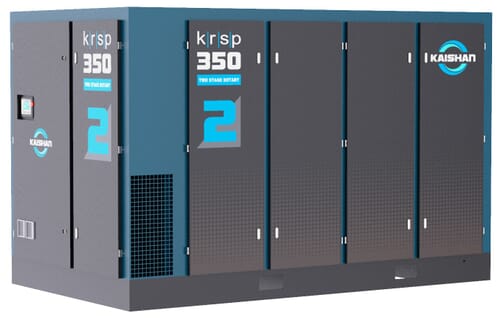
Kaishan’s KRSP2 two-stage rotary screw air compressor is one of the most energy-efficient machines on the market.
Single Stage vs. Two Stage Air Compressor: Side-by-Side Comparison
The table below summarizes the key differences at a glance. Detailed explanations of each factor follow.
| Factor | Single-Stage Compressor | Two-Stage Compressor |
|---|---|---|
| Compression steps | One stage (7.8:1 ratio) | Two stages (2.8:1 × 2) with interstage cooling |
| Typical pressure range | Up to 100–125 PSIG | Up to 125–175 PSIG |
| Energy efficiency | Baseline | Up to 15–20% more CFM per kW |
| Upfront cost | Lower | Higher (offset by efficiency gains) |
| Long-term operating cost | Higher (more energy, more wear) | Lower (energy, maintenance, parts) |
| Component life | Two discharge bearings carry full load | Seven bearings split load; longer service life |
| Noise level | Moderate | Lower (work split across two stages) |
| Best use case | Moderate demand, lower pressure apps | High run hours, base-load, industrial scale |
| Duty cycle | 100% (rotary screw) | 100% (rotary screw) |
1. Energy Efficiency: Two-Stage Delivers More CFM Per Kilowatt
Energy is the largest component of a compressor’s total lifetime cost—far outweighing the purchase price. The U.S. Department of Energy estimates that acquisition costs represent only 12% of the total cost of owning and operating an industrial compressed air system. The other 88% is energy and maintenance.
A two-stage compressor like the Kaishan KRSP2 generates up to 15–20% more compressed air flow than a single-stage unit of the same horsepower. This efficiency gain comes from splitting the compression work across two stages and removing heat between them. By building on the pressure achieved in the first stage rather than trying to achieve the full compression ratio in one pass, the KRSP2 does less thermodynamic work per unit of air delivered.
The practical implication: paybacks on energy costs alone may be less than two to three years. And because the KRSP2 produces more CFM for the same horsepower, you may be able to select a smaller model. A 250-HP two-stage KRSP2, for example, can often replace a 300-HP single-stage unit—narrowing the initial cost gap while delivering equal or better airflow. Adding a variable-speed drive amplifies this advantage further, particularly at partial loads.
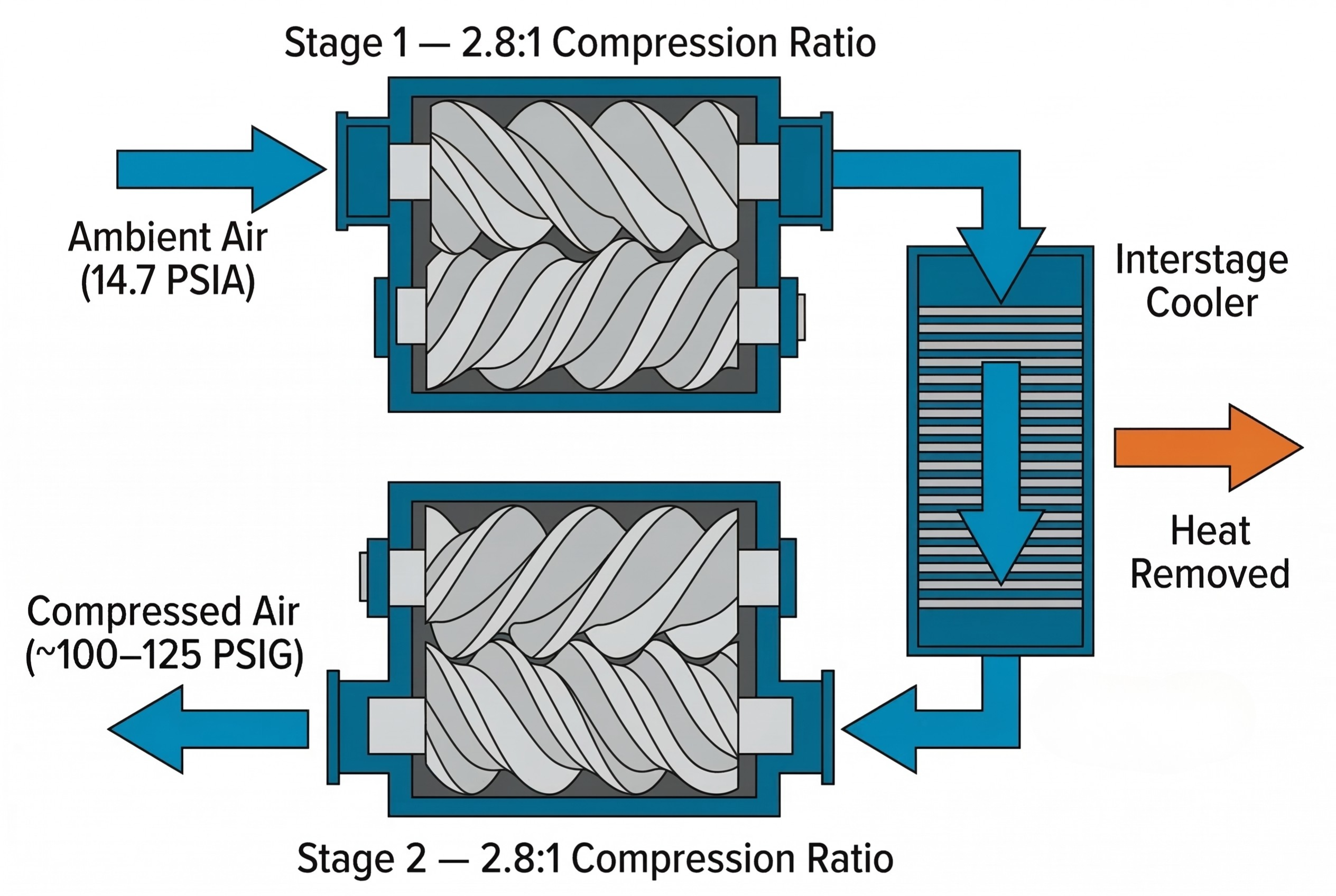
Two-stage compression process diagram.
2. Reliability and Component Life
Splitting the compression work across two stages does more than save energy—it extends the life of critical components. Because each stage operates at a lower compression ratio and lower temperature, less mechanical stress is placed on bearings, seals, and the airend rotors.
In a typical single-stage rotary screw compressor, two discharge bearings carry the entire thrust load. The Kaishan KRSP2 spreads that same load across seven bearings—four in the first stage, three in the second. Lower forces distributed across more bearing surfaces result in significantly longer service intervals and fewer unplanned failures. This is why Kaishan backs both the KRSP and KRSP2 with an industry-leading lifetime airend warranty.
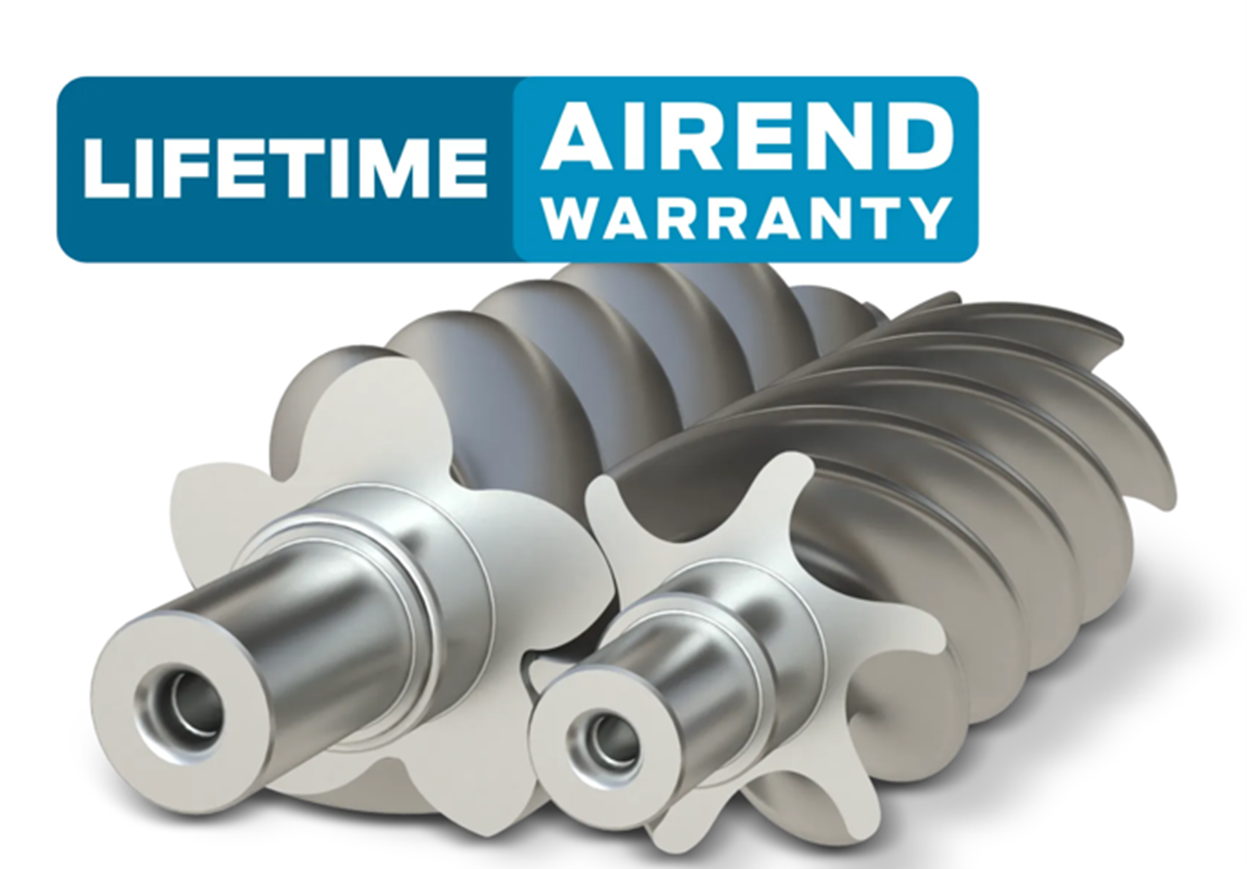
An industry-leading lifetime airend warranty backs Kaishan’s KRSP and KRSP2 screw compressors.
3. Compressor Sizing: Two-Stage May Let You Go Smaller
Because a two-stage compressor delivers 15–20% more CFM than a comparable single-stage unit at the same horsepower, you may be able to specify a lower horsepower model while maintaining your required flow rate. For example, a facility currently running a 300-HP single-stage compressor may be able to replace it with a 250-HP KRSP2 and achieve the same or greater airflow—reducing both the initial capital cost and the ongoing electricity consumption.
This sizing-down opportunity can close the initial cost gap between single- and two-stage units significantly. Combined with the energy savings, it often makes the two-stage option the better economic choice from day one. Need help calculating your required flow rate? See our post on how many CFM you need for your application.
It’s worth noting that Kaishan is currently the only manufacturer offering two-stage rotary screw compressors as small as 30 HP—making the efficiency and longevity benefits of two-stage compression accessible to a much wider range of industrial users than was previously possible.
4. Operating Costs: The Full Picture
Lower electricity consumption is the headline benefit, but the operating cost advantage of a two-stage compressor extends to maintenance and parts as well. Because temperatures are lower and mechanical stress is distributed, service intervals are longer, and wear parts last longer. Fewer unplanned failures mean less downtime and lower emergency maintenance costs.
Consider the full cost picture over 10 years. The acquisition cost is a one-time event. The energy and maintenance costs recur every year for the life of the machine. According to the U.S. Department of Energy, energy costs alone account for roughly 76% of a compressed air system’s total lifetime cost. Optimizing for efficiency at purchase is the highest-leverage decision a plant engineer can make.
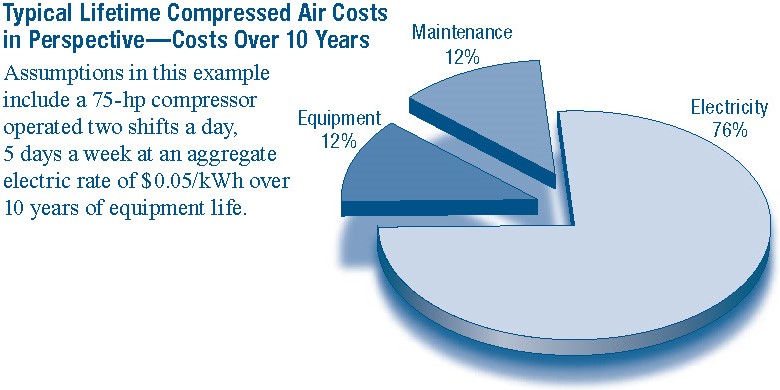
The U.S. Department of Energy estimates that the cost of purchasing an industrial air compressor is only 12% of the lifetime cost of owning and operating a compressed air system.
5. Total Cost of Ownership
When you add up the energy savings, the reduced maintenance expense, the potential to size down, and the longer component life, the total cost of ownership for a two-stage rotary screw compressor is lower than a single-stage unit in most industrial applications with high run hours. A higher initial price tag is a short-term consideration; TCO is the number that matters over the life of the asset.
Acquisition costs amount to only 12% of a compressor’s total cost of ownership, according to the U.S. Department of Energy. You pay that cost once. You’ll be paying energy and maintenance costs every year for 15 to 20 years. Optimizing for TCO rather than purchase price is the decision that separates high-performing compressed air operations from costly ones.
When to Choose a Two-Stage Rotary Screw Compressor
Two-stage rotary screw compressors like the Kaishan KRSP2 are the strongest choice in these situations:
-
- Base-load compressor in a multi-compressor configuration. When running at 100% full-load capacity for multiple shifts, the two-stage efficiency advantage pays back quickly in energy savings alone.
- High-hours operations. The higher the annual run hours, the faster the energy ROI. At 4,000+ hours per year, the 15–20% efficiency difference represents significant dollar savings.
- Mass production environments where reliability is critical. Industries such as automotive, food and beverage, aerospace, glass manufacturing, and semiconductor fabrication depend on continuous, uninterrupted compressed air. The KRSP2’s lower operating temperatures and distributed bearing load make it significantly more reliable over the long term.
- Facilities targeting sustainability and carbon footprint reduction. Generating 15–20% more compressed air per kilowatt means burning less electricity per unit of output—a direct reduction in energy consumption and associated emissions.
- Operations looking to right-size equipment. The KRSP2’s availability in sizes starting at 30 HP means the two-stage advantage is now accessible to small and mid-size facilities that previously couldn’t justify two-stage pricing.
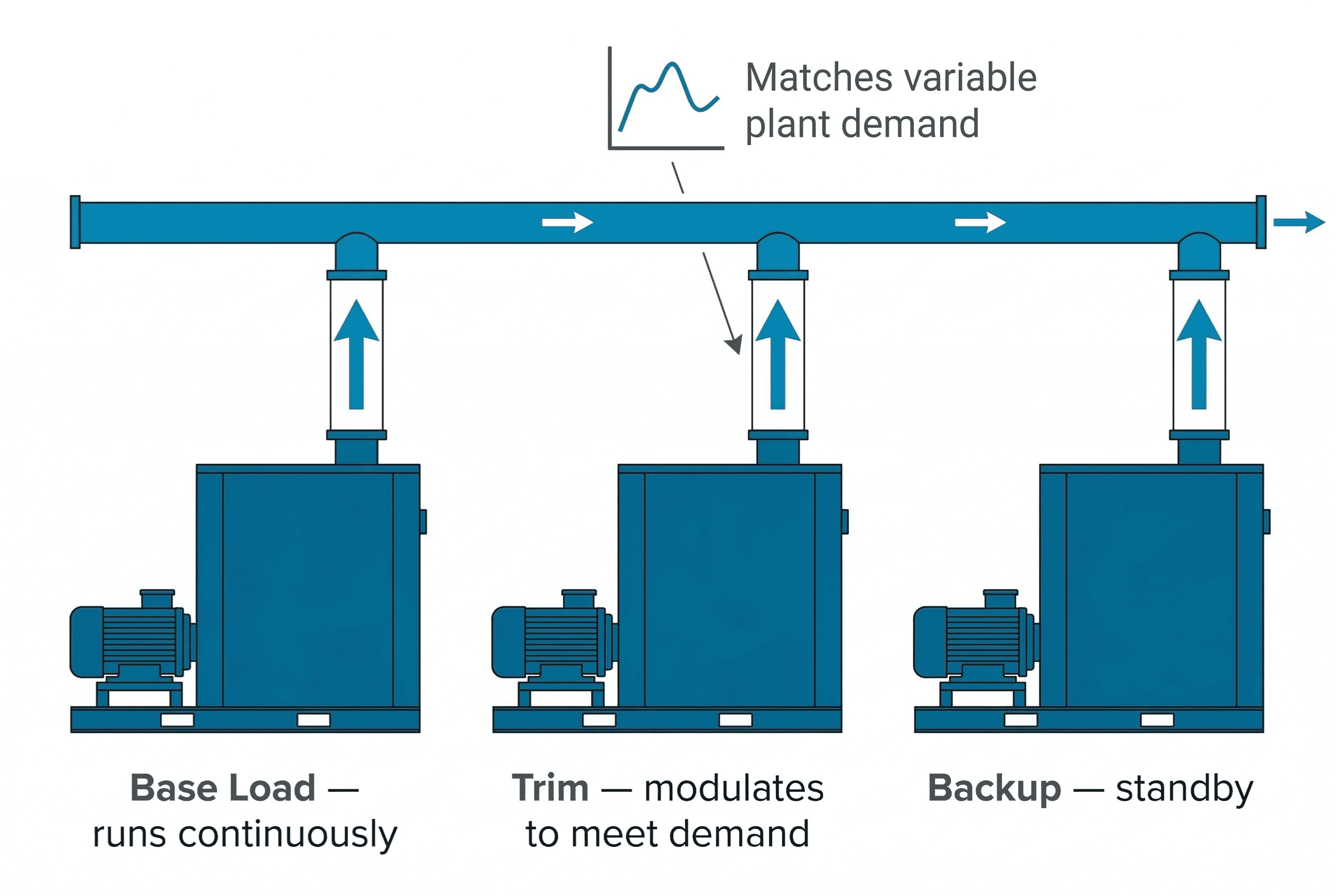
Three-compressor base/trim/backup system diagram.
When a Single-Stage Compressor Is the Right Choice
A single-stage rotary screw compressor is the right tool when the application doesn’t justify the added upfront cost of a two-stage unit. Specifically, consider a single-stage compressor when:
- Pressure requirements stay at or below 100–115 PSIG. The efficiency gap between stages narrows at lower pressures, and the upfront cost difference may outweigh the energy savings.
- Run hours are low. If the compressor runs fewer than 2,000 hours per year, the ROI timeline for a two-stage unit extends significantly.
- Budget constraints favor a lower initial investment. Kaishan’s KRSP single-stage is one of the most cost-effective industrial rotary screw compressors on the market and carries the same lifetime airend warranty.
- The application is intermittent or demand-variable. For facilities with low base-load demand and high peaks, a VSD-equipped single-stage unit may provide better overall efficiency than a fixed-speed two-stage.
A Kaishan distributor can help you model both scenarios using your actual run hour and pressure data to determine which configuration delivers the lowest total cost of ownership for your operation.
Frequently Asked Questions
Ready to Find the Right Compressor for Your Operation?
Deciding between a single-stage and two-stage rotary screw air compressor is one of the highest-impact decisions in compressed air system design. Kaishan USA’s nationwide network of independent distributors can perform an on-site assessment of your operation—analyzing run hours, pressure requirements, and demand profiles—to determine exactly which configuration delivers the lowest total cost of ownership for your facility.
Explore the Kaishan KRSP single-stage rotary screw air compressor and the KRSP2 two-stage rotary screw air compressor, or contact us today to connect with your local Kaishan distributor.