

Service plays a critical role in the life of your air compressor and the end-use applications it serves, helping companies:
- Avoid downtime. By performing regular maintenance, you’ll keep unplanned downtime to a minimum.
- Save energy. A properly maintained system will deliver significant energy savings. For more on energy efficiency, see our blog post, “Reduce Energy Costs: Four Tips for Plant Managers.”
- Extend equipment life. A well-maintained compressor will have a long working life and could impact the longevity of the equipment it serves.
- Enhance safety. Properly maintaining rotary screw air compressors will reduce the heat, vibration, pollution and noise impact on your people. And they are less likely to have the kinds of serious failures that injure workers. For more on safety, see our blog post, “Eight Ways to Improve Air Compressor Safety.”
As a result, original equipment manufacturers recommend maintenance programs as part of their operating and maintenance instructions. Services that will enable your compressor to function as designed for a reasonable lifespan.
Compressor OEMs require owners of their machines to perform key maintenance procedures to remain eligible for warranty coverage. We call those practices service intervals.
What Are Service Intervals?
Service intervals establish the schedule of recommended maintenance tasks for your compressor. For example, the manufacturer might require that you change an air filter every 4,000 hours. Different tasks are assigned specific time intervals based on an OEM’s experience with their products.
Top 10 Service Intervals
A good preventive maintenance checklist includes the following “top 10 key elements:”
1. Change air filters every 4,000 hours, per the manufacturer’s recommendation, or when service indicators are reached.
2. Check the oil level before starting your compressor.
3. Clean condensate traps and drains daily.
4. Use only OEM-specified oils and lubricants.
5. Change the oil separator and lubricant every year, every 8,000 hours or as per machine guidelines. Every 4,000 hours when using food-grade lubricant. Or as indicated by your oil sample.
6. Sample oil every 2,000 hours or 1,000 hours for food-grade lubricant.
7. Repair system air leaks as quickly as possible.
8. Use only quality OEM parts.
9. Maintain your warranty eligibility.
10. Adopt a consistent air compressor maintenance program.
OEMs will tell you, however, that their service intervals are only minimum recommendations. In effect, following the schedule may not be enough.
The reason is that the conditions at your site may require more frequent service.
Why Some Facilities Require More Frequent Service
The need for maintenance may differ across individual applications due to environmental conditions or other factors. A few examples:
- Dirt, dust or caustic chemicals in the air
- Use of food-grade lubricants
- Findings in an oil sample
So, while you need to follow your manufacturer’s guidance, the stated intervals are not the only factor to consider.
It’s one reason why more companies are turning to predictive maintenance.
Preventive vs. Predictive Maintenance
Following your manufacturer’s recommended service intervals is a classic preventive maintenance practice. You change the oil at 8,000 hours, like clockwork.
Unfortunately, as noted above, that may not be enough, depending on your site conditions.
That’s why more companies are using predictive maintenance to drive maintenance frequency. As it sounds, predictive maintenance uses data from your equipment to determine when service is recommended. For a more detailed comparison of predictive and preventive maintenance, read our blog post, “The Differences Between Air Compressor Preventive Maintenance and Predictive Maintenance. And Why You Should Care.”
Oil sampling is a classic example of predictive maintenance.
Oil Sampling
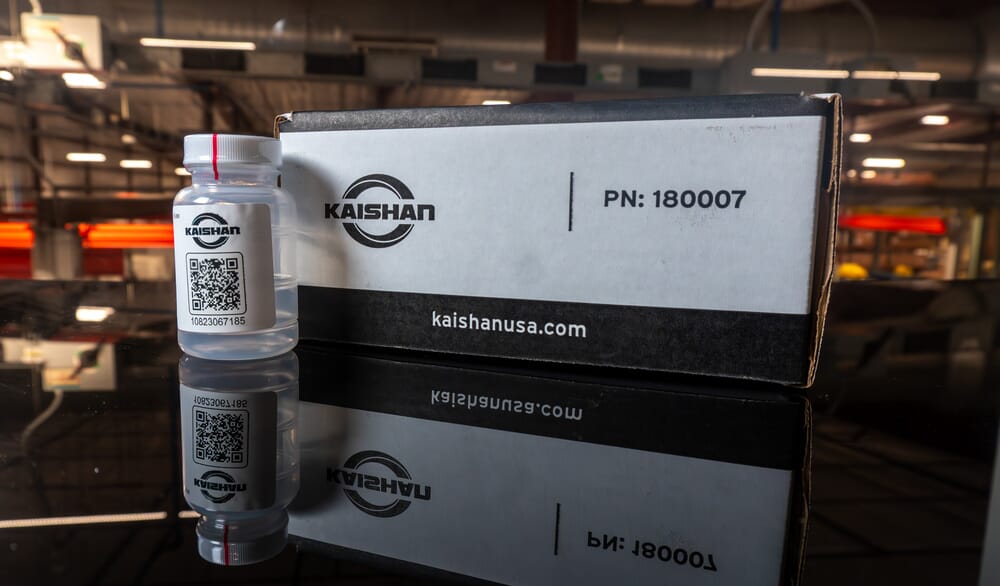
Oil sampling provides a wealth of information about your compressor’s health and operation. It will not only indicate it’s time to change your compressor oil, but also point out a host of potential problems:
- Elevated wear metals might indicate metal components such as bearings, rotors, gears or bushings are experiencing abrasive wear.
- Abnormal acid number, additive levels or viscosity may indicate that your oil is deteriorating prematurely and that service intervals should be shortened.
- High levels of contaminants indicate a problem with filtration or with the quality of the inlet air.
- The presence of water indicates short cycling, with water entering the oil through internal leaks.
The oil sampling report clearly demonstrates the value of predictive maintenance, allowing you to perform maintenance before issues turn into problems. For more on oil sampling, read our blog post, “Choosing the Right Rotary Compressor Oil.”
However, predictive maintenance does not replace preventive maintenance.
You Still Need to Observe Service Intervals
While you can easily see the benefits of predictive maintenance, you don’t want to ignore your manufacturer’s minimums for the following reasons:
- You might invalidate your warranty. Most manufacturers require proof that you performed the required services at the designated times.
- Even if your oil analysis comes back fine at 8,000 hours, do yourself a favor and change the oil. It’s not going to be okay for long. And it probably will go south fast.
- Maintenance can be critical to regulatory compliance. A good example is the frequent maintenance of advanced filters on an oil-flooded rotary screw compressor used in the food and beverage industry. Even a small amount of oil pass-through could not only ruin a batch of products but also contaminate piping and downstream equipment. The cost to remove that oil makes replacement filters a phenomenal bargain.
Predictive maintenance is a good example of the way in which maintenance of compressed air systems is becoming more data-driven.
Going forward, you’ll want to capture all the data your compressor generates and put it to long-term use. And create a baseline.
Collect Baseline Data
It’s smart to keep track of key data points for your compressed air system, including:
- CFM demand
- Pressure levels
- Energy consumption
- Load and run hours
Capturing and retaining this data gives a technician a goldmine of information about your system and how it’s operating. You can also add monitoring equipment (like our AirWatch remote monitoring capability) to view this information remotely. Even 24/7.
The next step is to organize that data so you can accurately predict when your compressor will need routine service and long-term maintenance.
The goal is to take the guesswork out of air compressor maintenance and make it more reliable:
- Scheduling regular service intervals to coincide with plant maintenance shutdowns
- Predicting maintenance expenses as well as long-term investments in new equipment
- And ultimately, avoiding system failures and resultant downtime
Top management will thank you.
Be Your Chief Financial Officer’s Hero!
Doing predictive maintenance, tracking baseline data and making service predictable and schedulable will move compressed air to a level of accountability your CFO will love. Avoiding shutdowns and unplanned downtime. Allowing routine maintenance to become, well, routine.
Plus, you will gain the credibility you need to lobby the front office for major equipment upgrades and acquisitions. You get a much better reception from top management when your presentation is based on hard data.
Admittedly, it’s a big leap from simply tracking and performing preventive maintenance. But you don’t have to go it alone.
Help in Taking Air Compressor Service Intervals to the Next Level
How you make the leap from reactive maintenance to predictable and accountable service could well determine your company’s success in achieving broader objectives such as reliability, energy efficiency and cost efficiency.
That’s a challenge with dwindling headcounts and resources devoted to maintenance. But your local compressed air professionals can help.
We work with a nationwide network of independent distributors, who can provide on-site help and consultation as needed.
They have a staff of factory-trained air compression experts who offer expert guidance, faster response times and personalized support tailored to your needs.
Best of all, you can customize the level of service they provide, working with them to develop a hybrid service arrangement that strikes a comfortable balance between their staff and your in-house resources. An agreement you can live with and afford. Not an ironclad service contract that feels like a payday loan from the mob. For more on the things you need to watch for in service agreements and warranties, download our white paper, “Eight Dirty Little Secrets About Air Compressor Warranties.”
So, when you buy through the Kaishan dealer network, you’re getting more than a product—you’re getting a local partner who cares about your business and wants to see it succeed.
Key Takeaways
- Maintenance plays a critical role in the life of your compressor and the end-use applications it serves.
- Original equipment manufacturers require owners of their machines to perform key maintenance procedures to remain eligible for warranty coverage.
- Service intervals establish the schedule of recommended maintenance tasks for your compressor and are a classic preventive maintenance practice.
- Observing routine service intervals, however, should be viewed as a minimum. They may not occur frequently enough, depending on your site conditions.
- Predictive maintenance uses actual observations to determine when service is warranted.
- The oil sampling report clearly demonstrates the value of predictive maintenance, allowing you to perform maintenance when the data indicates.
- While you can easily see the benefits of predictive maintenance, you should not ignore your manufacturer’s minimums.
- Following the manufacturer’s required service intervals helps preserve warranty coverage and can be critical for regulatory compliance.
- As compressed air maintenance becomes more data-driven, it is wise to capture and retain baseline data for key parameters.
Local Help in Setting Up a Maintenance Program
Developing a maintenance program that meets the needs of your company and your facility is critical to your success. And developing a partnership with one of our distributors is a great place to start.
Find a compressed air professional near you. Or contact us directly.
Further Reading
“Twelve Reasons Why You Should Be Monitoring Air Compressor Data.” Find out all the ways you can use your compressor’s data to save money, optimize performance, lengthen equipment life, enhance safety, improve reliability and reduce or even eliminate downtime.
“What Readings Tell You It’s Time For Air Compressor Maintenance?” Lists critical measurements that tell you when it’s time to perform maintenance, including operating hours, oil level and condition and pressure differentials.
“Ten Need-To-Know Rotary Screw Air Compressor Maintenance Tips.” A top-10 list of maintenance tips and service intervals.
“Air Compressor Maintenance: Ultimate Guide and Checklist.” A full guide and checklist on maintaining your air compressor.
Frequently Asked Questions
- If you're managing older equipment or dealing with frequent unexpected downtime, it might be time to upgrade your maintenance approach. Consider investing in:
- Computerized maintenance management systems (CMMS) to track service history automatically
- Condition monitoring equipment (oil analysis labs, vibration sensors and temperature monitors)
- Premium synthetic oils that extend intervals and improve equipment protection
- Air drying systems to address moisture issues upstream rather than managing problems downstream
- These investments often pay for themselves through reduced downtime and extended equipment life.
Listen to the Podcast Version



Seventy-Five Episodes In, and Still Here
[excited] Welcome to the show -- and I gotta say, Lisa, this one kind of sneaked up on me. Episode 75. Seventy-five! [laughs] The diamond anniversary, apparently. Which feels way too fancy for two people talking about compressors and maintenance, but here we are.[warmly] Yeah, 75 is the part that gets me. Not five, not 10, not even 50 -- SEVENTY-five. That's enough episodes to make me think, okay, somebody out there actually wants to hear practical shop talk. Which, honestly, I love. Because the stuff that keeps plants running is usually not dramatic. It's routine. It's checklists. It's somebody remembering to look at the thing nobody feels like looking at.
Exactly. Nobody throws a party because a condensate drain got cleaned on schedule. Nobody hangs a banner because somebody changed a filter at 4,000 hours. But miss that boring little job, and now everybody's standing around a dead compressor asking how this happened.
[questioning tone] And that's the trap, right? We talk about reliability like it's this big strategy deck, but half the time it's one ugly truth: did you do the maintenance when you said you were gonna do it? Or did the reminder sit there until it became a problem with a price tag?
[matter-of-fact] Right. Service intervals sound like paperwork. They're not paperwork. They're the line between planned maintenance and expensive surprises. If you've got an air filter due, oil coming up on hours, drains not being checked, leaks ignored -- you're not saving time. You're borrowing trouble.
And usually at the worst possible moment. [sighs] Not Tuesday at 10 a.m. when everybody's staffed up. It's Friday night, or during a production run, or right when the plant can't afford to lose air. Compressed air has this nasty habit of becoming visible only when it's gone.
That's a good way to put it. When the air's there, nobody says a word. When it's not, suddenly compressed air is the most important utility in the building. So if you're responsible for that system, the calendar matters. The hour meter matters. The service log matters.
[curious] But I do think people hear "service interval" and imagine a calendar on the wall -- first Monday, change this; third Thursday, check that. And some of it is calendar-driven, sure, but operating hours matter too. A compressor working hard tells the truth faster than the date does.
Yep. Track both. Hours tell you how hard the machine is actually running. Calendar time matters because oil ages, seals age, moisture shows up even when the machine isn't living a heroic life. So this isn't just, "Did we remember a date?" It's, "Are we paying attention before the machine teaches us a lesson?"
[lightly] Which is a very expensive teacher.
[chuckles] Tuition is brutal. And that's really the whole setup for today: service intervals are necessary, but if you treat them like a box to check and nothing more, you're leaving a lot on the table -- and taking on risk you don't need.
The Rulebook Is Only the Starting Line
[curious] Okay, so let's get into the part people can use. When you say service intervals are necessary but not enough, what are the absolute must-dos?[matter-of-fact] Start simple. Change air filters every 4,000 hours, or sooner if the indicator tells you they're loaded up. Check oil level before startup. Clean condensate traps and drains daily. Use the oil and lubricants the OEM calls for -- not whatever was sitting on a shelf because it was cheap. Change the oil separator and lubricant every year or every 8,000 hours, depending on the machine guidelines. And if you're using food-grade lubricant, tighten that up -- more like every 4,000 hours.
Wait -- that 4,000-hour split for food-grade lubricant is exactly the kind of detail people miss. They hear "oil is oil," and it is absolutely not.
Correct. And that's where folks get themselves in trouble. The manual gives you a baseline, but your plant conditions may not let you run that far cleanly. Dust in the air, dirt from outside, caustic chemicals, high heat, moisture, short cycling -- all of that changes the conversation.
[skeptical] So let me push on that. If the manual says 8,000 hours for oil, and a plant manager says, "Great, see you at 8,000," you're saying that's a minimum rule, not a promise.
That's EXACTLY what I'm saying. OEM intervals are minimum recommendations to keep the machine operating as designed and to protect warranty eligibility. They are not a magical guarantee that every facility gets the same result. A clean climate-controlled room and a dusty plant next to a racetrack are not living the same life.
[laughs] The racetrack example sticks, because you can picture it. Fine dust everywhere, getting pulled into the inlet air all day. Of course that machine is gonna want more attention than the one sitting in a cleaner environment.
Exactly. And then there are leaks. People treat leaks like background noise. They're not. Repair system air leaks as quickly as possible. You're paying to compress that air. Letting it escape is just burning energy for no reason.
And it's sneaky because a leak doesn't always shut you down dramatically. It just drags on efficiency, drags on runtime, drags on cost. It's death by a thousand hisses.
[deadpan] That might be the most accurate sentence in this episode. Now, the other piece is predictive maintenance. Preventive maintenance says, "At 8,000 hours, change the oil." Predictive maintenance says, "Let's look at what the machine is telling us before something goes sideways."
So this is where oil sampling comes in.
Yes. Oil sampling is one of the cleanest examples. Pull a sample every 2,000 hours -- and even more often in harsher environments or with food-grade lubricant, more like every 1,000 hours. That report can show elevated wear metals from bearings, rotors, gears, bushings. It can show viscosity issues, additive depletion, abnormal acid number, contamination, even water in the oil.
[sharper implication] And water in the oil is not just a lab curiosity. If you see water, now you're asking about moisture, short cycling, maybe internal leaks -- real operating problems, not abstract chemistry.
Bingo. Same with contamination. If a sample comes back dirty, that can point to poor filtration or lousy inlet air quality. That's predictive maintenance doing its job: catching a problem while it's still information instead of a failure.
But -- and here's the tension -- people hear that and immediately go, "Great, if the oil sample looks good at 8,000 hours, I can skip the scheduled service." That's the part I don't buy.
[firm] You shouldn't buy it. Predictive maintenance does NOT replace preventive maintenance. If the manufacturer says change the oil at 8,000 hours for warranty and reliability, do it. Even if the report looks decent. Because "decent right now" is not the same as "safe to ignore the rulebook."
And warranty is the part people remember too late. Most manufacturers want proof you did the required service at the required times. No records, no proof, now you're having a very unpleasant conversation.
That's right. And in some industries it's bigger than warranty. Think food and beverage. Filter maintenance there is not optional housekeeping. Even a small amount of oil carryover can ruin product, contaminate piping, foul downstream equipment. Replacing filters on time is cheap compared to cleaning up that mess.
[reflective] So the smart version of this is kind of a hybrid. Keep the required intervals. Then layer in real data -- oil samples, pressure levels, CFM demand, energy consumption, load hours, run hours -- so you're not flying blind between those intervals.
Exactly. Build a baseline. Know what normal looks like for your system. Then when pressure drifts, energy use climbs, moisture shows up, or runtime changes, you've got context. Data becomes a flashlight. It shows you where to look.
Not a hall pass.
[chuckles] Not a hall pass. That's the line. Data helps you tighten maintenance based on reality. It doesn't let you pretend the minimums don't exist.
And honestly, that's the grown-up version of maintenance. Not reactive, not superstitious, not just changing parts because the moon is full. You respect the rulebook, and then you pay attention to your actual plant.
[calm] That's it. The machine gives you a schedule. The environment edits it. And your job is to notice.
[warmly] That's a good place to leave it. Thanks for being here for episode 75 -- still a little surreal. We'll see you next time.