

Oil-flooded rotary screw air compressors, the type of compressor used most often in industrial applications today, inject a fine mist of oil into their compression chambers to remove heat and lubricate and seal their rotors.
The presence of even a small amount of oil is too much for sensitive applications such as food and beverage, electronics, healthcare, and semiconductors.
As a result, companies in these industries often turn to oil-free compressors, such as our KROF two-stage oil-free compressor or, for larger applications (over 400 HP), our KCOF oil-free centrifugal compressor.
Small amounts of oil mist, less than 3 ppm (parts per million), however, are not significant enough to be a factor in most other industrial applications, such as material handling, packaging and air tools.
As a result, most companies continue to use traditional rotary screw air compressors for non-sensitive applications because of the advantages they offer in cost efficiency, energy efficiency, ease of maintenance and long-term performance.
Even in those uses, however, oil carryover can get out of hand, creating several problems, including:
- Reduced air quality
- Compromised end product quality
- Damage or reduced lifespan for downstream equipment
- Increased maintenance and energy costs
- Downtime
There are many reasons why an oil-flooded rotary screw compressor can begin to carry over excessive amounts of oil.
Causes of Air Compressor Oil Carryover
There are several reasons why oil carryover can go from insignificant to excessive, including problems with air-oil separators, oil levels, temperatures and pressures.
Problems with the Air-Oil Separator
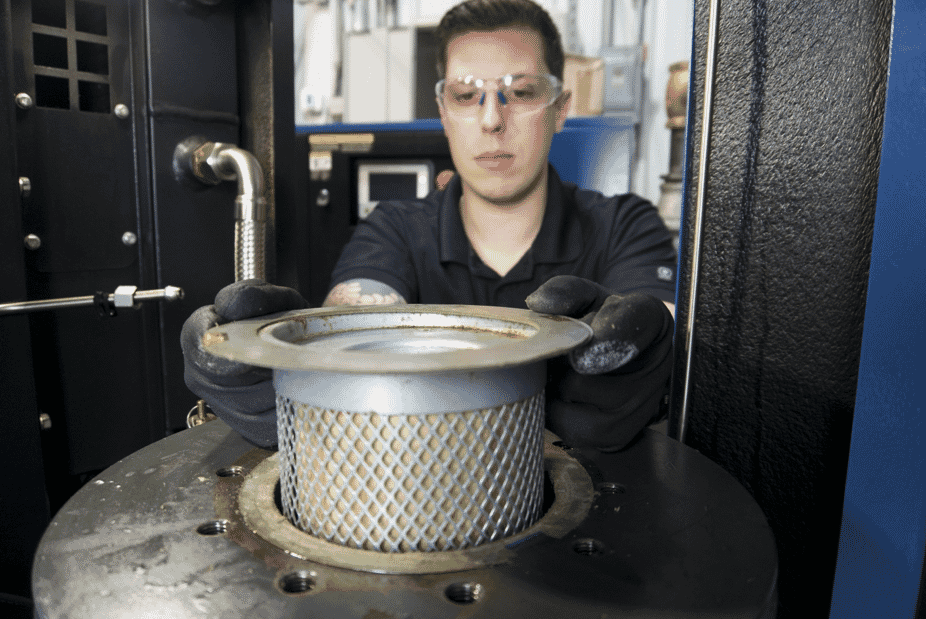
The air-oil separator is the primary component responsible for removing oil mist from the air that leaves an oil-flooded screw compressor’s compression chamber.
As air enters the separator tank or sump, it is drawn into a centrifugal motion, forcing most of the oil out. The air then goes into the separator element, a mesh filter that removes all but a tiny fraction of the oil.
Any coalesced oil that gets through settles at the bottom of the separator and is drained via a scavenge line. It goes through a filter (to remove impurities) and a cooler (to remove heat), then back to the main oil tank to start the process over again. Oil circuits may vary for individual machines, so consult your manufacturer’s product information for details.
Keeping your air-oil separator in good condition is essential for the performance of your rotary screw air compressor. A clogged separator will reduce air flow and increase energy consumption, forcing your compressor to work harder to produce the air pressure and flow your system requires. We’ll discuss separator maintenance in more detail later.
And while the air-oil separator is the Achilles’ heel for oil carryover, there are several system settings that you need to get “just right.”
Incorrect Oil Levels
You can experience both extremes in your oil level—too much as well as too little—can result in oil carryover:
- If you have too much oil, the excess can be picked up in the airstream and pushed downstream.
- If you have the wrong oil or too little oil, you could have poor separation in the separator or more vapor carryover.
Temperature
Ideally, your compressor should be running between 180°F and 200°F:
- If it’s too hot, your oil can vaporize and escape the separation process.
- If it’s too cold, it could condense, and you’ll have poor separation.
Pressure
Pressures that are too far outside the target range will also cause problems:
- High pressures may force more oil into the air.
- Low pressures can be a problem as well, since the air-oil separator needs a pressure differential to function properly.
So, how can you prevent oil carryover?
Preventing Air Compressor Oil Carryover
One key issue in oil carryover troubleshooting is the oil that’s present in the incoming air. Even an oil-free unit could experience oil carryover if it’s ingesting oil in the ambient air. That can happen when your air inlet is picking up diesel exhaust from a shipping bay, for example. You can also pick up water or other contaminants that way. So, having a good source of incoming air is important.
Other issues include maintaining your air-oil separator and drains and keeping pressures and temperatures in check.
Air Compressor Separator Maintenance
As the primary defense against oil carryover, your air-oil separator is the key component of your prevention strategy.
There are several key steps you need to take to keep your air-oil separator operating correctly:
- Change the air-oil separator and lubricant every 4,000 hours if it’s a spin-on type, every 8,000 hours of operation (or annually) if it’s a standard drop-in type or as indicated in your oil-sampling recommendations. Or as indicated by pressure differential (ΔP). Using a separator from your original equipment manufacturer is critical. More on this below.
- Check the air-oil separator pressure differential alarm and replace it if the pressure drop across the separator exceeds 10 PSI (or as indicated by the manufacturer of your exact machine). And don’t wait. Considering the energy loss and downstream implications, you’ll want to act sooner, rather than later.
- Check the scavenge line! Clogged scavenge lines and orifices are among the top causes of oil carryover. If the scavenge line is clogged, oil can accumulate and be carried downstream. Cleaning a scavenge line is a job best left to a skilled technician.
Use Only OEM Separators!
OEMs design their air-oil separators to fit tightly and ensure proper internal grounding. Unfortunately, many off-brand or pirated oil separators have a staple at the top. If that staple doesn’t make contact with the unit’s metal lid, it may not adequately ground it.
If a spark occurs in the sump, the tank could catch fire or even explode, potentially damaging equipment and causing severe injuries or death to nearby workers.
As mentioned, all manufacturers design air-oil separators to ensure a good fit, proper functioning and safe operation. We include material on the top of the separator to promote conductivity and proper grounding.
That’s why we recommend following your manufacturer’s recommendations in using replacement parts and maintaining your compressor.
For more information on the benefits of using original OEM parts, check out our blog post, “How to Maintain Your Air Compressor with Genuine Spare Parts.”
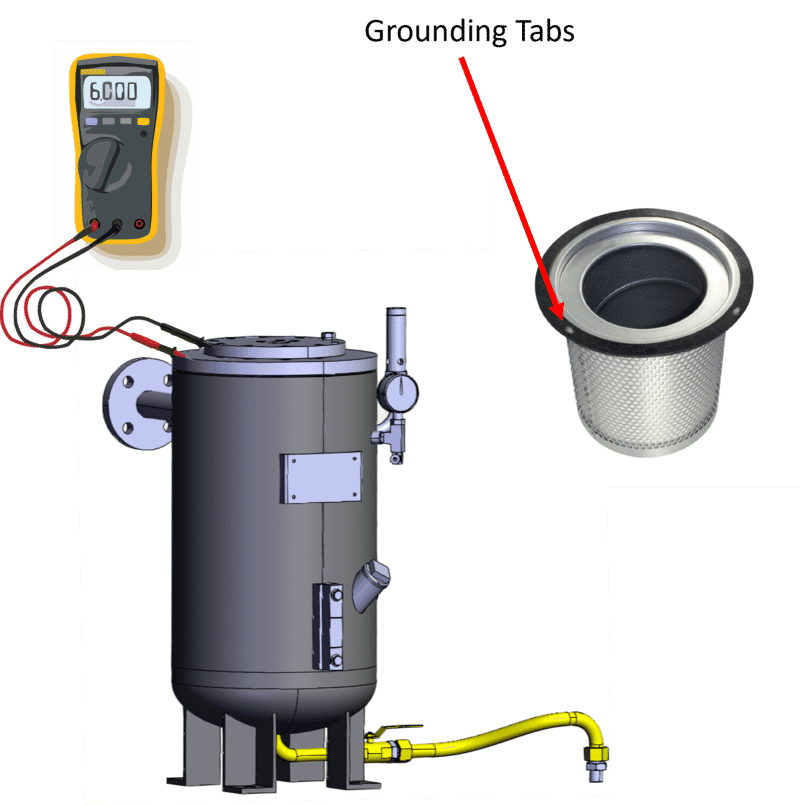
Kaishan designs its rotary screw air compressors so that the air-oil separator seats perfectly into the compressor, providing the required continuity and grounding.
Downstream Filters
You can install filters, of course, to remove any oil that does come through. The most common types include:
- Coalescing filters to remove oil aerosols
- Activated carbon filters for oil vapor, if you need that level of cleanliness
- Point-of-use filters for special applications or before your dryers (especially desiccant dryers)
You can get different grades of compressed air filters to match the requirements of your application, removing solid particles, liquid water, water and oil vapors, odorants and even bacteria and viruses. These distinctions are captured in the filter classes established by ISO 8573-1:2010, a standard the international body adopted in 2010. Filters are rated from 1 to 9, with lower numbers indicating higher levels of air purity. You’ll want to cascade filters—using coarser filters upstream to catch the larger particles that would prematurely clog a finer filter downstream.
The critical consideration for filters is maintenance, both for your compressor’s inlet air filter and any downstream filters you deploy. Clogged filters will impede and eventually block airflow, causing unnecessary and avoidable energy loss. So you’ll need to replace filter elements regularly.
How often? For the inlet air, it depends on the quality of the supply air and how many hours you operate your system. The standard Kaishan inlet air filter is a single-stage, dry element. On downstream filters, perform air filter maintenance when the maintenance gauge indicates a problem with the compressor running full load. Do it at least every 4,000 hours, or once a year, whichever comes first. Daily cleaning of the inlet air filter is common in dirty conditions. Follow your manufacturer’s recommendation for your specific model.
A better choice is to install differential pressure sensors on downstream air filters, which will detect any change in pressure between a filter’s supply and output. For example, a pressure drop would indicate the filter is becoming clogged and needs to be replaced.
Other Steps to Cut Compressed Air Oil Carryover
Other steps you can take to prevent air compressor oil carryover include:
- Clearing drains and return lines. Dirt and debris often accumulate in drains, causing them to become clogged. So, you’ll need to inspect the moisture trap and the drains in all your tanks, filters and dryers. You’ll want to remove any scale, rust, dirt or other solids from condensate traps and drain points daily. As mentioned, make sure that the oil scavenge line in your separator is not clogged.
- Check oil levels. Check your oil daily to ensure it is within the recommended range.
- Keep discharge temperatures in range. Make sure your oil coolers are properly maintained and free of pinhole leaks. Your service provider should clean them regularly and verify that your thermostatic valve is operating properly.
For any persistent problems, you’ll want to have a skilled compressed air technician check them at least quarterly to ensure you have addressed the root causes.
That’s why it’s so important to work with a qualified air compressor expert. The consequences to your operation can be significant.
Separating Yourself from the Pack
While some aspects of oil carryover, like maintaining filters, oil levels and drains, are fairly straightforward, others may require expert help.
A trusted professional can help you resolve some of the thorny issues that can arise. And even assist you in attaining a level of compressed air efficiency and air compressor performance that not only improves your productivity but offers the opportunity to build competitive advantage.
Key Takeaways
- High levels of oil carryover can reduce air quality, increase maintenance costs and cause downtime, product spoilage and reduced equipment lifespan.
- The most common causes of oil carryover include problems with air-oil separators, incorrect oil levels and variations in temperature and pressure.
- Ways to reduce oil carryover include the use of downstream filters and the maintenance of air-oil separators, drains, oil levels and discharge temperatures and pressures.
Local Help with Compressed Air Oil Carryover
Preventing compressed air oil carryover is critical to the operation of your system and to the processes that rely on it. We work with a nationwide network of independent distributors, who can provide on-site help and consultation as needed, helping you maximize efficiency and minimize downtime.
These factory-trained air compression experts offer expert guidance, faster response times and personalized support tailored to your needs. They don’t just sell compressors, they ensure you get the right system, reliable service and quick access to parts when you need them most.
Find a compressed air professional near you. Or contact us directly.
Further Reading
“Everything You Need to Know About Air/Oil Separators.” provides a general introduction to this critical part of your air compressor.
“How to Maintain Your Air Compressor with Genuine Spare Parts.” More information on the benefits of using original OEM parts.
Frequently Asked Questions
Listen to the Podcast Version



The Invisible Menace: Understanding Oil Carryover
Welcome to the show everybody! I'm Jason Reed, here with Lisa Saunders. And Lisa, I want to start today on the shop floor with a number that is incredibly small but carries a massive punch. Three parts per million. Three ppm. That is less than three drops of oil in a massive, Olympic-sized swimming pool of compressed air. But if you cross that line in a system utilizing rotary screw air compressors, you are entering a world of absolute pain.Three parts per million. That is practically microscopic, Jason. But you are so right. If you are running an oil-flooded machine, which is the workhorse of most plants because they are incredibly cost-efficient and reliable, you have to remember why that oil is there in the first place. It is injected as a fine mist directly into the compression chamber to lubricate the rotors, seal the gaps, and absorb the heat generated by the physics of compression—you know, that whole Ideal Gas Law where reducing volume spikes the pressure and temperature. But once that air is compressed, that oil has to go somewhere, and if it sneaks past your defenses, it becomes what we call oil carryover.
And that's the thing. In general industrial applications—think material handling, packaging, pneumatic tools—that tiny mist of under three ppm is completely fine. It is a rounding error. But if you are in robotics, precision painting, electronics, healthcare, or food and beverage? Even a fraction of a single part per million is an absolute disaster. If a single drop of compressor oil ends up on a high-end automotive paint job, the paint craters. It's called fish-eyeing, and it ruins the entire run. If you are in those ultra-sensitive sectors, you really have to look at dedicated oil-free technologies, like two-stage oil-free rotary screws or oil-free centrifugal units.
Exactly. Because if you let oil carryover get out of hand in those environments, or even in a standard shop, it is a silent killer. It's not just about spoiling the end product. That oil vapor travels down the line and starts coating everything. It degrades the seals in your downstream pneumatic actuators, gums up your control valves, and prematurely clogs your desiccant dryers. And when those downstream filters get clogged with oil, your system pressure drops, which forces your compressor to work twice as hard to maintain the target pressure. You are literally burning electricity and destroying equipment because of a microscopic leak.
The Sump and the Staples: Prevention, Troubleshooting, and the Danger of Cheap Parts
So let's talk about the defense system, because this is where the rubber meets the road. Your primary line of defense is the air-oil separator. When the compressed air and oil mixture leaves the screw, it enters the separator tank. It hits a swirling, centrifugal motion that knocks the heavy liquid oil out of the air stream so it drains to the bottom. Then, the remaining air passes through a specialized mesh filter element to trap the absolute finest mist. But here is the critical part that people miss: the scavenge line. If that tiny scavenge line or its orifice gets clogged with dirt or varnish, the oil that's filtered out can't drain back into the system. It just pools at the bottom of the separator element until the rushing air picks it up and carries it downstream.A clogged scavenge line is probably the number one reason we see sudden, massive oil carryover. And honestly, troubleshooting this requires looking at the whole ecosystem. It's a delicate balance. If your oil level is too high, the air stream just grabs the excess and overloads the separator. If your operating temperature is off—say, you're running too hot, over two hundred degrees Fahrenheit—the oil actually vaporizes, and no mechanical separator on earth can stop vapor. If you run too cold, below one hundred and eighty, water condenses in the oil, which ruins its viscosity and causes foaming, which also bypasses the separator. You have to keep that machine right in that sweet spot between one hundred and eighty and two hundred degrees.
And let's talk about pressure, too. If your system pressure drops too low, the velocity of the air moving through the separator increases dramatically. The separator relies on a specific flow speed and pressure differential to do its job. If you drag the pressure down, the high-velocity air literally tears the oil right through the mesh. But Lisa, there is a massive safety hazard here that we need to address, and it involves cheap, knock-off, non-OEM separator elements. This is something that scares the hell out of me.
Oh, the grounding issue. This is terrifying, Jason. People look at a replacement separator online and think, hey, it's just a metal canister with some mesh, why should I pay for the OEM brand? But what they don't realize is how static electricity works. As dry compressed air flows at high speeds through that separator mesh, it builds up a massive static charge. OEM manufacturers design their separators with built-in conductivity and grounding tabs to ensure that charge safely dissipates to the compressor frame. Some cheap knock-offs or pirated parts actually use a standard metal staple at the top gasket to try and create contact.
A staple! A literal office staple. And if that staple doesn't seat perfectly against the metal lid of the sump tank, or if there is any dirt or non-conductive gasket material in the way, you lose grounding. You now have a massive static charge building up inside a pressurized tank filled with a hot, atomized oil mist. All it takes is one tiny static spark inside that sump, and the entire tank can catch fire or literally explode. We are talking about catastrophic equipment failure, severe injuries, or worse. Saving fifty bucks on a non-OEM separator is putting your entire team's lives at risk. It is never, ever worth it.
It is an absolute nightmare scenario. That is why following the manufacturer's guidelines and using genuine parts with proper grounding continuity is non-negotiable. To keep things running safely and efficiently, you need a strict maintenance discipline. For example, replacing a spin-on separator every four thousand hours, or standard drop-in types every eight thousand hours or annually. And don't wait for the high differential pressure alarm to go off. If your separator pressure drop exceeds ten PSI, you are already wasting significant energy.
And do your daily walks! Check the oil level gauges daily to ensure they are in the recommended operating range. Inspect your automatic condensate drains and moisture traps every single day to clear out rust, scale, and debris. If those drains clog, water backs up into the filters, ruins the filter media, and you guessed it, pushes oil right downstream. You can also install differential pressure sensors on your downstream coalescing filters so you know exactly when they are clogging up, rather than guessing.
Exactly. Keep your intake air clean, too, because if your compressor is sucking in ambient oil mist or diesel exhaust from a nearby loading dock, your downstream filters are going to clog instantly. Maintaining a compressed air system isn't just about fixing things when they break; it's about disciplined prevention. Working with factory-trained technicians and local experts who actually understand these flow dynamics makes all the difference in the world. It keeps your air clean, your energy bills low, and your shop floor safe.
Well said, Lisa. That is all the time we have for this quick take. Keep your filters clean, check those scavenge lines, and for the love of engineering, stay away from cheap separators with staples. We'll see you next time on The Big Dog Podcast.
Stay safe out there, everyone.