

Choosing the right industrial compressed air service provider is more than just a purchasing decision—it’s a strategic investment in your facility’s success.
If you’re a maintenance manager or plant manager who needs to select a compressed air service provider, you may wonder where to start.
The answer lies in asking tough, specific questions about their capabilities, their approach and their track record. Their answers will reveal which provider is truly equipped to support your operation.
Here are the ten questions you’ll want to consider when you start discussions with a prospective compressed air service provider.
Question 1: Can You Service All of the Equipment Brands We Have In-House?
Some industrial compressed air service providers are tied to specific manufacturers through dealer agreements.
If your existing equipment is from a different brand than the one your prospective service provider is affiliated with, you’ll want to know that they can support it. And especially if they can get the original equipment manufacturer (OEM) parts you probably need to maintain eligibility for an extended warranty. If they can’t, you’ll have multiple maintenance contracts to manage, which could be a nightmare, especially if there’s a conflict in the system.
So, while working with an industrial air compressor service provider owned or closely affiliated with an OEM may meet eligibility requirements for an extended warranty, it may lock you into one manufacturer’s ecosystem. And an expensive service contract. An independent provider isn’t biased toward recommending equipment from their preferred manufacturer when optimization or upgrades are discussed.
Question 2: Where Are Your Technicians Based and What’s Your Emergency Response Time?
When your compressed air system fails, distance matters. If they’re more than two hours away or their response time is vague, that’s a significant concern. Especially if a compressor shutdown will cause downtime, which may lead to missed deadlines. And workers being sent home or standing around with nothing to do.
Proximity directly impacts emergency response. Closer providers respond faster, which means less downtime for your operation. They’re more likely to maintain a local inventory of common parts because they serve nearby facilities. And because they’re invested in your local community, they have reputations to protect.
Question 3: How Long Has Your Company Been in Business?
You’re building a relationship that should last years. Hopefully, decades. A company that’s been in business for a while has proven it can weather industry cycles and maintain customer relationships through all kinds of economic conditions.
Ask about their regional presence. How many facilities like yours do they serve in your area? Have they grown or contracted over the past five years? These details paint a picture of whether they’re a stable, thriving business.
Question 4: What’s Your Succession Plan?
A well-managed service company has identified successors for key leadership roles. They’re developing the next generation of technicians. A company without clear succession planning could face disruption—and you could be caught in the middle.
Ask directly: “Who will lead this company in five or ten years? How are you developing future leaders?”
Question 5: What Do Other Customers Say About Your Service?
References are your window into how this industrial air compressor service provider actually operates in the real world. Ask for specific references from facilities similar to yours. Reach out to colleagues at other facilities in your area for honest assessments.
When you contact references, ask:
- “How responsive is this provider when you call with problems?”
- “Have they helped you identify efficiency improvements?”
- “Do they charge what they quoted, or are there surprise fees?”
- “Would you continue working with them?”
And check out social media, such as Google reviews, Yelp or Reddit.
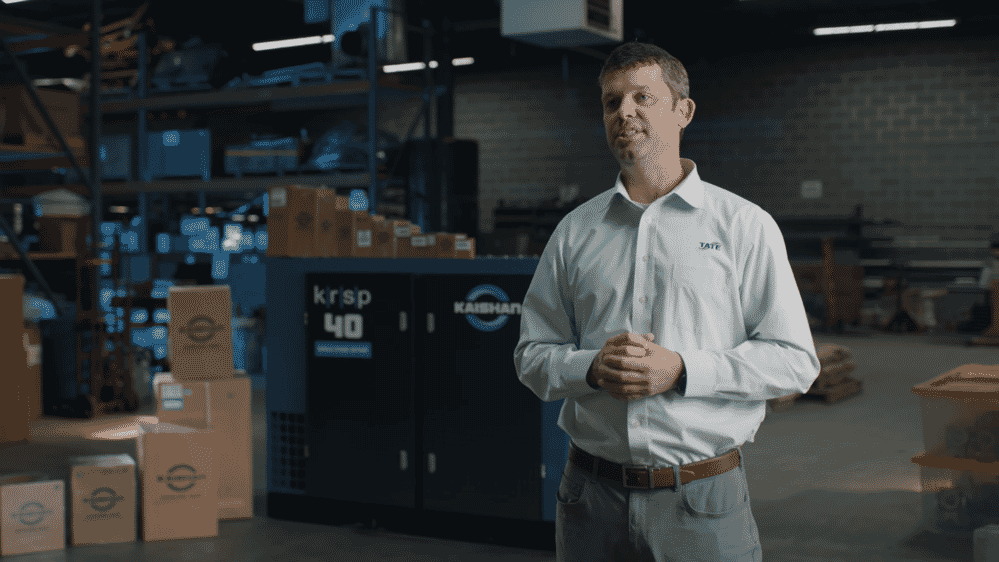
To hear just how good a compressed air service provider can be, visit our case studies page.
Question 6: What Certifications Do Your Technicians Hold?
Not all technicians are created equal. The skill level and certifications of the people working on your equipment directly impact the quality of service you receive.
Ask: “What certifications do your technicians hold?” Look for credentials from recognized industry organizations. And ask how many years of experience the techs have. You don’t want a rookie servicing your system.
Also, ask about training practices. How often do technicians receive continuing education? A company that invests heavily in technician development will deliver better results.
And ask about specific qualifications relevant to your business. Most likely, their people are comfortable with rotary screw compressors. But if you have a reciprocating or centrifugal air compressor, those may require specialized skills. So, make sure they have highly qualified techs who can handle your specific compressor type.
Question 7: What Parts Do You Stock Locally?
Your compressor fails, and your service provider arrives to diagnose the problem. But then they tell you they need to order parts. Now you’re likely waiting days while your production sits idle.
Ask directly: “What parts do you stock at your local facility?” A quality service provider maintains an inventory of common replacement items. Also ask about parts sourcing when inventory doesn’t cover it: “When you don’t have something in stock, how quickly can you source it?”
Ask about parts quality: “Do you use OEM parts or aftermarket alternatives?” OEM parts cost more but guarantee compatibility. Aftermarket parts cost less but may not perform as well as originals.
Availability of parts is one area where our local independent distributors outperform the factory-owned outlets. Our competitors, trained for decades to stay lean, keep inventories low. So, they may not have the part you need in their facility. Of course, they’ll offer to ship it from their warehouse and tell you to call when it arrives. Then they’ll come out and install it. That’s good for them financially. For you? Not so much.
Our nationwide network of independent distributors will help you identify the correct parts to repair or service your machine and install it as quickly as possible. They have shelves stocked with equipment and parts. And can deliver and install our products in your plant in days. Maybe even hours.
And, to back them up, we stock every part that could keep your Kaishan compressor down, including major components, in Loxley, AL. So, even if a distributor doesn’t have the part readily available, we do. Immediately.
During times like the COVID era, when it was hardest to obtain parts, how did your distributor perform? How did your OEMs support you? How long did it take to recover from the supply chain issues?
Question 8: What Are Your Emergency Response Capabilities?
Different facilities have different service needs. Your operation might run 9 to 5 on weekdays, or you might run around the clock.
Ask: “What are your standard business hours? Do you offer 24/7 emergency support? If so, what does that actually mean?” True emergency support means someone can physically respond at any time, not just answer a phone call.
Get specific commitments in writing. What’s their documented response time for emergency calls? Also ask about backup plans: “If your primary technician for our area is unavailable, who responds?”
Also ask about modern capabilities: “Do you offer remote monitoring of compressed air systems?” Remote monitoring enables predictive maintenance—identifying problems before they cause failures.
Question 9: Can You Provide Detailed Pricing with No Hidden Fees?
A good service provider will help you understand exactly what you’re paying for.
Ask for a detailed proposal that breaks down all costs. Ask about every potential charge:
- Do they charge for after-hours service?
- Do they charge for travel time?
- Is there a diagnostic fee separate from service calls?
- How are parts marked up?
- Do emergency calls include surcharges?
- Do they require that you sign a service contract?
- Beyond compressors, what other equipment can they support or maintain?
Get all of this in writing. A contract should clearly spell out every fee. And find out how the warranty process works: Will they get you up and running or demand payment and paperwork first?

Work with the provider to negotiate terms that work for your operation. Also discuss price escalation: “How often can you increase rates? Is there a cap on annual increases?”
Question 10: What’s Your Safety Record?
Your service provider’s technicians will be working in your facility, often around your employees. Their safety practices matter.
Ask directly: “What’s your recordable incident rate? Have any technicians been injured on customer sites in the past three years?” A company with a strong safety culture will proudly share its record.
Ask about their safety training and protocols: “How do technicians learn proper lockout/tagout procedures? Are technicians trained on our facility’s specific safety protocols before beginning work?”
Ask about insurance: “Do you carry adequate liability insurance? Can you provide a certificate of insurance?”
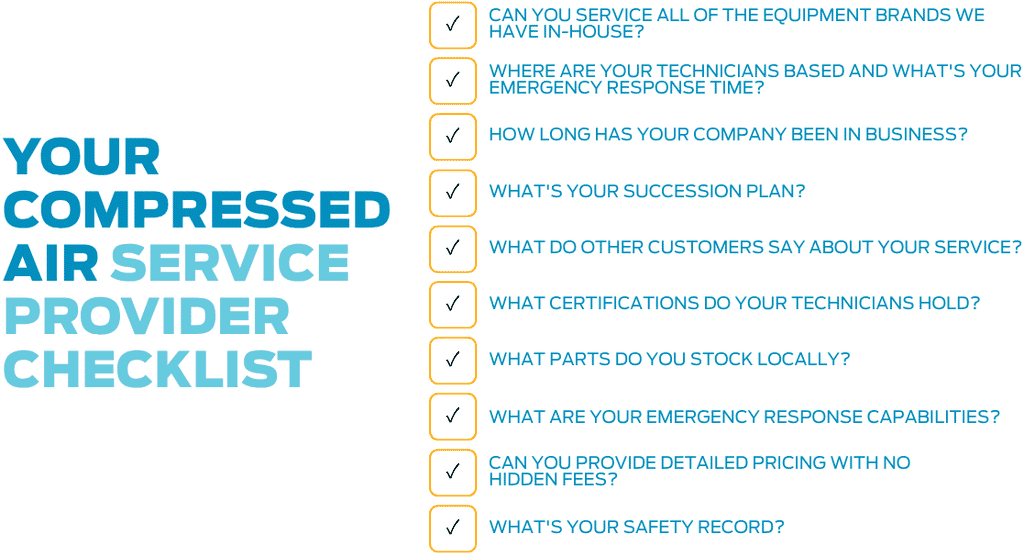
Bonus Question: Can You Conduct a System Audit?
A good service provider isn’t just reactive. They should help you identify ways to improve efficiency, reduce costs and optimize your compressed air system. When they recommend upgrades or changes, ask: “Will you justify the investment with data? Can you show us the expected ROI and actual savings?” A good provider backs up recommendations with calculations and payback periods.
Many service providers will suggest that you begin your relationship with an audit. A real audit involves measuring actual system performance, identifying leaks, analyzing operating pressures and highlighting inefficiencies. If you want to take a smaller first step, ask for a leak audit.
To hear actual customers talking about the benefits of compressed air audits, download our white paper, “How an Air Compressor Audit Can Help You Build Competitive Advantage.”
Key Takeaways
When you’re considering a new service provider, make sure to address the following 10 issues:
- Ask about their independence. Ensure they can service all your brands, not just preferred manufacturers.
- Verify proximity and response time. Confirm they’re close enough to respond quickly to emergencies.
- Investigate stability and succession planning. Look for companies with solid track records and clear leadership plans.
- Confirm technical expertise. Request details on technician certifications and ongoing training.
- Check references thoroughly. Talk to other customers about their real experiences.
- Understand parts availability. Ask about local inventory and stocking of OEM parts.
- Clarify service levels. Get specific commitments on emergency response capabilities.
- Demand transparent pricing. Require detailed proposals with no hidden fees.
- Verify safety practices. Ensure they maintain strong safety records and proper insurance.
- Assess commitment to optimization. Look for providers who offer audits and help improve efficiency.
We Rely on Independent Distributors
We work with a nationwide network of independent distributors, who can provide on-site help and consultation as needed. They can help you select new compressors, if needed, and optimize the performance of the equipment you already have.
They have a staff of factory-trained air compression experts who help maximize efficiency and minimize downtime. They offer expert guidance, faster response times and personalized support tailored to your needs.
We take pride in working with the top distributors in every region. Companies you’ll want to work with. Techs you’ll really want to do your service. People you’ll be happy to see in your facility.
We understand that most customers choose Kaishan compressors because their independent distributor recommends them. Our customers trust our distributors, and we respect that. They want to be our partners, and we do our best to treat them that way by engaging regularly with our distributors to make sure their teams have the most up-to-date training, service solutions and information on our products. They are an extension of our company, and we work hard to build a strong relationship with them.

That’s rare, and it’s why so many independent distributors have left the legacy brands and joined forces with us. They see the same customer focus in us that they try to practice in their own companies. So, they connect with our values. They love our culture.
We partner with these independent, local businesses because it’s the best way to serve you. They have skin in the game. Most of all, they are people with a can-do attitude. They get you back in service as soon as possible. They add value to customers every day. Those are the kinds of independent distributors we work with every day.

Best of all, you can customize the level of service they provide, working with them to develop a hybrid service arrangement that strikes a comfortable balance between their staff and your in-house resources. An agreement you can live with and afford.
Find a compressed air professional near you or contact us directly.
Further Reading
“Eight Dirty Little Secrets About Air Compressor Warranties.” More details on the things you need to watch for in service agreements and warranties.
“How an Air Compressor Audit Can Help You Build Competitive Advantage.” A white paper featuring actual customers talking about the benefits of compressed air audits.
Frequently Asked Questions
A qualified service provider will assess your situation and recommend a schedule tailored to your needs. The key is consistency—regular maintenance at appropriate intervals prevents the buildup of problems that lead to unexpected failures. Don't fall into the trap of thinking you can skip maintenance to save money in the short term. You'll almost certainly pay more when an unmaintained system fails during critical production time.
Your service provider should be willing to adjust the maintenance schedule based on actual system performance and wear patterns. If you're uncertain about the right frequency for your equipment, ask them to justify their recommendation based on manufacturer guidelines and industry best practices.
The financial difference is significant. Preventive maintenance costs more upfront but reduces the total cost of ownership by avoiding expensive emergency repairs and production downtime. Emergency-only service appears cheaper initially but costs far more over time when you factor in unplanned downtime, rush parts orders and premium after-hours service charges.
Smart maintenance managers view preventive contracts as insurance. You're paying a known cost to avoid unknown, larger costs. Most facilities find that the preventive approach delivers better value and more predictable budgeting.
Look for these indicators of genuine expertise:
- Certifications: Technicians should hold certifications from recognized industry organizations. Ask which certifications they maintain and verify them independently if needed.
- Specific equipment experience: They should have hands-on experience with your exact compressor model and system type. Ask for references from facilities with similar equipment.
- Detailed initial assessment: During your first interaction, do they ask intelligent questions about your operating conditions, production demands and facility layout? Knowledgeable providers dig deep to understand your situation rather than offering generic solutions.
- Technical depth in conversations: When you discuss your system, do they demonstrate genuine understanding, or do they rely on scripted talking points? Real expertise shows in the details.
- Willingness to educate: Good providers explain what they find during maintenance and teach your staff about your system. They're not gatekeeping knowledge—they're empowering your team.
- Industry involvement: Are they active in industry associations? Do they stay current with best practices? Providers who invest in their own education tend to deliver better service.
Don't hesitate to ask tough technical questions during the selection process. Their answers will tell you a lot about their actual expertise versus their sales pitch.
A comprehensive service level agreement should address:
- Scope of coverage: Exactly what's included in the contract? Which components, systems and services are covered?
- Maintenance schedule: How often will preventive maintenance occur? What specific tasks will be performed at each visit?
- Emergency response times: How quickly will they respond to emergency calls? What's their commitment for after-hours and weekend service? Is there a 24/7 hotline?
- Parts and labor: Are parts included, or are they charged separately? How are markups applied? What's the labor rate for emergency calls versus scheduled maintenance?
- Performance metrics: What uptime guarantees or response-time commitments do they provide? How will performance be measured and reviewed?
- Pricing and terms: Total monthly or annual cost, payment terms, what triggers price increases and how disputes are resolved.
- Communication and reporting: How often will you receive service reports? Who's your primary contact? How are issues escalated?
- Term and termination: How long is the contract? What notice is required to end it? What happens if either party isn't satisfied?
- Equipment inventory and diagnostics: Do they maintain certain parts locally? What diagnostic tools do they use?
A clear SLA protects both you and your service provider by eliminating ambiguity. It's the foundation of a professional relationship.
Pricing varies significantly based on several factors:
- Equipment type and size: Larger systems and more complex equipment cost more to service.
- Service frequency: Monthly preventive contracts cost more than quarterly visits, but spread costs more predictably.
- Geographic location: Service providers in areas with higher labor costs charge more than those in lower-cost regions.
- Provider reputation and expertise: Established providers with strong track records typically charge more than newer or less specialized competitors, but often deliver better value.
- Contract scope: 24/7 emergency support costs more than a business-hours-only service.
General pricing ranges (these are approximate and vary by region):
- Preventive maintenance contracts: $200–$600 monthly, depending on system size and service frequency
- Standard maintenance calls: $145-$250 per hour, plus travel and parts (often with a minimum call-out fee)
- Emergency hourly rates: one and a half times the hourly rate, plus travel and parts (often with a minimum call-out fee)
- System audits: Often free or $500-$2,000 for comprehensive analysis. For larger installations, fees can be as high as $15,000.
Rather than focusing solely on the lowest price, compare the total value proposition. A provider charging 20% more might be worth it if they include emergency support, maintain local parts inventory and have faster response times. Calculate your potential savings from improved efficiency and reduced downtime—this often far exceeds the service cost difference.
Get detailed proposals from multiple providers and compare them on a line-by-line basis. Make sure you're comparing equivalent services.
Be cautious if a provider:
- Doesn't ask detailed questions about your system: If they launch into their standard pitch without understanding your specific situation, they're not thinking about your needs.
- Can't explain their recommendations: If they suggest upgrades or changes but can't justify the expense with data and ROI calculations, they may be trying to sell rather than solve.
- Offers vague pricing: Contracts with undefined rates, lack of clarity about what's included or lots of potential additional charges are red flags. Transparency matters.
- Won't provide references: Any reputable provider should have satisfied customers willing to vouch for them. Unwillingness to provide references is suspicious.
- Focuses only on reactive repair: If they discourage preventive maintenance or don't emphasize the value of proactive service, they may be more interested in emergency call volume than your long-term success.
- Shows poor communication: If they're hard to reach, slow to respond or vague about timelines during the sales process, expect those same issues as a customer.
- Can't discuss energy efficiency: A modern service provider understands that efficiency directly impacts your costs and should be able to discuss optimization strategies.
- Seems desperate for your business: While it's nice to be wanted, providers offering unrealistic promises or pricing that seems too good to be true probably are.
Trust your instincts. If something feels off during the selection process, it's worth exploring further or moving on to another option.
Track these metrics to evaluate ongoing performance:
- System uptime: What percentage of time is your compressed air system operational and available for production? Track both planned maintenance downtime and unplanned failures.
- Response time to emergencies: When you call for emergency service, how long until a technician arrives? Compare actual performance against your SLA commitments.
- Maintenance schedule adherence: Is your provider performing scheduled maintenance on the agreed-upon schedule, or are appointments being missed or rescheduled?
- Energy consumption: Monitor your compressed air system's energy usage over time. Is it improving, stable or degrading? A good provider should help you trend toward improved efficiency.
- Maintenance cost trends: Track maintenance spending over time. You should see relatively stable costs with preventive contracts, not escalating emergency repair bills.
- System reliability: How many unexpected failures occur? Fewer unplanned downtime events indicate good preventive maintenance.
- Customer satisfaction: Are you getting responsive support when you contact them? Are technicians professional and knowledgeable? Is communication clear?
- Parts availability: When you need parts, how quickly does your provider have them available? Can they minimize wait times?
Schedule quarterly business reviews with your provider to discuss these metrics. If performance is slipping, address it directly. If they're delivering strong value, let them know you appreciate it—good relationships are two-way streets.
Listen to the Podcast Version



The question that saves you from a bad service contract
I still get a headache thinking about the time at the old automotive assembly plant when the main packaging line went completely dark because a, a three-dollar solenoid valve failed. It was just one tiny piece of hardware, but we didn't have it on the shelf, and it took six hours to get a tech on site. Six hours of paying guys to stand around and sweep the floor while we missed our shipment window. That's when it clicks that a compressor service contract isn't just a piece of paper you sign to satisfy corporate—it's either a real shield or a total illusion.Six hours? Oh, that's brutal, Jason. But, you know, the illusion is exactly what people buy into. They see a logo on a van, they sign the quarterly maintenance agreement, and they think, "Okay, we're covered." But then it's 2 a.m. on a Tuesday, your system loses pressure, and you find out the hard way that the nearest tech is actually three hours away in another district. It's a commodity mindset, right? People treat air service like buying copier paper. But when the air stops, the whole plant stops.
Exactly. And the very first filter you need to run—and it's so simple but people skip it—is asking, "Can you actually service every single brand we have in this building?" Because most plants aren't just one pure, sterile brand-new setup. They've got a- a Kaishan over here, an old legacy machine over there, maybe a different brand of dryer. It's a- it's a mixed bag.
Right, a complete jigsaw puzzle. And if you go with a service provider that's heavily tied to one specific original equipment manufacturer—an OEM—they might say they can service other brands, but can they actually get the OEM parts to keep your extended warranties valid? Or are they going to push you into managing three different maintenance contracts just to keep from violating some warranty clause? It becomes an absolute nightmare to manage.
Well, and there's a real conflict of interest there too, right? If the provider is owned by or exclusive to one manufacturer, they have zero incentive to optimize your mixed system. Every recommendation they make is going to lead back to their own ecosystem. It's like... um, like going to a doctor who only prescribes one brand of medicine because they own the pharmacy. You're getting locked into an expensive service contract and a very narrow line of equipment upgrades.
Mm, that's a great way to put it. So, if we had to distill this down for someone sitting in their office right now looking at a pile of service bids, the real question isn't just, "Hey, do you guys fix air compressors?" It's, "Can you keep my entire, messy, real-world system running efficiently without forcing me to play by one single manufacturer's rules?"
Yeah, that's the core of it. Are they there to serve your plant's actual configuration, or are they there to be a- a funnel for one brand's sales pipeline? If they can't show they can handle the whole floor, you're setting yourself up for finger-pointing the second a system-wide issue pop up.
What separates a real partner from a tech with a truck
Okay, so let's say they pass that first test. They can work on your machines. But now we get to the actual operational reality. What separates a real partner from just... you know, a guy with a set of wrenches and a pickup truck? For me, it starts with actual, physical distance and where those techs are sleeping at night. If their response time is some vague promise like, "Oh, we get there as fast as we can," but they're based two hours away... that's a massive red flag.Oh, "as fast as we can" is code for "you're at the bottom of the list if a bigger account calls." You need a documented, written commitment. But it's not just about the drive time. It's about what's in their local warehouse. I mean, if a distributor has been trained for decades by a corporate parent to keep their local inventory ultra-lean to save money, guess what? When your compressor goes down, they're going to diagnose it, tell you they have to order the part from some centralized hub halfway across the country, and leave you sitting idle for three days.
Exactly! Meanwhile, you're losing thousands of dollars an hour. Independent distributors—the ones who actually have skin in the game locally—they tend to keep their shelves stocked because their entire business relies on their local reputation. They can't hide behind a corporate shield. If they let down a plant manager down the road, everyone in the local industrial park hears about it.
Yep, reputations are local. And that actually brings up another big one: stability and succession. You're trying to build a relationship that's supposed to last ten, fifteen, twenty years. So, you have to ask the uncomfortable questions: How long have you been in business? What does your leadership succession plan look like? Who is going to be running this place in five years? If the founder is retiring next year and there's no plan, that technician expertise you're relying on could walk right out the door.
Wait, that's a really smart point. You're not just buying their current capability; you're buying their future stability. And speaking of expertise—this is a big one—you can't just assume every tech is qualified for every machine. A crew that spends ninety percent of their time on standard rotary screw compressors might look great on paper, but if you're running a reciprocating or a massive centrifugal machine, those require completely different, specialized skill sets. You have to ask for their actual certifications.
Oh, absolutely. You don't want a rookie learning how to service a centrifugal compressor on your dime. But let's talk about the money side of this, because I know some plant managers are going to look at the hourly rate and just go with the lowest number. But- but a cheap hourly rate is completely meaningless if they don't have the part on the truck and it takes them three visits to actually solve the problem. You're paying for the downtime, not just the repair invoice.
Well, sure, Jason, but on the flip side, a higher rate isn't automatically better either. If a provider is charging a premium, they have to prove it. They need to show you the local inventory, provide solid references from facilities just like yours, and show you exactly what's included in their pricing. No hidden travel fees, no surprise diagnostic surcharges. It's about transparency.
Right, right. No "gotchas" on the bill. So, if we translate all of this, the best service provider is the one who can show up fast, actually knows your specific machine inside and out, has the parts locally to fix it on the first visit, and has a stable business model that ensures they'll still be there to support you a decade from now.
Perfect. Couldn't have said it better myself. Alright, I think that's a solid place to wrap this up. Good chatting, Jason.
You too, Lisa. Talk next time.