
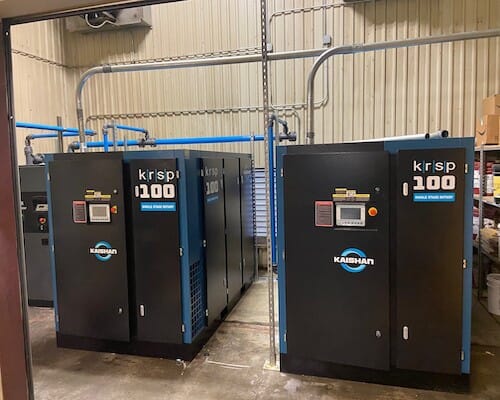
How you install a new air compressor could determine how well it performs, in the short and the long term. That’s why it pays to make sure your installation is done right.
A host of factors will determine the success of your installation. Is it sized correctly? Have you put it in the right place? Do you have a backup? Was the unit damaged during shipping?
An Ideal Installation
In a perfect world, your air compressor would be installed in a clean, dust-free, dry and oil-free area. The area would be relatively cool and properly ventilated. There would be good lighting and spacious enough to allow your maintenance people good access to the equipment. The compressor would rest on a concrete floor that is flat and level and can handle the weight of the unit.
Unfortunately, we don’t live in an ideal world. And we can’t always anticipate all the issues that might arise. So we’ll review those issues below and show you how a solid installation gets your new air compressor off to a good start.
Location
Indoor locations are preferable. But, in more moderate climates, like the southeastern and southwestern states of the U.S., it’s certainly possible to locate an air compressor outside, protecting it from the following conditions:
- The elements. You’ll want to ensure your compressor isn’t exposed to rain, snow and UV light.
- Temperature extremes. Avoid ambient temperatures above 122°F maximum or below 32°F minimum, taking into account any temperature rise from indirect or direct sunlight. Low ambient temperature package upgrades are available.
- Prevailing winds. Shield the machine from prevailing winds, which typically blow west to east in much of the U.S.
- Direct sunlight. Place your compressor out of direct sunlight, especially the morning or afternoon sun, to avoid damage to the compressor’s HMI and additional machine heating.
- Poor ventilation. Make sure the roof isn’t so low that it would trap the hot exhaust air and keep it recirculating after it’s discharged from your compressor. Ventilation hoods are available to redirect the cooler discharge air flow and ensure that the exhaust air does not recirculate.

If your air compressor is equipped with a variable speed drive, you’ll want to take special care to protect it from the elements.
Plus, you’ll want to allow enough space around the compressor to enable your maintenance teams to access it with a forklift.
Floor
The floor should be flat and level concrete that can handle the static weight of the unit. Most rotary screw compressors do not require special foundations, nor will you need to anchor it down. However, pistons, centrifugals and some rotary screws do require special foundations.
The compressor’s base should rest on a level surface that can support the gross dead weight of the machine. If the floor surface is uneven or irregular, install it on a 5- to 15-mm pad made of rubber or other pliable material.
Compressor Room Design
The ideal situation for an air compressor is in a room of its own, placed in a dry, well-lit, cool and dust-free area. Locating the unit centrally, as closely as possible to the tools it’s intended to service, reduces the amount of piping required. It also eliminates many leaks and pressure drops that sometimes occur in long piping runs.
Because an air compressor runs hot, it should not be in the same room as any device, like a boiler, that also generates heat. The room should have a maximum ambient temperature of 122°F.
Clearances
To allow adequate spacing for operation and maintenance, you should place your compressor at least three feet away from walls or other equipment. Refer to your machine’s installation manual for manufacturer’s recommendations.
You can place more than one compressor in the room, but you’ll want to make sure one compressor is not blowing exhaust air onto another.

Ventilation
The combination of air compressors and dryers generates a lot of heat. Compressors alone produce 17,522 BTU/hour for every 1 HP. And don’t forget to include compressed air dryers in your calculations of ventilation requirements.
Because air compressors generate so much heat, ventilation is one of the most critical considerations for the operation and longevity of your compressed air equipment. The goal is to remove all that heat generated during compression and keep it from recirculating back into the room.
You can use several possible configurations to move air through your equipment room.
- Louvered vents. For smaller compressors, louvered inlets and outlets in your compressor room may provide enough airflow through your enclosure to remove the heat generated in the compressor. But it all depends on the ambient conditions. Consult a qualified heating and air conditioning professional in your area for sizing, design, and installation of ductwork.

- Forced ventilation. Compressors larger than 25 HP usually require forced ventilation, but every site is different. An exhaust fan pulls the air through the ductwork and blows it outside. Unfortunately, it’s not as simple as it looks, especially in small enclosures with low ceilings. If you add bends and curves to reach the outlet, you build up back pressure in the ducts—a 90° turn, for example, is like adding 30 feet of straight ductwork. So just adding a few zigs and zags creates a lot of resistance, resulting in heat building inside the compressor.

- Heat recovery. In northern climates, it’s possible to save significant amounts of energy by recovering the heat removed from the compressed air system in the winter. A damper directs the air toward an outside vent in the summer. In the winter, the air goes toward space heating or preheating other operations

Removing the excess heat does have an upside: all that energy can be converted for use in other parts of your enterprise, for space heating, preheating boiler water, water heating, or even process heating (like drying).
We’re talking about a substantial benefit. In most cases, at least 70% to 80% of the energy used to compress the air becomes waste heat. And Air Best Practices says 90% of that heat loss can be recovered, while Manufacturing.net places the figure as high as 96%.
Whatever configuration you adopt, be sure to follow your manufacturer’s requirements. And do not undersize your ductwork.
And, if you have more than one compressor in the area, you’ll want to add the ventilation requirements together to determine the total ventilation needed. So that two 100 HP compressors will require the same ventilation as one 200 HP compressor since the heat generated will be similar. An alternative is to give each compressor its own air intake.
For more on the subject, see our blog post, “Compressor Room Design.”
Sizing
It’s important to size your compressor correctly, considering both the flow (CFM) and the pressure (PSIG), as well as the applications you’ll need to service.
For example, paint spray tools must draw enough pressure to atomize paint for an even, consistent coat. And they need high-quality air.
Pneumatic devices, on the other hand, don’t need that much pressure, but they need more volume (CFM) to keep the pressure stable. For more on sizing, see our blog post, “How To Determine What Size Air Compressor You Need For Industrial Use.”

Cooling
Removing heat is extremely important for the reliability and longevity of your compressor. Excessive heat will break down the oil in the compressor and reduce the oil’s ability to protect the system’s moving parts.
We’ve seen all too many end users who carefully reviewed compressor specifications but forgot about cooling, to their detriment. That’s why we encourage all our customers to make cooling capabilities an integral part of the design and installation of any industrial air compressor system.
You can find out more about the importance of cooling in our blog post, “Air Compressor Cooling.”
Backup Compressors
Adding a backup to your compressed air system can help eliminate downtime, increase reliability, simplify maintenance, and improve equipment life.
We recommend a three-compressor system featuring base, trim, and backup units to help you deliver more consistent and reliable pressure (PSIG) and flow (CFM). With a backup unit in place, you don’t have to wait for weekends, holidays, or planned shutdowns to do routine maintenance.
Doing load sharing enables you to reduce the amount of wear on your compressors, prolonging their useful life.
For more on the subject, see our blog post, “Four Reasons Your Plant Needs a Backup Air Compressor.”
Safety
Require that everyone who operates your equipment has been properly trained in compressed air basics and operating procedures. And make sure everyone who uses your equipment has taken the safety training.
Plus, you’ll want to give your operators a checklist to follow when starting their machines, checking fluid levels, filters and air connections. And make sure end-use tools don’t have their trigger pulled before you start up.
If you’d like to know more about operating your compressor safely, go to our blog post, “Eight Ways to Improve Air Compressor Safety.”
Delivery
You’ll want to inspect your compressor carefully for freight damage. Make sure to unwrap and thoroughly check it before taking delivery.
Refuse it if there is significant damage. And even for minor damage, you’ll want to describe fully on the bill of lading and take pictures and video for a freight claim.
Electrical Service
Before installing the compressor, ensure that your electrical service voltage matches the voltage on the compressor nameplate (located inside the electrical cabinet). If your compressor is a dual-voltage model, ensure it is internally wired for the proper voltage.
Most manufacturers recommend that each compressor have a dedicated electrical circuit and disconnect panel. Electrically operated air treatment equipment should be powered through a separate circuit.
You’ll want to install an appropriately sized fused disconnect or circuit breaker between the compressor and main electric service and ensure all equipment is properly grounded.
Local Help with Installation
Kaishan USA works with a nationwide network of independent distributors, who can provide on-site help and consultation as needed. These factory-trained air compression experts have an investment in their local communities and can service your air compressor system without a problem. And they have staff members who are skilled in using leak-detection technology on a daily basis.
Key Takeaways
- The ideal setup. In a perfect world, your air compressor is installed in a clean, dust-free, dry and oil-free area.
- Outside. Air compressors can be installed outside, but they must be protected from the elements.
- Sizing. It’s important to size your compressor correctly, considering both the flow (CFM) and the pressure (PSIG), as well as the applications you’ll need to service.
- Enclosures. The ideal situation for an air compressor is an enclosure of its own, placed in a dry, well-lit, cool and dust-free compressor room.
- Cooling. We encourage all our customers to make cooling capabilities an integral part of the design and installation of any industrial air compressor system.
- Backups. Adding a backup to your compressed air system can help eliminate downtime, increase reliability, simplify maintenance and improve equipment life.
Let Us Help
Installing a new rotary screw air compressor is critical to the performance of your compressed air system and all the processes that rely on that system. If you need help with compressor installation, get in touch with the experts at Kaishan. Contact us today.