

The similarities between stock car racing and compressed air performance are hard to miss:
- Pre-race planning? Check!
- Steady, not just fast? Check!
- Buckling in for the long run? Check!
- Great backing, driver and pit crew? Check, check and check!
The point is, we expect a lot of the stock cars that race almost every weekend around the country. They go hundreds of miles in a few hours, traveling at breakneck speeds. The pressure is on! It’s not your average Sunday drive.
And while air compressor operators don’t need the nerves of steel that race car drivers possess, they do have pressures of their own to deal with:
- Are end uses getting the air they need?
- Does it meet quality standards?
- Will the top brass be angry about the electricity bill?
They don’t have a simple drive around the block, either.
So, like a stock car race, operating a compressed air system requires a focus on performance. Air compressor performance, after all, is one of the key elements of compressed air efficiency, a mindset that starts well before the green flag drops and the pace car pulls away.
Pre-Race Prep
Getting ready for a big race requires that a stock car team makes sure it has the right car and the resources it needs for race day.
Operating a compressed air system requires the same level of advanced planning and preparation, starting with choosing the right air compressor.
Choose the Right Compressor
Three main types of compressors are commonly used in industrial applications: reciprocating, centrifugal and rotary screw compressors. Each has its unique advantages.
Rotary screw compressors, however, are the best choice for most industrial applications, delivering more compressed air per horsepower. They are known for their dependability, long life and low cost of ownership.
The good news is that it’s now easier to compare compressor performance across brands. New standards help you compare the efficiency of air compressors, not only across different sizes and types but also among brands. They rate each compressor’s isentropic efficiency, which measures how effectively it converts electrical energy into compressed air.
You also have to decide what level of quality you need.
For High-Quality Air, Go Oil-Free
Many applications require high-quality air to prevent contamination, particularly in challenging compressed air applications such as food and beverage, and healthcare.
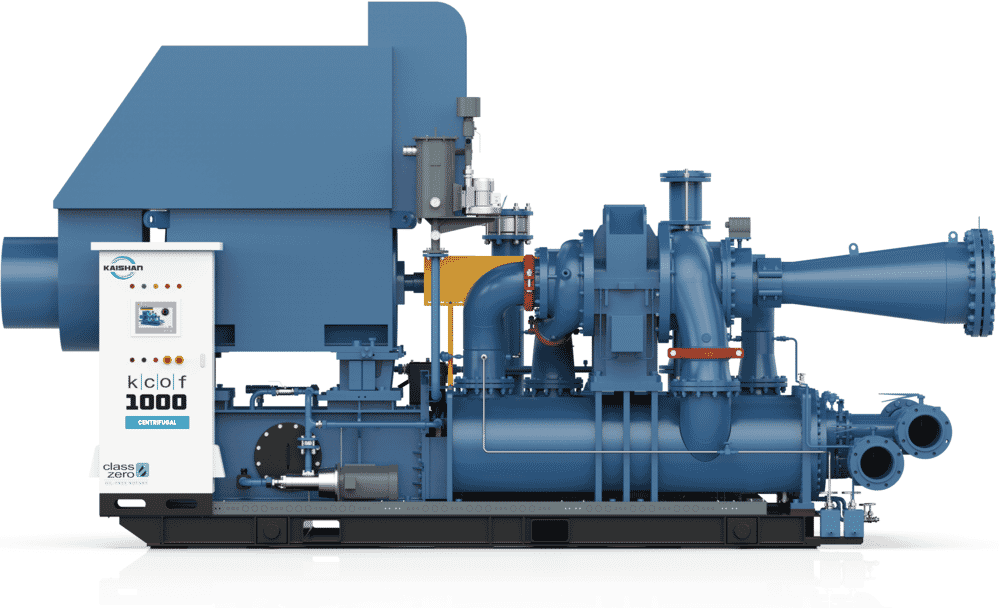
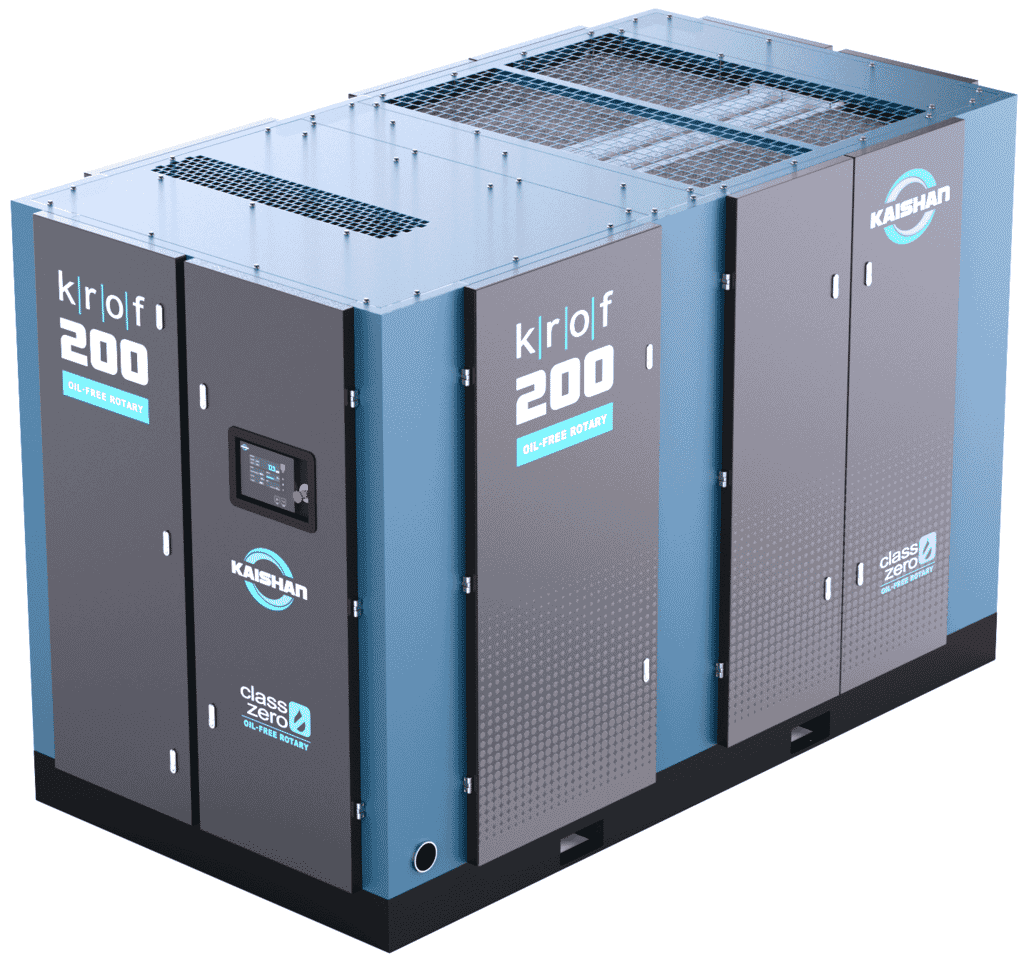
As a result, these industries turn to centrifugals, like Kaishan’s KCOF centrifugal air compressor, and oil-free rotary screw machines, like Kaishan’s KROF two-stage oil-free rotary screw air compressor.
For more on the pros and cons of different compressor types, read our blog post, “Which Type of Air Compressor Is Best for Your Application?“
Next, you have to size your compressor correctly.
Size It Correctly
Although we’re talking about performance, rotary screw air compressors should not be oversized. It may seem counterintuitive, but “too much” is almost as bad as “not enough.”
Here’s why: Experience has shown that the most serious air compressor problems stem from mistakes in sizing or application. Oversizing is the leading cause of rapid cycling, which causes maintenance nightmares, equipment failures and downtime.
For more information on properly sizing your compressor, see our blog post, “Everything You Need to Know About Sizing Industrial Air Compressors for Manufacturing.” download our white paper, “Demystifying Air Compressor Sizing” or connect with one of the members of our nationwide network of independent distributors.
Next, decide what controls approach is best for your application.
Choose The Right Controls
The control system plays a pivotal role in ensuring your air compressor runs successfully. Over the years, we’ve seen that a well-planned controls approach is critical to optimizing the operation of your compressed air system. Find out “Everything You Need to Know About Compressed Air Controls.”
Next, you have to be ready to adapt quickly to changing situations.
Build in Flexibility
Helping you turn down your compressor to meet varying demand, variable-speed and variable-frequency drives also save energy, reduce costs, qualify for rebates and avoid utility peak amp charges.
They deliver the greatest benefits when you have significant variation in demand. However, they are not recommended for capacities below 20% or above 80%. More on “The Benefits of Installing Variable-Speed Compressors.”
Most controls, including VSDs, require adequate storage. Like a racecar coming down the home stretch, you need to have a little extra in reserve.
Keep Something in the Tank!
Storage is integral to any compressed air system, balancing the supply of air with the system’s demand. As a result, air compressor tanks can help accommodate surges in demand, acting as reservoirs during peak times. A properly sized storage tank helps with optimizing compressed air performance, significantly improving energy efficiency, reducing the number of compressor starts and stops, conserving energy and extending the compressor’s life.
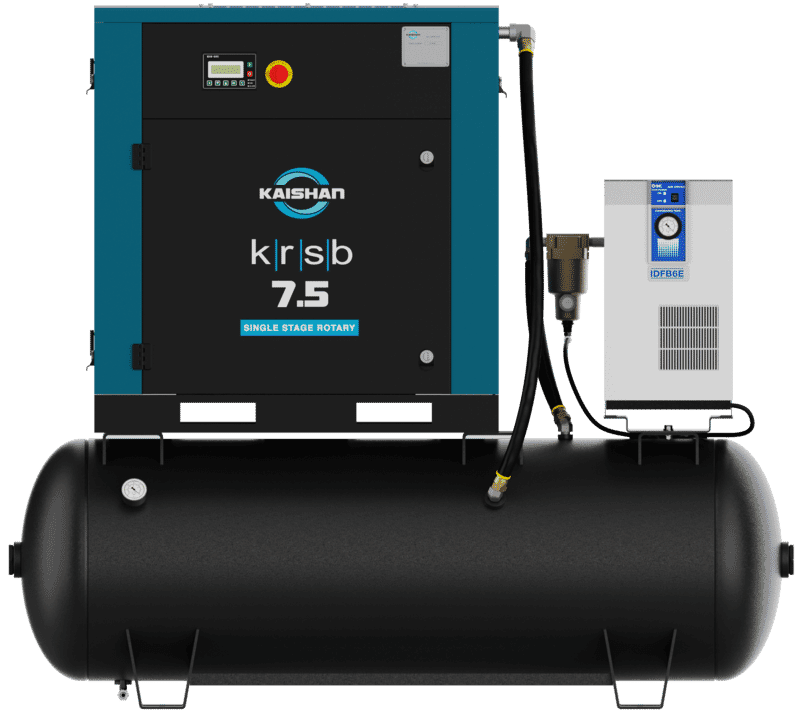
You can get a tank-mounted version of our KRSB belt-drive rotary screw air compressor with an integrated dryer as an option.
For more information on storage, see our blog post, “A Quick Guide to Accurately Size Air Compressor Tanks.”
Finally, you have to install your system properly.
Install Your System Properly
How you install a new air compressor could determine its short- and long-term performance. To help you get the job done right, we’ve compiled an “Air Compressor Installation Checklist—18 Things To Check Before, During and After Your Installation.”
Following those steps will get you ready for race day!
Drivers, Start Your Engines!
After the green flag drops, you’re off to the races. But you can’t slam the pedal to the metal right from the start. You have to pace yourself and your equipment. It’s all about reliability and efficiency.

The same is true of a compressed air system. Start by paying attention to system pressure.
Set Pressure as Low as Possible
A stable header pressure is critical in delivering the even flows of compressed air needed in many applications. It’s tricky: if you set your header pressure too high, you’ll waste energy and incur unnecessary cost. Too low, and your end users will complain.
Meanwhile, you’ll need to pay attention to your compressor band—the difference between load and unload pressures. If you set it to load at 115 PSIG and unload at 125 PSIG, that’s a 10 PSIG gap. Too much, in most cases.
Compressed Air Best Practices notes that you should reduce the pressure band as low as possible without affecting end-use applications. The same is true of the header pressure.
For a comprehensive discussion on setting your system pressure, visit our blog post, “How Lowering the Pressure Band of Your Compressed Air System Can Save You Money.”
You can’t win the race if you have wasted motion. So, another key issue is reducing overall compressed air demand.
Reduce Compressed Air Demand
A key part of operating a compressed system is eliminating artificial demand—anything that is not an authorized use. That includes air leaks, high header pressure problems and even workers blowing dust off their clothes at the end of a shift.
That’s why the most sophisticated compressed air systems take a hard line on artificial demand. For more details, read the blog post, “Eliminating Artificial Demand.”
Throughout the race, you’ll want to keep a close eye on the data.
Track Your Performance
For the same reasons a race team tracks their car’s key operating parameters, you’ll want to make good use of the data now available from your air compressor. Staying on top of this information can help you enhance efficiency and reliability, prevent downtime and lengthen equipment life. Not to mention, save money.
The good news is that there are several ways to monitor air compressor data. For a review of the latest air compressor monitoring techniques, see our blog post, “Air Compressor Monitoring Tools for a Smart Factory.”
Finally, you need to bring it all together by assembling a great team.
Build a Great Pit Crew!
In NASCAR, pit crews are an integral part of the team. That’s why they’re introduced right alongside their driver at the start of most races.

For good reason. They have 12 seconds to leap in mid-race and change tires, top off fuel levels and deal with any other issues that arise.
You and your people may have more time. But you might feel otherwise. If downtime in your plant is measured in millions of dollars per hour, as in some industries, the pressure may be just as intense.
Industry research has shown that a proactive maintenance strategy can reduce maintenance costs by up to 70%.
Plus, there are always leaks to fix. The Compressed Air & Gas Institute estimates that the average leak rate in U.S. manufacturing facilities is 30%. It also estimates that poorly designed and maintained compressed air systems waste up to $3.2 billion in utility payments in the U.S. annually. To get to the root causes, see our blog post, “Eight Causes of Compressed Air Leaks and How to Find Them.”
Properly maintaining your air compressor can yield many benefits, cutting downtime, reducing energy costs, extending equipment life and improving safety.
For our top 10 essential rotary screw air compressor maintenance tips, read our blog post, “What You Need to Know About Rotary Screw Compressor Maintenance.”
Get in the Winner’s Circle!
Just like a racing team wins or loses based on the efforts of its pit crew, your air compressor maintenance team will help you achieve broader objectives such as reliability, energy efficiency and cost efficiency.

But that’s a huge challenge today with dwindling headcounts and resources devoted to in-house maintenance.
That’s why Kaishan has put so much effort into establishing a close working relationship with a nationwide network of independent distributors.
They have a staff of factory-trained air compression experts who offer expert guidance, faster response times and personalized support tailored to your needs. They are the reliable backup and support you and your team need.
Depending on the skills of your in-house staff, you can customize the level of service they provide, working with them to develop a hybrid service arrangement that strikes a comfortable balance between their staff and yours. An agreement you can live with and afford.
And that’s not the only benefit. When you buy through the Kaishan dealer network, you’re getting more than a product—you’re getting a local partner who cares about your business and wants to see it succeed. Find out “The Top 25 Reasons anIndependent Air Compressor Distributor Enhances Compressed Air Performance.”
Key Takeaways
Performance is the name of the game in NASCAR. And in air compressors:
- Pre-race planning
- Choose the right compressor.
- Size it correctly.
- Choose the right controls.
- Build in flexibility.
- Keep a little in the tank!
- Install your system properly.
- Drivers, start your engines!
- Set pressure as low as possible.
- Reduce compressed air demand.
- Track your performance.
- Build a great pit crew!
- Get in the winner’s circle.
Local Pros Who Can Help
As mentioned, Kaishan USA works with a nationwide network of independent distributors, who can provide the on-site help and consultation you need to adjust to change.
Their factory-trained technicians have a deep understanding of industrial applications and help maximize efficiency and minimize downtime. They don’t just sell compressors—they build relationships, ensuring you get the right system, reliable service and quick access to parts when you need them most.
A pro you trust can make a huge difference in your long-term success. Find a compressed air professional near you. Or contact us directly.
Further Reading
“A Beginner’s Guide to Reading Rotary Screw Compressor Performance Curves.” How to compare the efficiency of air compressors, not only across different sizes and types but also among brands.
“How Well-Designed, Well-Managed Compressed Air Systems Avoid Downtime.” with unplanned downtime now costing the world’s largest manufacturers $1.4 trillion annually, downtime deserves our attention.
“How a Multi-Compressor System Can Help You Reduce Compressor Downtime.” We discuss the advantages of multiple compressor configurations in greater detail.
“The Top 25 Reasons anIndependent Air Compressor Distributor Enhances Compressed Air Performance.” Just a few reasons why you’ll benefit from a working relationship with a member of the Kaishan distributor network.
“Eliminating Artificial Demand.” The most sophisticated compressed air systems take a hard line on eliminating artificial demand—anything that is not an authorized use.
Frequently Asked Questions
Talk to your operators about their real-world usage patterns. If you're constantly running out of air during peak production or if your compressor is idling most of the time, you've got a sizing problem. A properly sized compressor should handle your peak demand without constantly maxing out, but also shouldn't be oversized for your actual needs. When in doubt, bring in a compressed air specialist to audit your system. It's money well spent.
A VSD also plays better with multiple compressors in a system. If you're trying to optimize energy efficiency and you have variable demand, a VSD should be your choice. If the budget is tight and your demand is predictable, load-unload might work temporarily, but plan for an upgrade.
Don't just crank up the pressure because you think more pressure equals better performance. It doesn't. In fact, excessive pressure can strain your equipment and shorten its lifespan. Pressure fluctuations are also a problem. Stable pressure means consistent equipment performance. This is where proper system design, appropriate compressor sizing and good maintenance of your header pressure all come together. When you optimize pressure, you optimize both efficiency and reliability.
Listen to the Podcast Version



The Race for Industrial Efficiency
[excited] Welcome to the show everybody! I'm Jason Reed, here with Lisa Saunders. And Lisa, picture this: you've got exactly TWELVE seconds. In those 12 seconds, you have to change four tires, top off a fuel tank, and fix a dented fender while a 3,400-pound stock car is SCREAMING in your ear. One slip, and you lose the race.[laughs] Twelve seconds. I take longer than that just trying to find my car keys. [sighs] The pressure of that is unbelievable.
[seriously] Right? But here's the thing -- if you're a plant manager whose assembly line goes down because of a blown airline, you might feel like you're under that exact same pressure. Because in some of these large manufacturing industries, [pauses for effect] downtime costs a MILLION dollars an hour.
Wait, a million dollars an hour? [pauses] [realizing] Okay, suddenly the NASCAR pit crew analogy makes total sense. If you're losing a million an hour, you can't afford a breakdown. Which means success isn't about how fast you drive -- it starts way before the green flag drops. It's all about pre-race prep.
Exactly. Pre-race prep. [enthusiastically] If you show up to Daytona with the wrong car, you're TOAST before you even start the engine. For a manufacturing plant, that means choosing the right machine from day one. And for most heavy industrial setups, you're looking at rotary screw air compressors. They just deliver the most compressed air per horsepower, and they're built for the long haul.
[wryly] But here's where a lot of plants completely mess up that prep. They think about sizing their compressor like buying a truck engine -- if a 50-horsepower is good, a 100-horsepower MUST be better, right? So they oversize it. But the data shows that oversizing is actually the leading cause of rapid cycling.
[groans] Rapid cycling. Yeah, that is a total maintenance nightmare on the shop floor. That's when the compressor just keeps loading and unloading CONSTANTLY because it makes air way faster than the plant can actually use it. [chuckles] It's like driving a Ferrari in bumper-to-bumper traffic -- you're just burning up the transmission and wasting fuel.
[helpfully] And if you want to avoid that, you need a VSD -- a variable-speed drive. A VSD continuously adjusts the compressor's speed to match exactly what the plant demands. If you have highly variable demand, a VSD can reduce your energy consumption by 20 to 40 percent.
[whistles] Twenty to 40 percent? If your compressed air system is eating up a third of your plant's electric bill, knocking 40 percent off that is a MASSIVE chunk of cash.
It's huge! [excited] Most plants see a payback on a VSD investment within two to three years just from the energy savings alone. But even if you know what kind of machine you want, how do you actually compare them? It used to be basically impossible to compare a 100-horsepower compressor from Brand A to Brand B. But now we have this standard called isentropic efficiency.
Isentropic efficiency. [chuckling] Man, that sounds like a term from an advanced thermodynamics textbook. [curious] What does that actually measure in the real world?
It's basically the dyno test for compressors. It measures exactly how effectively the machine converts electrical energy into compressed air. [matter-of-fact] It's a level playing field. So instead of guessing, you look at the isentropic efficiency rating, and you know exactly what you're getting, no matter what brand is painted on the side of the box.
Pacing for the Checkered Flag
[energetically] Alright, so you've done your prep, you've checked the isentropic efficiency, and you didn't oversize your rotary screw compressor. The green flag drops. Now it's about pacing. And the biggest mistake I see guys make on the shop floor is cranking the system pressure way too high just to be "safe."[warningly] Because they think more pressure equals better performance. But the math on that is BRUTAL, Jason. The rule of thumb is that every two PSI increase in system pressure drives up your energy consumption by roughly one percent.
Two PSI equals one percent. So... [calculating] if a maintenance guy cranks the header pressure up by 20 PSI just because somebody on the line complained about a sluggish pneumatic drill, they just hiked the entire plant's compressor energy bill by ten percent.
TEN PERCENT! [scoffs] Just from twisting a dial without thinking about the whole system. And it gets even worse when you look at your pressure band -- the gap between your load and unload pressures. If you set it to load at 115 PSIG and unload at 125 PSIG, that's a 10 PSIG gap. For most systems, that's just... [sighs] too wide. You're forcing the machine to overwork.
[serious] You have to keep that pressure band as tight and as low as possible without stalling out the end-use tools. But you know what really kills your pacing? [pauses] Artificial demand. That's the air you're paying to compress that isn't actually doing any authorized work.
[responds quickly] You mean leaks.
[shudders] Oh man, leaks. I have walked through manufacturing plants on a weekend when production is shut down, and [whispers] it sounds like a pit of angry snakes in there.
Well, get this number from the Compressed Air and Gas Institute: they estimate that the average leak rate in U.S. manufacturing facilities is 30 percent. [matter-of-fact] Thirty percent of the air they generate just hisses out of bad fittings and old hoses.
[disbelief] Thirty percent? You're telling me almost a THIRD of the power going into these systems is just evaporating?
[solemnly] Evaporating. And it adds up to an estimated 3.2 BILLION dollars wasted in utility payments every single year in the U.S.
Three point two billion dollars. [angry laugh] We are literally blowing billions into thin air. And that right there is why you need a pit crew. You can't just install a million-dollar system and forget about it until it breaks.
Exactly. [confidently] You need a proactive maintenance strategy. Industry research actually shows that shifting to proactive maintenance can reduce your overall maintenance costs by up to 70 percent.
Seventy percent is MASSIVE. [sighs] But let's be real -- most plants today are running on skeleton crews. Headcounts are dwindling. The in-house maintenance guys are putting out ten different fires a day on the production line. They simply do NOT have the time to walk around with an ultrasonic leak detector hunting down a hissing hose.
Which is exactly why you shouldn't try to do it all in-house. [firmly] You need to partner with an independent distributor. They have factory-trained experts who come in, do the air audit, find that 30 percent leak rate, and fix the rapid cycling issues. They become your external pit crew.
[concluding] And they keep you out of that million-dollar-an-hour downtime zone we talked about. Because when your compressor goes down, your whole line goes down.
[matter-of-fact] It takes a team to win. Get your pre-race prep right, pace your system pressure, fix your leaks, and you'll actually stay in the winner's circle.
[warmly] Couldn't have said it better myself. That's all the time we have for today. Thanks for tuning in to The Big Dog Podcast. Keep those pressures low and your efficiency high. We'll catch you next time.