
Buying and installing a compressor used to be easier. A compressor was a compressor. The initial cost was a major factor in air compressor cost savings. Which, in turn, was a major factor in air compressor efficiency in general.
Now it’s more complicated. We have oil-free and two-stage compressors. Variable-speed/variable frequency drives and controls. And a constantly changing industrial environment of regulations, energy costs and business pressures.
As a result, increasing compressed air cost efficiency is more challenging than ever. But not insurmountable with the right guidance. We’d like to suggest 10 steps to follow.
1. Focus on Total Cost of Ownership, Not Initial Cost
Everyone loves a bargain. Unfortunately, the lowest-priced products may not offer the lowest cost of ownership. Sometimes, a few hidden provisions can lurk in the details, making a seemingly irresistible deal a lot pricier. Things such as service contracts, parts cost, parts availability and warranty coverage.
We lay out some of those pitfalls in our blog post, “Six ‘Gotchas’ That Turn Low Sticker Prices into High Lifetime Costs.”
So, which type of compressor is right for you? That’s next.
2. Start with the Right Compressor
There are many kinds of air compressors. But most industrial facilities use one of three main types— centrifugal, reciprocating or rotary screw air compressors. To summarize quickly:
- Centrifugal air compressors are most cost-effective for high-volume applications (above 2,500 CFM).
- Reciprocating compressors are the best choice for low-volume applications (less than 20 CFM).
- Rotary screw compressors are the best for everything in between.
For more on the subject, read our blog post, “Which Type of Air Compressor Is Best for Your Application?”
Oil-Free vs. Oil-Flooded
Kaishan always recommends oil-free compressors for applications where regulations or contamination concerns require them. However, we make sure our customers recognize and are prepared for the tradeoffs of these machines. And we encourage them to explore the use of oil-lubricated compressors for applications not covered by the regulations, such as operating pneumatic tools and equipment.
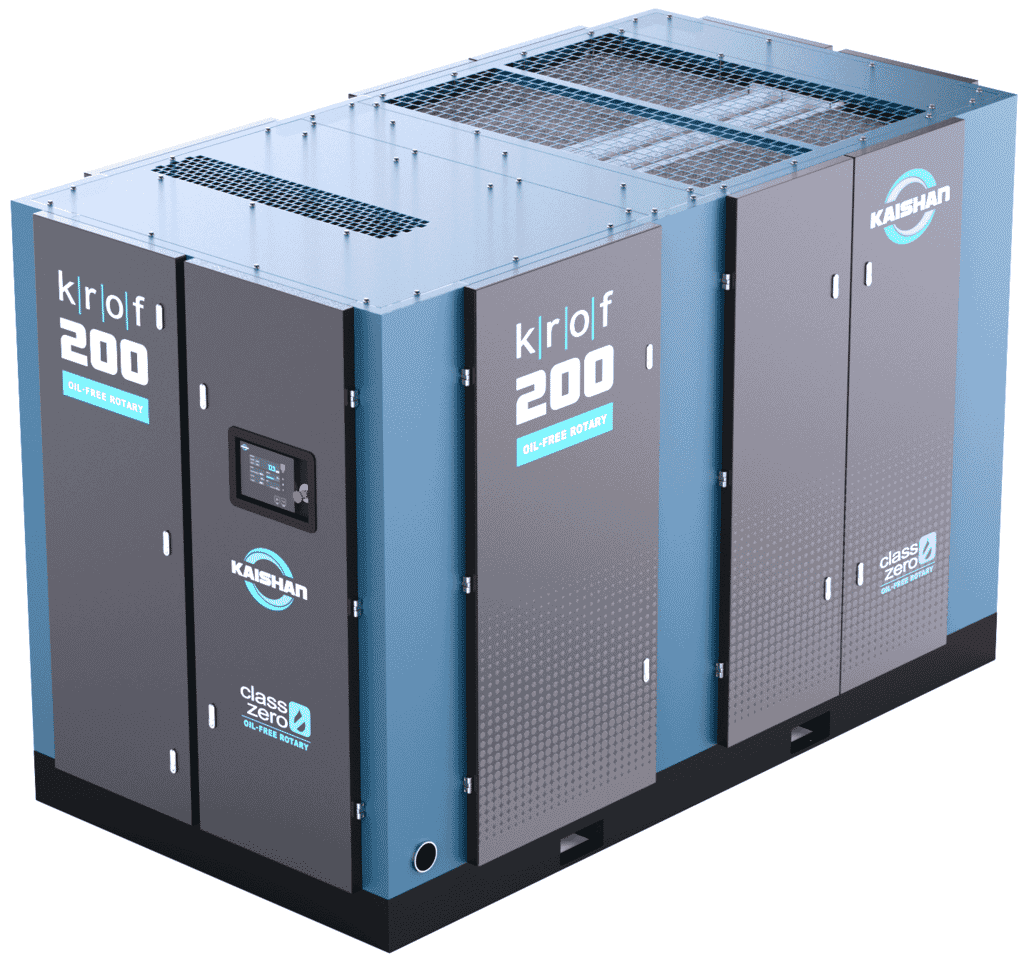
Kaishan’s KROF two-stage oil-free compressor is an excellent choice for providing compressed air that meets ISO 8573 Class 0 requirements.
U.S. Food and Drug Administration and international ISO 8573 standards recognize three types of contact with food or other products consumed by humans:
- Direct contact. In applications where compressed air comes into direct contact with the product or process, most companies use oil-free compressors.
- Indirect contact. Companies also turn to oil-free compressors where a barrier, usually a packaging material, separates the compressed air from the product.
- Incidental contact. Where contact with products is not expected, some companies save money by turning to oil-flooded rotary screw compressors equipped with advanced filtration and food-grade oil.
The decision to use oil-flooded compressors with advanced filtration and food-grade oil should not be made lightly, but preferably with the help of a compressed air professional.
Sizing
Sizing may be the most important decision you make when you’re buying a new air compressor.
The reason? Time and again, experience has shown that the most serious air compressor problems stem from mistakes in sizing or application.
With rotary screw air compressors, especially, that means oversizing, the leading cause of rapid cycling, which causes maintenance nightmares, equipment failures and downtime.
For more on correctly sizing your compressor, download our white paper, “Demystifying Air Compressor Sizing.”
Variable-Frequency and Variable-Speed Drives
The application of VFD/VSD technology to rotary screw air compressors has enabled many companies to save significant amounts of energy. And energy savings are not the only benefit. VFD/VSD compressors can earn rebates, allow soft starts and offer better control of your compressed air system. They are also an energy-efficient way to address rapid cycling.
But they are not for everyone. We encourage customers not to use a traditional induction-motor VFD/VSD compressor when the machine runs at 20% of its total capacity most of the time. Or more than 80%.
For more information on the pros and cons of VFD/VSDs, see our blog post, “When To Use a VSD on a Rotary Screw Air Compressor.”
3. Equip It Properly
Any compressor needs additional support, including filters, storage and piping, to deliver compressed air cost effectiveness.
Filtration
You can get different grades of inline compressed air filters to match the requirements of your application, removing solid particles, liquid water, water and oil vapors, odorants and even bacteria and viruses. These distinctions are captured in the filter classes established by ISO 8573-1:2010.
The critical consideration for filters is maintenance. Clogged filters will impede and eventually block airflow, causing energy loss that is both unnecessary and avoidable. So you’ll need to replace filter elements regularly.
Storage
Storage plays an integral role in any compressed air system. Air compressor tanks help balance the supply of air from the compressor with the demand from the system.
The Compressed Air & Gas Institute (CAGI) recommends up to 10 gallons per CFM. We recommend both wet and dry storage.
For more information on storage, see our blog post, “A Quick Guide to Accurately Size Air Compressor Tanks.”
Your Distribution System
Properly sized piping is a critical component of any compressed air distribution system. If piping is too small, your system will be inefficient and consume more energy. Pressure will drop, and your compressor will be overworked, causing additional wear and maintenance.
In addition, the layout of the compressed air piping in your plant can significantly impact your system’s operation. A faulty design will increase energy costs, equipment failures, production losses and maintenance.
For more on proper distribution, read our blog post, “Ultimate Guide to Rotary Screw Air Compressor System Design, Part One: 10 Important Questions To Get You Started.”
Heat Recovery
At least 70% to 80% of the energy used to compress the air becomes waste heat. And Compressed Air Best Practices says you can recover up to 90% of that heat loss.
In northern climates, especially, it’s possible to save significant amounts of money by recovering the heat removed from the compressed air system in the winter. It can also be used in process heating.
For more information on configuring your compressed air system to maximize heat recovery, see our blog post, “Compressor Room Design.”
4. Back It Up
Having a backup compressor in place reduces the risk of unplanned downtime and eliminates costs associated with emergency replacements, such as rush charges, expedited shipping and overtime. You’ll have fewer occasions where employees are standing around, getting paid to do nothing.
As a result, we often encourage customers to adopt a multi-compressor approach involving base, trim and backup units.
- A base load compressor to meet your system’s minimum compressed air load.
- A trim compressor tohandle fluctuations in demand above the base unit.
- A backup compressor on standby if a base or trim unit goes offline.
Configuring your compressed air system in this way virtually eliminates unplanned downtime, which, in the real world, is the biggest (and most avoidable) expense associated with it.
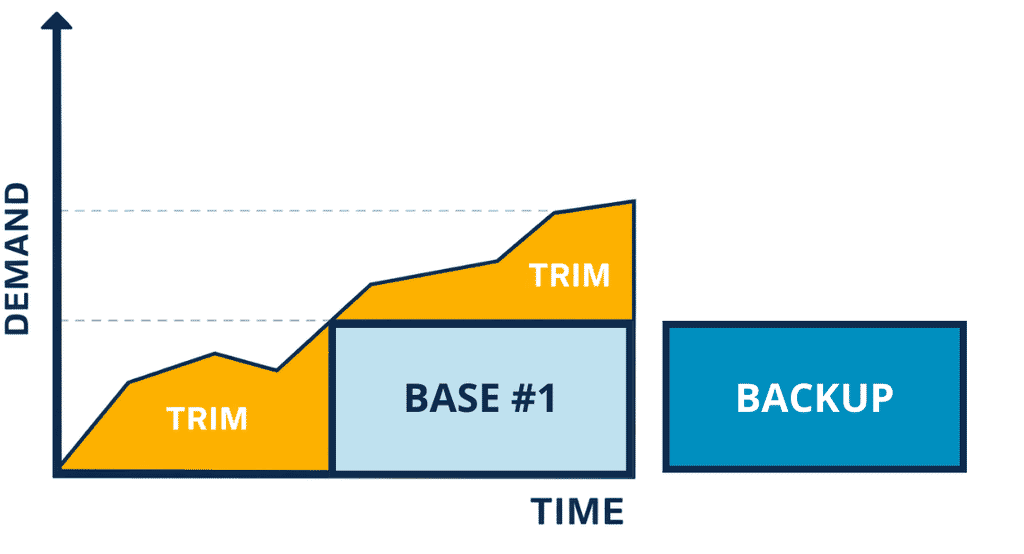
A multi-compressor system is the best way to ensure compressed air cost savings.
For more details on how a multi-compressor system can help you save electricity (and cost), conserve energy, avoid emergency services and extend equipment life, read our blog post, “How a Multi-Compressor System Can Help You Reduce Compressor Downtime.”
5. Maintain It
Good maintenance extendsthe life of your equipment, turning a short-term investment into an asset that pays dividends for decades. Plus, it can help you improve the operation and performance of your compressed air system, keeping costs under control, improving reliability and creating a safer environment for your team.
You can do all that and more with a comprehensive, well-planned maintenance program that includes preventive and predictive maintenance. Read the details in our blog post, “The Differences Between Air Compressor Preventive Maintenance and Predictive Maintenance. And Why You Should Care.”
Specific concerns include oil maintenance, leak repairs and artificial demand.
Oil
Oil is so central to your compressor’s operation that we consider rotary compressor oil the lifeblood of your system. As a result, it’s essential to maintain fluid levels, change filters, replace oil and submit oil samples regularly.
You’ll especially want to collect and analyze an oil sample, following your manufacturer’s recommendations. You’ll extend the lifespan of your compressor and maintain your warranty eligibility.
For more on the importance of oil in optimizing your compressor’s useful life, read our blog post, “Four Key Steps To Extend The Lifespan Of Your Rotary Screw Compressor With Proper Lubrication.”
Fix Leaks
Poorly designed and maintained compressed air systems waste up to $3.2 billion in utility payments in the U.S. annually, according to the Compressed Air & Gas Institute (CAGI).
We give you a detailed, leak-fighting game plan in our blog post, “Eight Causes of Compressed Air Leaks and How to Find Them.”
Eliminate Artificial Demand
A key part of operating a compressed system is eliminating anything that is not an authorized use, including air leaks, high header pressure problems and even workers blowing dust off their clothes at the end of a shift.
We encourage you to take a hard line on artificial demand. For more details, read the blog post, “Eliminating Artificial Demand.”
6. Use OEM Parts
Our compressors and parts have been engineered as an integrated system, with all the elements working together to optimize performance and productivity. Even the slightest variations could reduce life expectancy, reliability, energy consumption and air quality.
We strongly recommend that you use industrial air compressor parts from your original equipment manufacturer to maintain the integrity of your air compressor system and ensure it achieves the performance level you expect.
For more details on the value of using OEM parts, read our blog post, “How to Maintain Your Air Compressor with Genuine Spare Parts.”
7. Run It Properly
Achieving air compressor cost efficiency requires you to monitor how your compressor goes through its load and unload cycles.
Load vs. Run Hours
Load hours represent the time your air compressor is actively producing compressed air, while run hours include all the time the compressor is operational, whether under load or not.
If the load hours on your compressor are less than 50% of its run hours, it is idling too much. Excessive idling could indicate that your system is oversized for your needs, leading to inefficiencies. Water may condense out of the oil, increasing the risk of low oil pressure and bearing damage.
In addition, while you’re monitoring run hours, pay attention to your service intervals and ensure your maintenance is up to date.
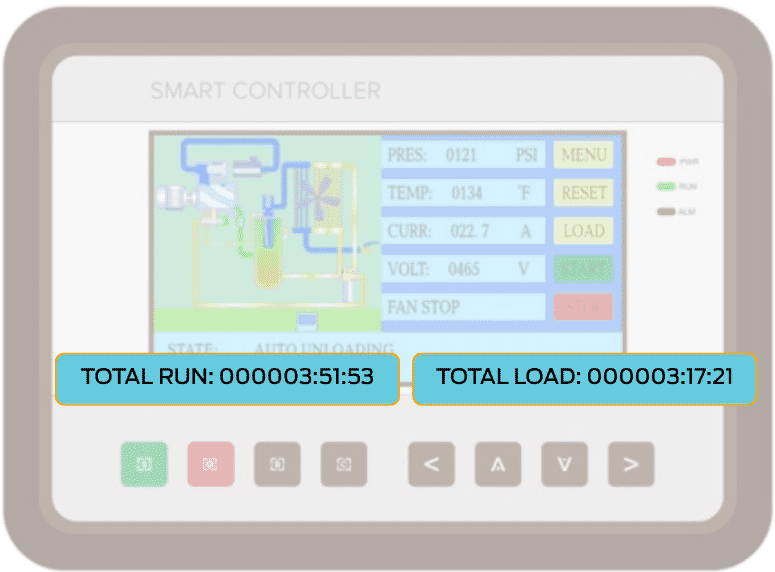
Load and run hours help you determine how efficiently your system is using your compressor. These totals appear at the bottom of the controller display screen on a Kaishan compressor.
Header Pressure
A stable header pressure is critical in delivering the even flows of compressed air needed in many applications. But if you set your header pressure too high, you’ll waste energy. And incur unnecessary cost.
Pressure Band
Your pressure band is the difference between load and unload hours. If you set your compressor to load at 115 PSIG and unload at 125 PSIG, the 10 PSIG gap between them is called the pressure band.
Compressed Air Best Practices notes that you should reduce the pressure band as low as possible without affecting end-use applications. The same is true of the header pressure.
Avoid Short Cycling
Compressor short cycling happens when you’re constantly turning your compressor on and off, loading and unloading.
All of that turning on and off can be devastating to your compressor, causing:
- Extra wear and tear on the motor, valves, bearings and other internal parts
- Overheating
- Carry-over of moisture and oil
- Wasted energy
- Additional maintenance
- A shorter lifespan
Compressors have completely burned out after only six months of compressor short cycling.
The main causes of compressor short cycling include:
- You don’t have enough storage.
- You’ve set your pressure band too tight.
- Your compressor is oversized.
- Some combination of the above.
To find out more about compressor short cycling, read our blog post, “My Compressor is Rapid Cycling. Now What?“
8. Pay Attention
You’ll want to check sound levels and vibrations, which can indicate leaks or other problems with your system.
Track the Data
Air compressor data can play an essential role in keeping your plant running smoothly and efficiently. It helps you monitor and control your compressed air system. And it can be absolutely invaluable to a service tech when a problem arises. And you can monitor it remotely.
Monitor It Remotely
Newer data monitoring systems give you 24/7 remote access to your air compressor data, tracking system performance and identifying readings that are out of spec. That’s an important step in fixing a problem before it starts.
Our most advanced connection is through our AirWatch system, which uses a wireless cellular modem to enable real-time monitoring of your air compressor data on any connected device, from a desktop to a cell phone.
For a complete list of the air compressor monitoring techniques available to you, see our blog post, “Air Compressor Monitoring Tools for a Smart Factory.”
9. Replace It When It’s Time
Deciding whether to repair or replace an existing air compressor is one of the toughest decisions a facility or plant manager must make. There are a host of issues to consider, including technical, financial and logistical concerns.
Unfortunately, there’s no quick answer or blanket statement we can give you about whether to repair or replace an existing compressor.
- If your compressor’s problem can be remedied with a quick fix, an air compressor repair is probably worth it.
- If your equipment is nearing the end of its rated service life and you’re looking at a costly repair, a replacement may make sense.
Manufacturers are constantly working to improve the efficiency of their products, so the older your air compressor, the more energy savings you will get from a replacement. And, if your equipment is not sized correctly for your application, a replacement is probably the best choice.
10. Find an Expert Partner
Probably the most important advice we can provide is to find a compressed air professional who can be a real partner in enhancing your goals to achieve compressed air cost efficiency. Someone you can trust.
We know that the right person or company will help you immensely. That’s why we work with a nationwide network of independent distributors.
We’re confident that our distributor partners are the top compressed air professionals in your region. So, naturally, you’re going to find many of them as you look for compressed air expertise. And we know that all of our distributor partners are worthy of your trust.
Most likely, they’ll suggest you start with an audit. It could save you time and money. Reduce or prevent downtime. Give you higher-quality air. Prolong the life of your equipment. Create a better environment for your team.
Time and again, we’ve found that audits pay for themselves. Our customer Berry Global, a $12 billion manufacturer of innovative packaging solutions, told Compressed Air Best Practices Magazine that it has conducted audits at 40% of its plants over the past three years. And some of these audits resulted in dramatic improvements in operational efficiency and cost savings, as documented in our story on the company, “Case Study: Kaishan Centralized Compressor Provides a Huge Savings.”
The Ten Steps to Air Compressor Cost Efficiency
1. Focus on TCO, not initial cost.
2. Start with the right compressor.
3. Equip it properly.
4. Back it up.
5. Maintain it.
6. Use OEM parts.
7. Run it properly.
8. Pay attention.
9. Replace it when it’s time.
10. Find an expert partner.
Your Local Compressed Air Cost Efficiency Expert
As mentioned, Kaishan USA works with a nationwide network of independent distributors, who can provide on-site help and consultation as needed. These factory-trained air compression experts can service your air compressor system without a problem. And they have staff skilled in advanced technology.
We partner with these independent, local businesses to ensure you get the right system, reliable service and quick access to parts when you need them most. Maximizing efficiency and minimizing downtime. They offer expert guidance, faster response times and personalized support tailored to your needs.
Find a compressed air professional near you. Or contact us directly.
Further Reading
“Six ‘Gotchas’ That Turn Low Sticker Prices into High Lifetime Costs.”
“Six Low-Cost Fixes for Compressed Air Optimization in Times of Economic Uncertainty.”
“How You Can Turn Your Compressed Air System into a High-Efficiency Profit Center.” Two-stage compressors, deploying a multi-compressor configuration and using our AirWatch system to monitor and control your system remotely.
“Seven Strategic Ways To Reduce Expenses From Compressed Air.” More tips on improving air compressor cost effectiveness.
Frequently Asked Questions
TCO = Purchase Price + Energy Costs + Maintenance + Repairs – Salvage Value
Break down energy costs by determining your compressor's power rating (in kW), annual operating hours and local electricity rates.
Regular maintenance significantly extends lifespan and efficiency:
- Change air filters every 1,000-1,500 operating hours
- Drain moisture from the tank daily (prevents corrosion)
- Check for air leaks (even small leaks waste 20-30% of energy)
- Replace worn components like gaskets and seals
- Inspect cooling fins to ensure proper heat dissipation
- Use the correct lubricant as specified by the manufacturer
Neglecting maintenance can increase operating costs by 15-25% annually.
| Feature | Reciprocating | Rotary Screw |
|---|---|---|
| Initial Cost | Lower | Higher |
| Energy Efficiency | Moderate (75-85%) | Higher (85-92%) |
| Maintenance | More frequent | Less frequent |
| Best For | Intermittent/low-volume use | Continuous/industrial use |
| Noise Level | Louder | Quieter |
For continuous operation, rotary screw compressors offer superior cost efficiency despite higher upfront costs.
Air leaks are "silent killers" of efficiency. A single ¼-inch hole at 100 PSI wastes approximately $26,000 per year in electricity costs (varies by location). Even tiny leaks compound across a system:
- 1/8-inch hole: ~$6,500/year
- ¼-inch hole: ~$26,000/year
- ½-inch hole: ~$104,000/year
Regular leak audits using ultrasonic detection tools can identify and repair leaks, often paying for themselves immediately.
Listen to the Podcast Version



The Cheap Compressor That Becomes the Expensive One
Welcome to the show -- Lisa, the cheapest compressor on the quote sheet is very often the most expensive machine in the building. Lisa Saunders [skeptical] And that is exactly the kind of line people hear and think, "Sure, okay, salesman math." So let's make it real. What turns a low bid into a bad deal? Jason Reed [matter-of-fact] Energy, first. In a lot of plants, 70% to 80% of what that compressor will cost you over its life is electricity. Not the PO. Not the delivery charge. The power bill. Then stack on service contracts, replacement parts, parts availability, warranty fine print, and the fun surprise where the bargain machine is down and nobody can get the right element or valve for three days. Lisa Saunders Wait -- 70% to 80% is the number that should stop people cold. Because if electricity is that big a slice, then shaving, what, a few thousand off the purchase price can be completely meaningless.That's it. Folks fight hard over sticker price and then ignore the next ten years. And the world made that mistake more expensive. Energy prices move. Regulations got tighter. Some applications need oil-free air, some don't. Service isn't as simple as calling the nearest guy with a truck anymore. So the question stopped being, "What's cheapest today?" and became, "What can I actually live with for the next decade?"
[curious] Let's stay on oil-free for a second, because this is where people get almost religious. If you're in food and beverage, for example, is oil-free always the answer?
Not automatically everywhere in the plant. If compressed air is in direct contact with product, yeah, most companies go oil-free. A lot do the same for indirect contact, where packaging is the barrier. But for incidental contact -- where air isn't expected to touch product -- some facilities use oil-flooded rotary screw machines with advanced filtration and food-grade oil. That can save money. But I wouldn't make that call casually. That's a sit-down-with-an-expert decision.
So this is already more nuanced than the usual "premium machine equals smart machine." Because sometimes the smarter move is oil-free, and sometimes paying for oil-free everywhere is just... overkill.
[matter-of-fact] Correct. Same with compressor type. If you're above 2,500 CFM, centrifugal often makes the most sense. Under 20 CFM, reciprocating is usually the fit. Between those? Rotary screw owns a lot of that middle ground. One machine is not "best." Best depends on demand, duty cycle, air quality, and how the plant actually runs.
And this is where people still get trapped by the lowest bid, right? Because the low bid might be the wrong TYPE before we even get into how it's installed.
Yep. Wrong type, wrong size, wrong controls. And sizing is the land mine. I mean, if I had to circle one mistake in red marker, it's oversizing. People think they're buying safety margin. What they're really buying, especially with rotary screw machines, is rapid cycling, maintenance headaches, failures, downtime -- all the ugly stuff.
[questioning tone] Okay, let me say that back. Bigger isn't safer if the machine spends its life loafing around, loading and unloading, never really running where it should. That's the trap?
Exactly. And since everybody loves VFDs right now, I'll add this: variable-speed drives can save serious energy and help with control, soft starts, even rebates. But they're not magic. If that compressor is living around 20% capacity most of the time -- or above 80% most of the time -- a traditional induction-motor VFD setup may not be your best answer. People hear "variable" and think "always better." Not always.
[laughs softly] There it is -- our first fight with a common assumption. Because "just buy the VFD" has become the compressed air version of "there's an app for that."
And it's just as wrong. Cost efficiency starts before startup. It starts with fit.
The Ten Moves That Actually Save Money
So if fit is step one, the money-saving part is really the whole system around it. Because I think this is where plants miss it -- they buy a compressor, not a compressed air system.[approving] That's the right frame. Compressor selection, proper sizing, filtration, storage, piping, heat recovery, backup, maintenance, OEM parts, monitoring -- that's where cost efficiency lives. Not in one heroic purchase.
Pick one that people neglect the most.
Storage. Easy. CAGI recommends up to 10 gallons per CFM, and I still see systems starved for storage. Wet storage, dry storage -- both matter. Not enough storage and now the machine reacts to every little demand blip. That feeds short cycling.
That "10 gallons per CFM" is one of those numbers maintenance teams should probably just keep on a sticky note somewhere.
Yep. And pair it with proper piping. Undersized piping creates pressure drop. Pressure drop means the compressor works harder, burns more energy, and you get extra wear for the privilege. Bad layout does the same thing on a bigger scale -- higher costs, more failures, production headaches.
I always think piping is like arteries. Too narrow, too twisted, too many bad turns, and the whole body pays for it. [short pause] Also filtration -- because people love clean air right up until it's time to replace filter elements.
[laughs] Exactly. Filters have to match the application. Particles, water, oil vapor, odor, even bacteria and viruses depending on the requirement. But clogged filters choke flow and waste energy. It's avoidable loss. Same story with maintenance in general. Good preventive and predictive maintenance extends equipment life, controls cost, improves reliability, safer environment -- all the boring stuff that becomes very exciting when it's ignored.
Let's get specific on "ignored." Oil, leaks, and artificial demand. Those are the three, right?
Those are big ones. On oil-lubricated machines, oil is the lifeblood. Maintain levels, change filters, replace oil, sample it on schedule. Skip that and you're gambling with bearings and warranty coverage. Then leaks -- CAGI says poorly designed and maintained compressed air systems waste up to $3.2 billion in utility payments annually in the U.S. That's not a rounding error. That's a flashing red light.
$3.2 billion. See, that's the number that sticks. Because leaks feel small. A hiss at a fitting doesn't sound like a budget problem. But across a plant, across a year -- there it is.
And then artificial demand. That's the sneaky one. High header pressure, unauthorized uses, operators blowing dust off clothes with compressed air -- all that nonsense. If the system makes air nobody should be using, you're paying to create waste.
[frustrated] I knew you were gonna bring up the clothes thing. Every plant has that one guy turning compressed air into a leaf blower and a laundry service.
Every plant. And while we're on pressure, header pressure and pressure band matter more than people think. Stable header pressure is good. Too high is expensive. If you load at 115 PSIG and unload at 125 PSIG, that 10 PSIG spread is your pressure band. You want it as tight as you can without hurting the end use. Too high a pressure or a bad band setting wastes energy. Too tight, without enough storage, and you can trigger short cycling.
So short cycling is really the machine telling you the system design is wrong. Not just the compressor being dramatic.
[deadpan] Compressors are dramatic, but yes. Not enough storage, oversized machine, pressure band set badly, or some mix of all three. And short cycling is brutal: extra wear on motors, valves, bearings, overheating, moisture and oil carry-over, more maintenance, shorter life. Machines have burned out in six months from it.
Six months. That's not "we lost a little efficiency." That's "we set money on fire."
Pretty much. That's why I watch load hours versus run hours. If load hours are less than 50% of run hours, the machine is idling too much. That's a clue -- maybe oversized, maybe poorly controlled, maybe system demand isn't what you thought it was. The controller is telling you a story if you'll read it.
And newer monitoring setups let you read that story from anywhere, right? Remote access, real-time data, stuff drifting out of spec before it becomes a shutdown.
Right. Sound, vibration, trends, alarms, remote monitoring -- 24/7 visibility matters. Data helps the service tech, too. You're not guessing blind. And backup planning matters just as much. Base unit, trim unit, backup unit. That multi-compressor approach cuts unplanned downtime, avoids emergency freight and overtime, keeps people from standing around waiting on air.
I also don't want to skip heat recovery, because this one surprises people. You're telling me 70% to 80% of the energy used to compress air becomes waste heat... and up to 90% of that can be recovered?
[emphatic] Yes. Especially in colder climates, that heat can offset building heat in winter or help with process heating. That's real money sitting in the compressor room pretending to be a problem.
And OEM parts? I know some people roll their eyes there.
I get it. But compressors are engineered as systems. Small variations in non-OEM parts can hit reliability, life expectancy, energy use, air quality. Sometimes the "cheaper" part is just another version of the same bad math we started with.
[reflective] Which brings us full circle. The expensive mistakes are usually not dramatic. They're ordinary. A little too much pressure. A little too much idling. A filter nobody changed. A leak nobody heard. A machine that's too big, bought because bigger felt safer.
And when the stakes are high, get an audit. A real one. Because compressed air efficiency is almost never about one bad box. It's about whether the whole system is telling the truth about what your plant actually needs. [short pause] That's the part I'd want to know before I signed anything.