
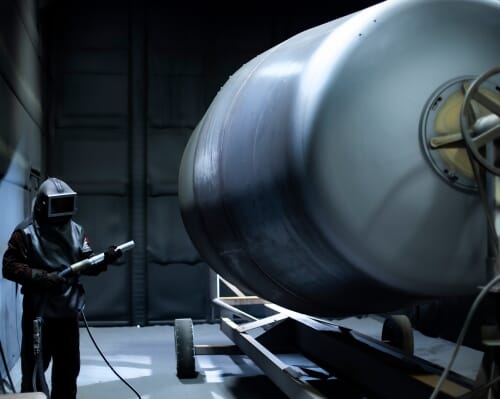
Sandblasting has been around for centuries. In the oil and gas industry, it’s used to clean and prepare surfaces of equipment and other facilities. Shipyards sandblast rust and corrosion off boats and marine equipment. Artists use it to etch glass, shape sculptures and create designs.

It blasts rust, paint and coatings off buildings. It removes paint, rust and other coatings from car parts. It prepares surfaces in the aerospace industry, and helps keep historical monuments and other structures free of paint, grime and other coatings.

It’s used in a variety of industries to clean and prep surfaces of machinery, electronic components and even consumer goods.
In short, sandblasting is almost universally accepted as a means of cleaning and preparing surfaces. It’s used everywhere and relied on for all kinds of critical cleaning and surface prep processes. And you will find sandblasting equipment in special cabinets where parts are prepared or deburred. Or in independent, free-standing units.

Unfortunately, however, in all too many plants, sandblasting is separated from the main operation because it’s too dusty, dirty and noisy. Thus, sandblasting is not controlled or monitored, “since it often ‘only uses compressed air’ and therefore [is] perceived to be ‘inexpensive to operate.’” That’s according to Don and Scott van Ormer, writing on the Air Best Practices site. Don van Ormer is a Senior Auditor at AirPowerUSA in Ohio and Scott van Ormer is a Compressed Air Master Industrial and Construction Sales executive located in Baltimore.
That means it’s often neglected, failing to get the attention it deserves.
Air Compressors for Sandblasting
Successful sandblasting requires a careful balancing of several different factors, including the abrasive material, the nozzle and the surface to be sandblasted. But most of all, it relies on a powerful and reliable air compressor. And rotary screw air compressors are usually the best option because of their efficiency, reliability and durability.
Sizing a compressor for sandblasting requires that you answer five questions:
- 1. How many booths?
- 2. How many people per booth?
- 3. What nozzle sizes do you use?
- 4. What’s the expected duration for each booth?
- 5. How many booths operate at once?

Using that information, you can determine the size of the compressors and the storage tanks you need to deliver a consistent flow of compressed air.
In the typical plant, sandblasting is just one of dozens of applications that use compressed air. But it is one of the most demanding. What complicates matters is that many plants only do sandblasting sporadically—a few hours per week or even per month. As a result, it is usually not cost-effective for plants to purchase a single air compressor to handle both the wildly fluctuating sandblasting needs and their regular compressed air applications.
We often recommend that our customers get a dedicated compressor to handle the intermittent sandblasting and a separate model—as low as 10 HP—to run their other compressed air applications. And they usually need a storage tank to help with the initial pressure drop when the sandblasting cranks up.
For example: if you need a flow of 500 CFM at 125 PSIG pressure for sandblasting and your plant needs 60 CFM of flow at 100 PSIG pressure for normal operations, we’d recommend two separate systems—a 125 HP compressor for the sandblasting area and a 15 HP compressor for the rest of the plant. That’s the best way to keep both systems efficient and reliable.
We recognize that most companies prefer to have a single compressor handling all their needs. But that’s not the most effective and efficient approach. A 100 HP compressor operating at a fraction of its capacity will be neither efficient nor reliable.
Once again, we highly recommend that sandblasting have its own dedicated compressed air system to keep energy cost down and reliability high.
And then there’s the issue of fuel source.
Fuel Source
Most companies want their sandblasting equipment to be mobile, especially when they’re doing outdoor projects. All too often, that means they’re using diesel compressors.
Plus, many companies use diesel compressors as critical backup for a compressed air system when their primary compressor goes down.
Unfortunately, a diesel compressor, though it gives you flexibility, is an expensive alternative to electrically-driven models. Diesel compressors have several important shortcomings:
- Maintenance. Portable diesel compressors require engine oil, oil filter, fluid filter and compressor oil filter maintenance or replacement every 250 hours. In a facility operating 24/7, that’s every 10 days. By contrast, electric compressors require minor maintenance every three months.
- Fuel efficiency. Electrical compressors cost much less to operate, delivering more compressed air per horsepower. And many of our customers are thrilled when they no longer need to haul in fuel oil to power their diesel compressors.
- Pollutants. A diesel compressor emits toxic carbon monoxide and other harmful emissions like nitrogen oxide and particulates.
- Air quality. The compressed air is of lower quality. It contains more moisture and oil, and the pressure level can fluctuate.
- Noise. Electric compressors are much quieter than diesel compressors.
- Better warranties. Manufacturers of electric compressors offer warranties, like Kaishan’s own lifetime airend warranty, that are significantly better than those provided by diesel compressor suppliers.
As a result, those portable diesel compressors are expensive to operate. Electric compressors can offer the same level of flexibility with significant energy savings. In fact, it’s been estimated that the savings in larger applications—those using 1,000 CFM or more—can be $100,000 or more a year.
If you have a diesel compressor, you can save time and money by choosing an electrically-powered compressor. We have created a calculator to help you determine how much you can save. Ask your Kaishan distributor or consultant for details.
Pressure and Flow
Another complicating factor is that operators think that when they are getting poor sandblasting results (low quality, low coverage), they need more pressure. In fact, they need more flow.
Admittedly, if the pressure gets too low, sandblasting doesn’t work. But we could give them a 500 PSIG compressor, and they still would not have the flow and the results they expect. Here’s why:
If the sandblasting is inconsistent, it’s usually because the nozzle is wearing out.
The same abrasive action that cleans a surface is working inside the nozzle. The more a nozzle is used, the more its opening gets larger and larger. It will release a lot more air and, as a result, pressure will drop. Your #6 nozzle goes to a #8, so you need an extra 100 CFM of flow to maintain the pressure.
Another example: if the nozzle orifice goes from a #7 to #8 size, it becomes one-sixteenth of an inch larger. To maintain the pressure, you need an extra 80 CFM of flow. That’s equivalent to a 20 HP air compressor.
It’s such a gradual process users don’t realize how quickly the nozzles wear out. That’s why we recommend that customers be proactive about nozzle replacement, swapping them out every two or three months.
The van Ormers cite numerous examples of operators bragging that their nozzle “works great,” meaning that they’ve used it for ten years. They recommend that no nozzle be run beyond 20% wear or increase in diameter of the opening.

Unfortunately, too many companies take a one-size-fits-all approach to sandblasting. To be successful, however, they should evaluate each job and select the proper nozzle and media (sand, aluminum oxide, steel shot or grit).
The good news? Mastering the basics will give you ample opportunity for savings. As the van Ormers point out, “Efficient operation and testing will identify and implement the proper blast media, nozzle size and alignment for each operation.”
And we would add that you should have a rotary screw air compressor and storage tanks sized appropriately for your operation.
Consulting Help
If you need assistance choosing the right compressor to power your sandblasting operation, Kaishan can help. We are fortunate to work with a nationwide network of independent distributors, who have the skills and experience to provide on-site help and consultation. These factory-trained air compression experts have an investment in their local communities and help you develop and operate an air compressor system that meets your needs.
Key Takeaways
- Widespread. Sandblasting is almost universally accepted as a means of cleaning and preparing surfaces.
- Not controlled. Frequently separated from the main operation, sandblasting is often not controlled or monitored.
- Efficiency. Electrically-powered rotary screw compressors are easier to maintain, deliver greater fuel efficiency, provide better air quality, are less noisy and have better warranties than diesel compressors.
- Opportunity. Intelligently managing sandblasting can result in significant savings and better performance for most companies.
Let Us Help
Pairing your sandblasting operation with the right air compressor system is critical to your success. The right compressor can save you time and money and ensure your compressed air system operates correctly. If you need help finding a qualified professional to evaluate your needs and find the best compressor for your operation, get in touch with the experts at Kaishan. Contact us today.