

Three contaminants define compressed air quality: solid particles, water and oil. Each type of compressor handles these three differently. Some produce inherently clean air. Others require downstream filtration to reach the necessary purity. And the difference between “oil-free” and “technically oil-free” is a distinction that matters more than most plant managers realize.
Three things are true no matter which type you are evaluating:
- Filtration. Downstream filtration can upgrade air quality, but it cannot change the fundamental design of the compressor.
- Class 0 Air. If your application requires ISO 8573-1 Class 0 air, the compressor type may matter more than the filtration package. Water content is a consideration in all classes of air quality.
- Incoming air quality. The quality of the incoming air is absolutely critical. Even with an oil-free compressor, the diesel exhaust, dirt particles and other pollutants you suck into your compressor come out the other end concentrated. More junk per cubic foot. Much more. And, no matter what compressor type, even an oil-free compressor, moisture is going to be an issue.
Let’s start with the standard that defines it all.
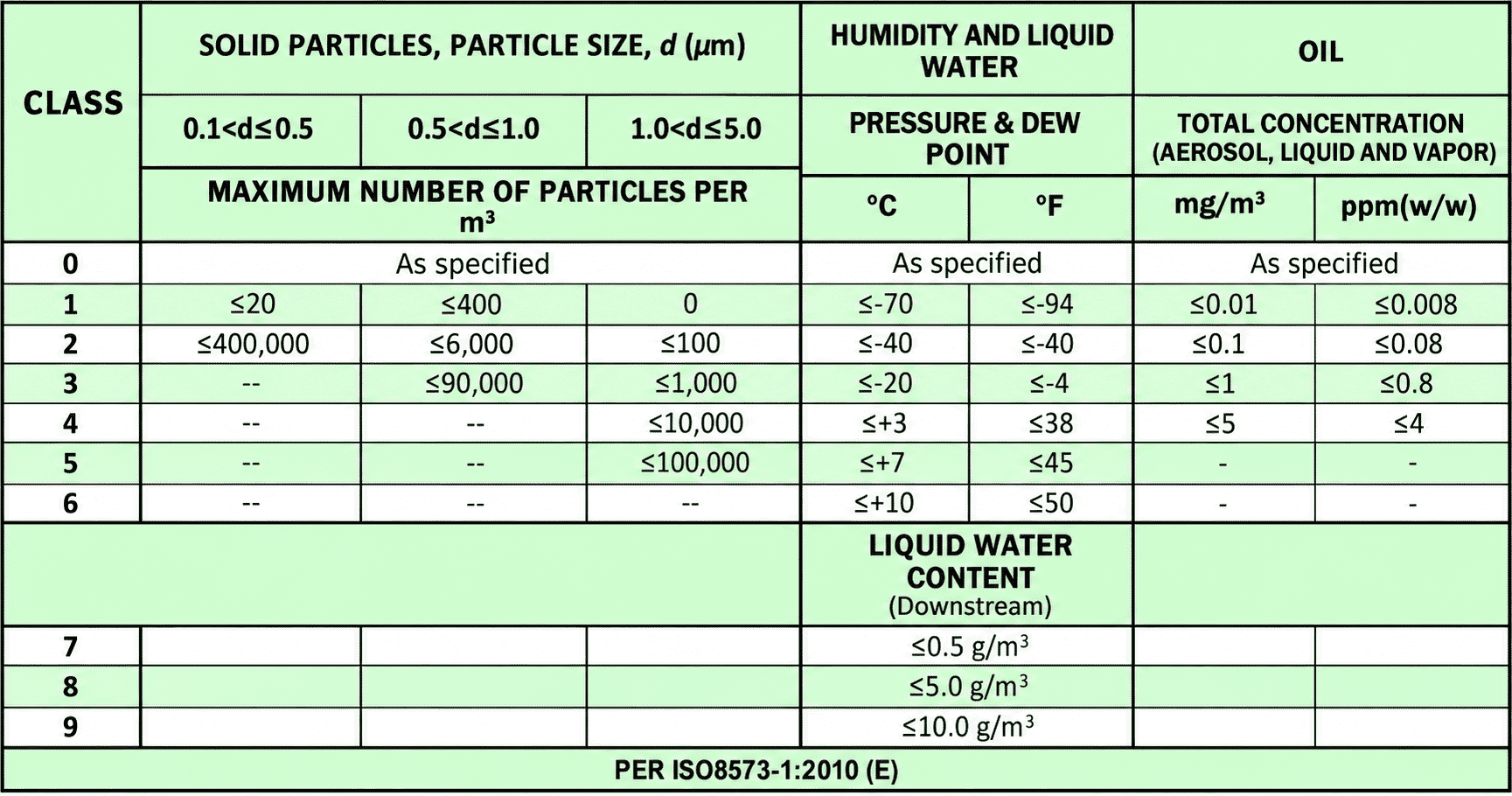
What “Air Quality” Actually Means in Compressed Air
ISO 8573-1:2010 is the international standard that classifies compressed air purity. It assigns class numbers from 0 (most stringent) to 9 (most relaxed) for each of three contaminant categories: solid particles, water and oil. A complete air quality specification looks like three numbers separated by dots—for example, ISO 8573-1 Class 1.2.1 means Class 1 for particles, Class 2 for water and Class 1 for oil.
CAGI’s Compressed Air Purity Guide groups industrial compressed air into three categories based on risk and application:
- Plant air is the most common, used for general tools and actuators.
- Instrument air is higher purity, used for sensitive control systems.
- Process air is the highest, used where compressed air comes into direct contact with the product—food and beverage, pharmaceuticals, electronics.
The contaminant that separates these categories most sharply is oil. And oil is where the compressor type matters most.
The Three Industrial Workhorses
Each of the three main compressor types delivers a different baseline air quality..
Reciprocating Compressors: Oil-Lubricated with Increasing Carryover
Most commercial-grade reciprocating compressors are oil-lubricated. The piston rings and cylinder walls require lubricant to operate, and some of that lubricant passes into the compressed air stream as oil carryover. The amount of carryover is modest when the machine is new but increases as the unit ages.
For a body shop or a small manufacturing plant running air tools, that carryover is manageable. A basic coalescing filter handles it. For anything requiring process air or ISO 8573-1 Class 1 or better, a worn reciprocating compressor is a liability. The air quality degrades as the machine ages.
In addition, the piston pumping back and forth creates a pulse of pressurized air on every stroke, then a brief lull. Not good for applications, such as painting, that require compressed air stability.
We should point out, however, that multi-stage, double-acting recips are available and can be an energy-efficient choice. But they are only appropriate in specialized applications. They also will deliver pulse after pulse into your header. A receiver tank dampens it but does not eliminate it.
Where they win: Adequate air quality for general plant air and intermittent-duty applications where oil carryover is tolerable.
Where they lose: Oil carryover increases as the machine wears. Not suitable for instrument air applications without extensive downstream treatment that becomes unreliable as the compressor ages.
Oil-Flooded Rotary Screw Compressors: Clean Enough for Most, Not for All
The oil-flooded rotary screw compressor is the most common industrial compressor in North America. It injects lubricant into the compression chamber to seal, cool and lubricate the rotors. Unfortunately, a tiny portion of that oil passes into the discharge air as carryover—typically a few parts per million in a well-maintained machine.
For most general manufacturing, that carryover is fine. A downstream coalescing filter removes the bulk of it. For applications that need ISO 8573-1 Class 1 oil purity (less than 0.01 mg/m³), an oil-flooded compressor can reach that level with multi-stage filtration, including an activated carbon filter for oil vapor. That configuration is called “technically oil-free.”
The distinction between “technically oil-free” and truly oil-free is critical. A technically oil-free system uses an oil-flooded compressor plus downstream filtration to achieve clean air. A truly oil-free compressor never introduces oil into the compression chamber in the first place (although, as mentioned, both types might have contamination from incoming air).
For general manufacturing, the difference is academic. But it is important in industries, such as food and beverage and healthcare, which have more stringent regulations about introducing contaminants into the air stream.
It’s all about managing the risk. If oil carry-over contamination occurs, what are the implications for your business?
- Would you lose an entire batch of products, as might happen in bakeries, food processing plants or semiconductor fabs?
- Would your plant face fines, closure or product recalls due to oil contamination in a food product?
- Would the presence of oil in your compressed air distribution system require a complete replacement?
For many plants in these types of applications, the savings don’t justify the risk. For more on managing these risks, download our white paper, “Oil-Free Air Compressor Buyers’ Guide: Cracking the Code on Class 0 Compressed Air.”
Where they win: Rotary screw machines produce a steady flow of air suitable for the majority of industrial applications. Can reach Class 1 with proper downstream filtration, but not recommended where true oil-free air is required.
Where they lose: They cannot reliably achieve Class 0. Filtration-based oil removal degrades over time and, unfortunately, filters are not often maintained properly. Not recommended for regulated processes where oil contamination is unacceptable.
Centrifugal Compressors: Inherently Oil-Free at Scale
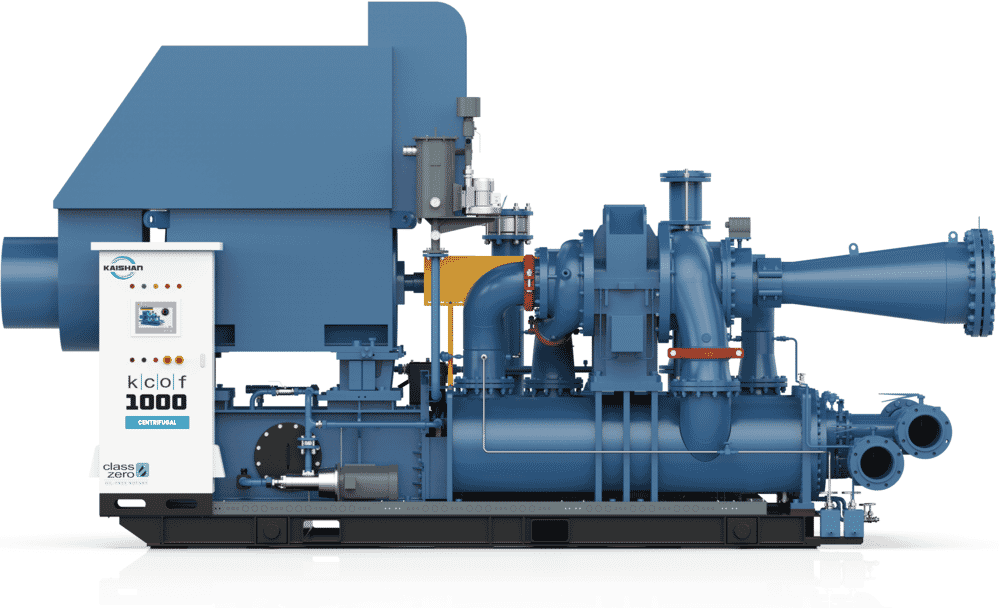
A centrifugal compressor delivers oil-free air by design. There is no oil in the compression chamber. The impeller accelerates air, the diffuser converts velocity to pressure, and the air that comes out never touches lubricant during compression. CAGI notes that centrifugal compressors deliver ISO 8573-1 Class 0 certified oil-free air.
For large facilities with large volumes and steady demand, the centrifugal is the cleanest option available. The air quality does not depend on filter condition or maintenance discipline. It is a function of the compressor’s design.
Centrifugals have limited turndown, typically 25% to 35%, controlled by inlet guide vanes. That makes them best suited for baseload applications rather than variable demand. But for air quality specifically, the centrifugal wins on purity without qualification.
Where they win: Inherently oil-free. Class 0 certified. No downstream oil filtration required. Air quality is stable regardless of filter condition.
Where they lose: Only cost-effective at larger scales (typically above 400 HP). Not suitable for smaller facilities or variable-demand applications.
Compressed Air Quality: Which Type of Compressor Wins?
| Type | Reciprocating (light-duty commercial model)* | Oil-Flooded Rotary Screw | Centrifugal |
|---|---|---|---|
| Universal Issues |
|
||
| Key Issues |
|
|
|
Two Variations Worth Knowing
Two additional compressor types come up frequently in air quality conversations: scroll compressors and oil-free rotary screw compressors.
Scroll Compressors: Typically Oil-Free
Scroll compressors used in industrial applications are typically oil-free by design, since the compression mechanism does not use oil in the air stream. Downstream filtration is minimal—a moisture separator is usually sufficient. The scroll seals do wear over time, but at such a low rate that carryover is negligible.
Because they deliver smooth, pulsation-free, oil-free air in a quiet, enclosed package, scroll compressors are the default choice for dental offices, clinics, laboratories and other small clean-air applications. The limitation is capacity. Scroll compressors are not available in the sizes needed for most industrial plant air systems.
Where they win: Class 0 oil-free air at small scale. Minimal downstream filtration. Ideal for medical, dental and laboratory applications.
Where they lose: Limited capacity and pressure. Not suitable for plant-wide industrial air systems.
Oil-Free Rotary Screw Compressors: Class 0 With Continuous Duty
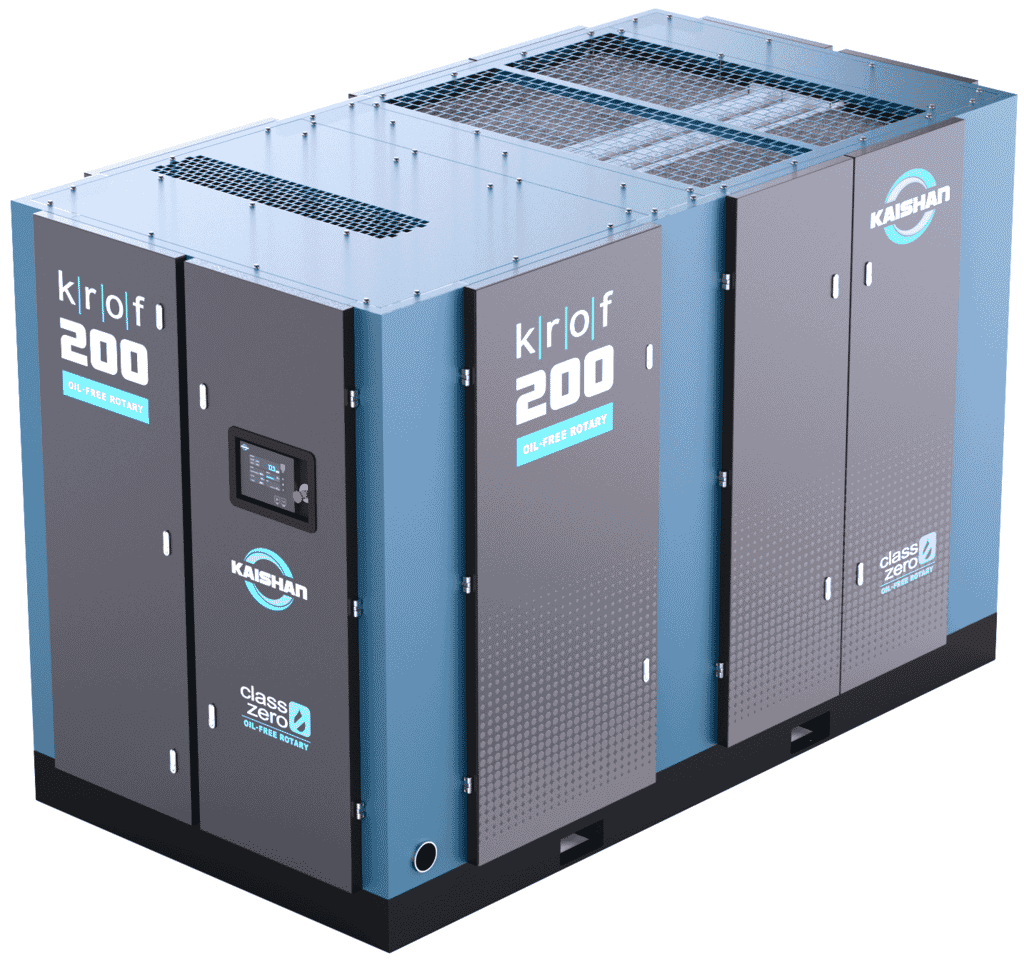
For applications that need Class 0 air quality at industrial scale, the oil-free rotary screw fills the gap. It delivers true oil-free air—no oil in the compression chamber, no oil carryover, no oil in the condensate (once again, assuming there are no contaminants in the incoming air). The rotors do not use lubricant to seal and compress the air. Many use a coating and tight clearances and a few use stainless steel rotors.
In the air quality category, the oil-free rotary screw is the right choice for food and beverage, pharmaceutical, electronics, paint lines and any application where less than 400 HP is required and oil contamination is unacceptable. Kaishan’s KROF two-stage oil-free compressor is a great example.
The trade-off is that oil-free rotary screws run hotter than oil-flooded units, because there is no oil to carry heat away from the compression chamber. Higher operating temperatures mean that interstage cooling and condensate management are critical to maintaining air quality. If the coolers are not kept clean, moisture can carry through the system and degrade downstream air quality.
Where they win: True Class 0 oil-free air with continuous-duty capability. No oil is added to the airstream, no oil in the condensate, no carbon buildup risk. Suitable for regulated industries.
Where they lose: Higher operating temperatures. More expensive than oil-flooded alternatives.
How Downstream Filtration Fits In
Downstream filtration is the variable that can upgrade an oil-flooded compressor’s air quality.
But only so far. A coalescing filter removes oil aerosols. An activated carbon filter removes oil vapor. Together, they can bring an oil-flooded system to ISO 8573-1 Class 1, which is sometimes called “technically oil-free.”
The limitation is that filtration is a consumable, not a design feature. Filters degrade, and their performance depends on maintenance discipline.
For plant air and instrument air, downstream filtration on an oil-flooded compressor is a practical, cost-effective solution. For process air that contacts food, pharmaceuticals or electronics, it is a risk. The filter can fail, and when it does, oil enters the product stream. A truly oil-free compressor eliminates that failure mode by design.
In addition, point-of-use filtration can help filter out corrosion in air pipes and/or water from condensation that is in the air lines.
The Bottom Line
The answer to “which type of compressor wins on air quality?” depends on what your application requires.
- For general plant air, an oil-flooded rotary screw is the right choice.
- For instrument air, you should have Class 1.4.1 air, which typically requires an oil-free compressor and a dryer.
- For process air requiring ISO 8573-1 Class 0, only a true oil-free compressor wins. That means a centrifugal at large scale, an oil-free rotary screw at mid-scale or a scroll at small scale.
The distinction between “oil-free” and “technically oil-free” is not semantics. It is the difference between stable air quality by design and air quality by filtration.
Meeting your air quality requirements depends on what you are making, what regulations you must meet and how much risk you can tolerate.
Having the right answers to those questions will help you figure out the best system for your application.
Key Takeaways
- ISO 8573-1:2010 defines compressed air quality through purity classes for three contaminants: particles, water and oil.
- Reciprocating compressors produce adequate plant air, but oil carryover increases as the machine wears.
- Oil-flooded rotary screws can achieve technically oil-free air (Class 1) with multi-stage filtration, but the filtration degrades over time.
- Centrifugal compressors deliver Class 0 oil-free air by design, with no downstream oil filtration required.
- Scroll compressors deliver Class 0 oil-free air at small scale, making them ideal for medical and laboratory applications.
- Oil-free rotary screws deliver Class 0 air with continuous-duty capability for food, pharma and electronics applications.
- The distinction between true oil-free and technically oil-free is the difference between stable air quality by design and filtration-dependent air quality that can fail.
Find the Right Air Quality Solution for Your Plant
To determine the configuration of compressed air equipment that will produce the air quality you need for your application, it’s hard to beat a walk-through with a local compressed air professional.
That’s why we work with a nationwide network of independent distributors who can provide on-site help and consultation as needed.
They have factory-trained technicians with a deep understanding of industrial applications, ensuring you get the right system, reliable service and quick access to parts when you need them most. They can walk through your application, your air quality spec and your downstream equipment and point you to the solutions that deliver the air quality your process demands.
When you buy through Kaishan, you’re getting more than a product—you’re getting a local partner who cares about your business and wants to see it succeed. Find a local pro near you or contact us directly.
Further Reading
“Three Ways Compressed Air Optimizes Air Tool Performance Downstream.” How the quality of your compressed air affects the performance of your downstream tools and equipment.
“Ensuring Compressed Air Pressure Stability: A Balancing Act.” Pressure stability is one of the three dimensions of compressed air performance, alongside air quality.
“Air Compressor Intake Air: The Original GIGO.” Shows how critical it is to have good air intake.
“The Five Pillars of Air Compressor Efficiency.” An overview of the factors that contribute to overall compressed air system efficiency, including air quality.
Frequently Asked Questions
Listen to the Podcast Version



The Three Contaminants and the Loading Dock Trap
Picture this. You spend tens of thousands of dollars on a brand new, high end oil free compressor setup. You think your air stream is pure, untouchable. But then downstream valves start sticking, and your filters are clogging every few weeks. You look around, and turns out the intake pipe was installed right next to the loading dock.Oh, no. So it is pulling in diesel exhaust all day long?
Every single time a truck idling at the bay revs up. Welcome to the Big Dog Podcast, I am Jason Reed.
And I am Lisa Saunders. That loading dock mistake, Jason, it is, it is the ultimate example of garbage in, garbage out. Because when you compress ambient air to say, one hundred pounds per square inch, you are squeezing roughly eight cubic feet of atmospheric air into just one single cubic foot.
Right. So whatever pollutants were floating around outside, now you have eight times the concentration per cubic foot inside your pipes. The diesel fumes, the humidity, the dirt particles, it all gets hyper concentrated.
Yeah, I actually ran into this exact thing on a plant walk through a couple years back. This facility was running a clean room application, and they could not figure out why their high efficiency filters were blinding over and over. We walked outside, followed the intake duct, and sure enough, it ended about five feet from an engine exhaust stack on their loading dock. It was literally baking soot into their air lines.
Man, that is brutal. And that brings us right to the standard that governs all of this, ISO 8573 1. It classifies compressed air purity across three specific contaminant categories. Solid particles, water, and oil. Lisa, how does that specification actually look on paper?
It usually reads as three numbers separated by dots, like Class 1 dot 2 dot 1. The first number is your rating for solid particles, the middle is water dew point, and the last is total oil content. Class 0 is the most stringent rating in the standard, while Class 9 is the most relaxed.
And the Compressed Air and Gas Institute, or CAGI, groups industrial air applications into three practical categories, right? You have general plant air for air tools and actuators, instrument air for delicate control systems, and process air where the air touches the product directly, like in food, beverage, or pharmaceuticals.
Exactly. And oil is usually the big divider between those categories. Which leads to a distinction that confuses a lot of plant managers, the difference between oil free and what people call technically oil free.
Oh yeah. Technically oil free usually means you are taking an oil lubricated compressor, like an oil flooded rotary screw, and adding multi stage coalescing and activated carbon filters downstream to scrub the oil out. You might get the air down to Class 1, less than zero point zero one milligrams per cubic meter.
Right, but the key word there is filtration. Downstream filters are consumables. They degrade, they saturate, and if maintenance gets skipped, or a filter element ruptures, guess where that oil goes?
Straight into your product. A true ISO Class 0 oil free machine never introduces lubricant into the compression chamber in the first place. You are eliminating that mechanical failure mode by design, not by relying on a paper element downstream.
Comparing Compressor Types for Baseline Air Purity
So let us break down how the actual mechanical design of different compressor types impacts that baseline purity, starting with old school reciprocating piston machines.Recips are classic workhorses, but in commercial lubricated models, the piston rings and cylinder walls need oil. As those rings wear down over time, oil carryover steadily increases. Plus, every stroke creates a physical pulse in the line.
Which can be terrible for precision applications like industrial painting, right? You get pressure pulses and tiny oil droplets ruining the finish on a spray line.
Exactly. Receiver tanks help dampen the pulse, but a worn recip is going to bleed oil downstream. Now, contrast that with oil flooded rotary screw air compressors. These inject oil directly into the compression chamber to seal, cool, and lubricate the rotors.
And they give you a nice, steady, continuous flow of air, which is why they are the standard choice across North American industrial plants. But you always have a baseline oil carryover, typically somewhere between two to ten parts per million by weight.
Right. Downstream filters can catch the vast majority of that oil for standard plant air. But again, downstream treatment can upgrade your air quality, but it cannot alter the fundamental physical design of the compressor itself. If you are operating in a regulated sector like healthcare, electronics, or food production, you have to weigh the risk.
What does that risk actually look like in dollars when something goes wrong?
Well, ask yourself, if oil breaches your filters, do you lose an entire batch of product in a bakery or semi conductor fab? Are you facing regulatory fines or product recalls? Or worse, do you have to strip out and replace hundreds of feet of contaminated header piping because oil soaked into the distribution lines?
When you factor in those catastrophic risks, saving a few bucks upfront on an oil flooded unit suddenly does not look so smart for process air.
Not at all. For large scale continuous facilities, centrifugal compressors give you Class 0 air naturally because there is no oil in the compression chamber. For mid scale facilities under four hundred horsepower needing true oil free process air, an oil free rotary screw like a two stage unit is purpose built for that continuous duty.
And for small scale clean applications like dental clinics or labs, oil free scroll compressors step in to deliver smooth, quiet, Class 0 air.
The bottom line for any plant manager or maintenance crew is simple. First, check your intake location. Make sure you are not feeding your system diesel exhaust or dock fumes. Second, look at your actual point of use purity needs. Do not just rely on filters to fix a machine design that does not match your risk tolerance.
If you are unsure, walking your plant lines with a local compressed air professional can save you a mountain of headaches down the road. Well, that wraps up today's quick take. Thanks for joining us on the Big Dog Podcast!
Catch you next time.