
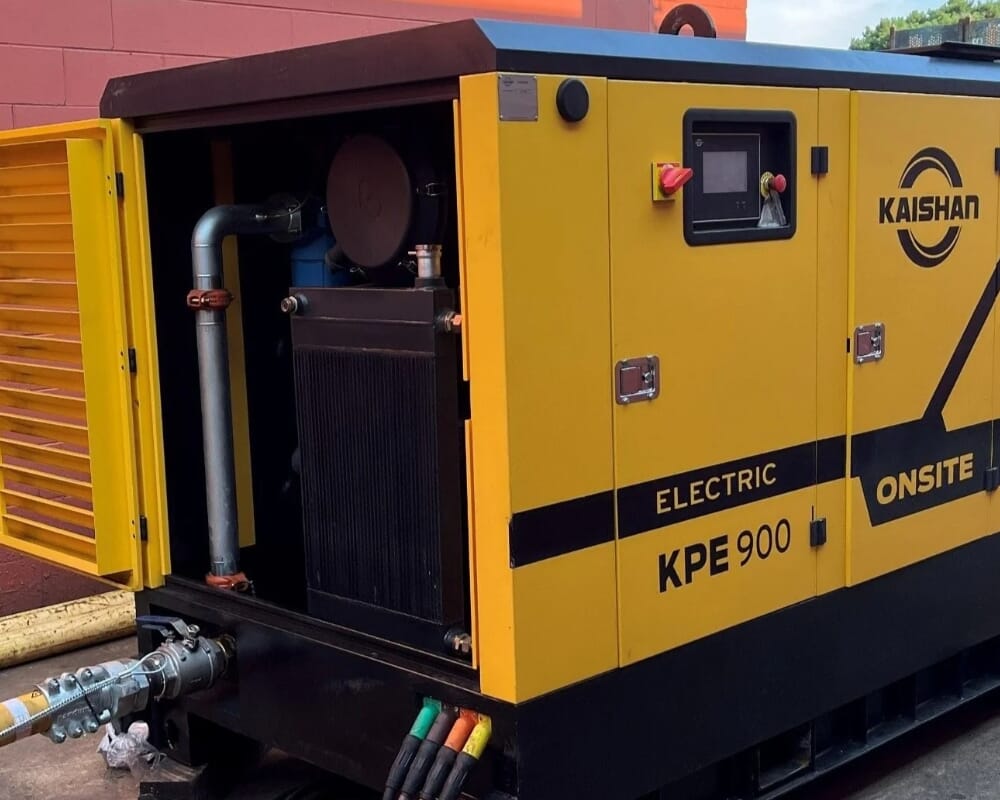
Portable compressors, mostly diesel-driven, have been around a long time.
But how portable is a portable air compressor?
- How easily can they be moved around?
- How well do they meet the needs of many different applications?
- Can they be moved from place to place without degrading or disrupting the workflow or work environment?
- How easy is it for your workers to set them up and get them running again?
- How easy is it to supply them with the continuous power they need?
In many of these instances, the limitations of portable diesel air compressors are well established. Those problems have created an opening for electric portables, like Kaishan’s KPE portable electric air compressor.
Even more importantly, they provide important new benefits to end users like you.
So, just how “portable” should a portable air compressor be? We list eight ways below. Ways that will make your life easier. We’ll start with mobility.
1. Mobility
A portable compressor is only portable if it’s easy to move. And while moving diesel compressors is straightforward, they weigh anywhere from 2,000 to 5,000 pounds, depending on their capacity, with one model on the market weighing in at more than 19,000 pounds. And they can be top-heavy.
The KPE can be mounted on a DOT-approved trailer and has been designed for easy transport:
- It has vibration isolators on coolers and other major components to minimize vibration-related stress.
- It has an internal latch to keep the compressor’s doors from opening during transit.
- It can be equipped with an optional DOT-approved trailer for over-the-road transport.
The KPE was designed with three practical ways to move them around once they’re on site:
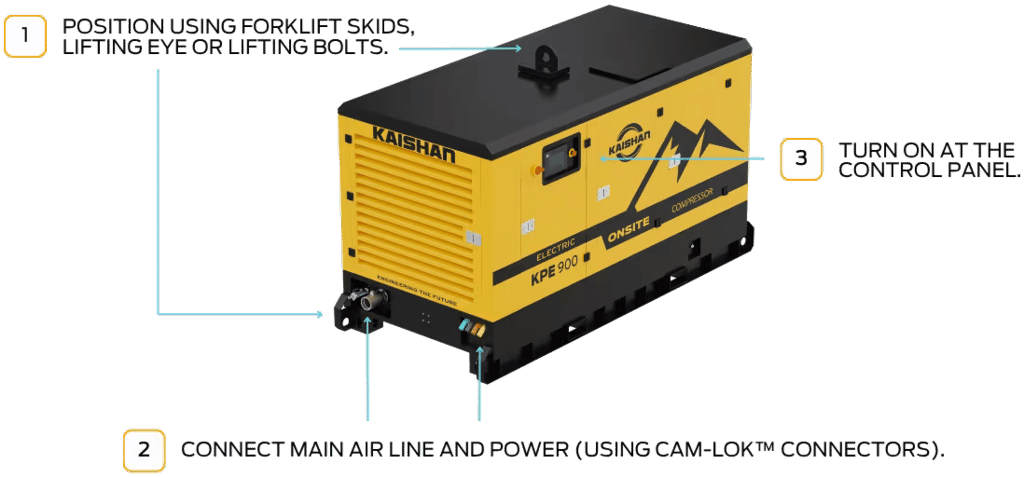
- A single-point lifting eye on top of the unit for crane lifts
- A drag bar for short movements around the yard
- Forklift pockets for routine loading and unloading
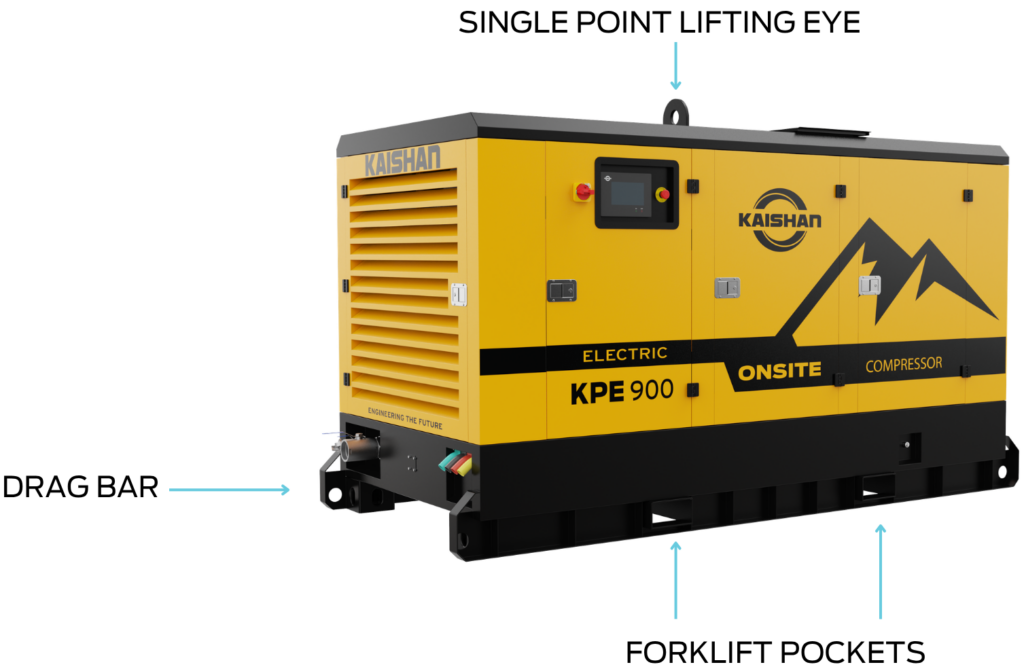
The KPE is easy to move around a jobsite. It can also be mounted on a trailer for DOT-approved transport.
And once you’re at your destination, hooking the unit up is straightforward. If the plant or job site has 460-volt power, you simply plug in. The KPE uses cam-type connectors for fast, safe electrical setup; attach your air hose and turn it on. There’s no elaborate wiring, no field improvisation needed.
2. Suitability Indoors
Diesel units are notorious for producing tailpipe emissions, which means carbon monoxide risk, indoor air-quality concerns and the constant logistical headache of running engines in semi-enclosed spaces.
That’s especially an issue in sensitive environments such as food and beverage, electronics and healthcare. And it’s even a problem on construction sites where work largely begins outdoors and becomes enclosed as the project proceeds.
Portable electric air compressors, on the other hand, don’t emit fumes or toxic substances and can be used indoors.
And then, there’s the noise level.
3. Noise Level
Diesel-powered air compressors generate noise during the mechanical compression phase and have secondary noise from the combustion in the diesel engine. As a result, they are loud. Too loud to be near offices or facilities that serve the general public.
They typically operate at noise levels between 74 dB and 76 dB, depending on their size and design. OSHA noise standards establish a 90-dB limit for eight hours of exposure. Some units are equipped with sound-dampening features.
As a result, they create environments where operators must wear hearing protection, and crews have to use hand signals to communicate.
KPE portable electric compressors, on the other hand, don’t have a motor or engine. Just a permanent magnet motor with a variable-speed drive. In addition, they have a full enclosure. As a result, they are much quieter than a diesel unit—74-81 dB, depending on the size.
4. Power Access and Flexibility
Diesel fuel cost per hour is about four times more expensive than grid electricity. And it is not always available in some locations globally.
Admittedly, a plug-in electric portable such as Kaishan’s KPE needs access to a power source. So it may not be the perfect tool for heavy-duty, remote construction jobs out in the middle of nowhere. With no power lines in sight.
So, at first glance, diesel compressors sound like a winner here. Except that you need to have access to high-quality diesel fuel.
Diesel portables need scheduled fuel deliveries or on-site fueling, and that usually means you have a large diesel fuel tank with a fuel pump to service it. Or you bring in fuel every few days. And you’ll need to make sure your fueling vehicle can access your unit easily. All of which introduce spill risk and storage and compliance requirements.
In addition, modern diesel portables typically require diesel exhaust fluid to comply with Tier 4 Final regulations. DEF adds consumable cost, additional maintenance, storage considerations and one more thing that can run out at the worst moment. Plus, there’s additional paperwork—the SDS sheets for the new fluids.
So diesels aren’t exactly a clear winner for off-grid flexibility either.
That’s why we created the KPB battery-powered air compressor. It offers all the off-road flexibility you’d want, plus the convenience of a battery. It has a runtime of 3-4 hours, and it takes a little over two hours to charge from 20% to 80%.
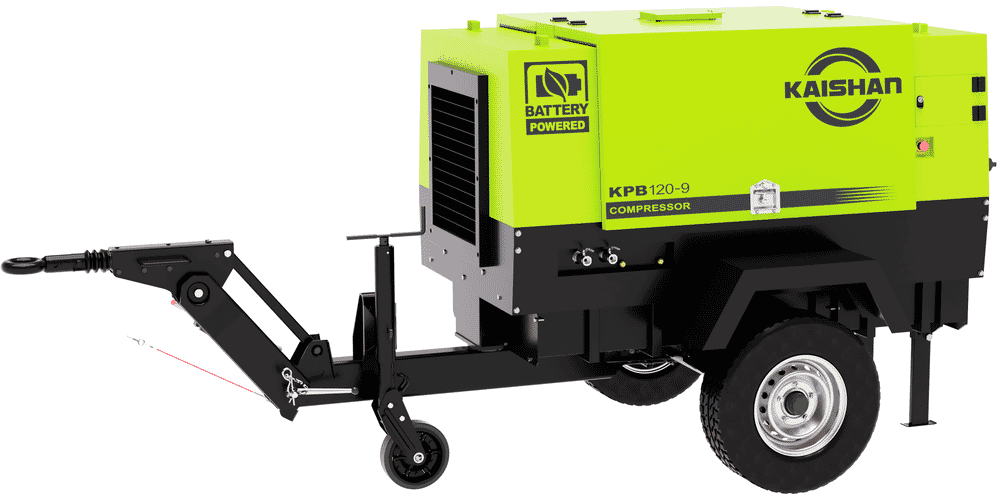
The limited runtime may not be enough for a major project. But our distributors tell us they have strong demand for short-duration jobs: 20-30 minute jobs where you need a little compressed air. For those types of jobs, the KPB is ideal.
5. Intuitive, Easy to Set Up and Use
The KPE is designed so operators can get productive quickly, even if they have never run a portable electric compressor before.
If you have a stationary air compressor in place, you probably already have the 460-volt power infrastructure to run an electric portable. No elaborate wiring or improvisation needed. You simply connect power to the KPE’s camtype connectors and turn it on.
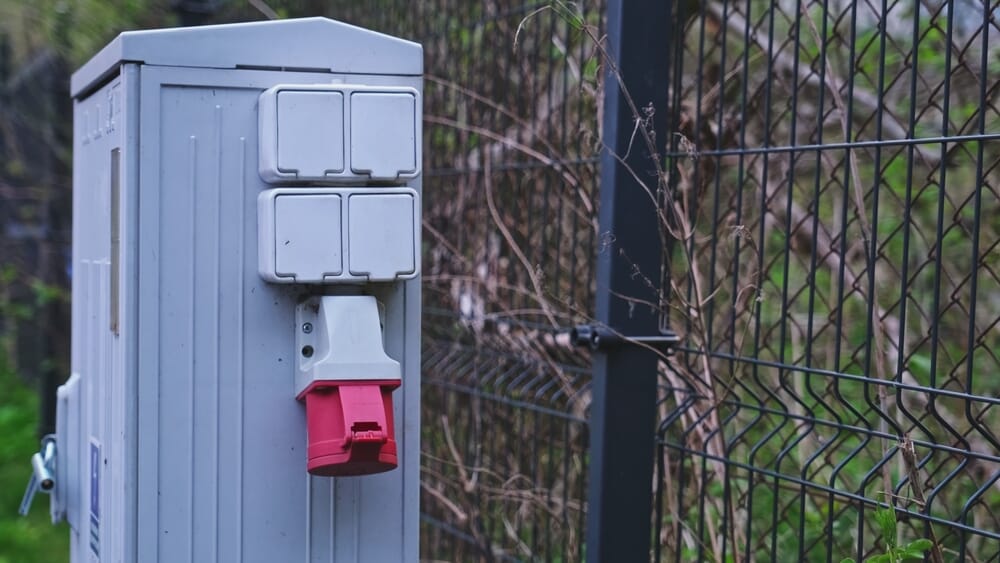
The KPE has two air outlets:
- A standard connection for a pneumatic hose to connect to the facility’s main compressed air header.
- A smaller ¾-inch Chicago universal coupling for an air hose running to a hand tool, such as a rock drill, pavement breaker/jackhammer, sandblaster or heavy-duty impact wrench.
No elaborate wiring or improvisation needed.
6. Resistance to Harsh Conditions
Diesel portables are not equipped for cold weather or higher elevations, where thin air and freezing temperatures create starting and running problems.
The KPE comes standard with heat tracing to keep the unit properly protected in especially cold environments, including internal heaters to prevent condensate lines from freezing and a sump heater.
The unit has a NEMA 4 electrical enclosure rating, which means it is protected against windblown dust and water spray. That expands your placement options and gives you confidence that the compressor can handle unpredictable weather.
The KPE can handle almost any environment, no matter how dirty or dusty. Unlike other portable electrics with traditional VSDs that can’t handle harsh environments, the KPE has closed-loop liquid cooling that isolates critical components from dusty, abrasive air streams and stabilizes temperatures under varying loads.
So you get the versatile range and performance of a VSD without the risk of heat exchanger clogging. The liquid cooling circuit cools both the drive and the motor.
7. Versatility: One Machine for Many Applications
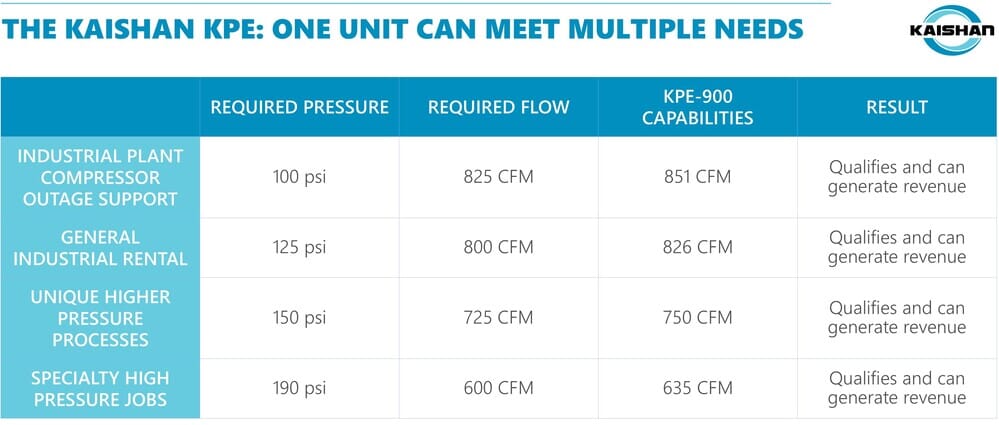
Although there are diesel units with dual capacities, most are rated for a single pressure and have a fairly limited range. So, a plant that needs widely varying pressures may need more than one unit. That’s not true of the KPE.
The KPE is not sized for one application. It is sized for whatever application you have, delivering pressures from 80 to 190 PSIG and flows up to 800 CFM. That entire range from one unit.
The range for our battery-operated KPB is a little smaller: 80 to 150 PSIG.
Pressure Changes
While most other portable units require an external regulator to reduce pressure to a hand tool, the KPE builds that flexibility in. Speed up or slow down the unit by modifying the power input. It is that straightforward.
The VSD regulates compressor speed up and down to produce the optimum pressure profile for demand, and it can reduce speed and save power when demand drops. A 100-HP-rated unit can run at 75 HP if that is all the application needs, or all the available electrical service can handle.
Plus, you can change the pressure directly from the control screen, toggling in the pressure you need without changing hardware or calling a technician. You don’t need to swap in a different machine.
If an operator needs 175 or 180 PSIG rather than 100 PSIG, the change is a simple adjustment on the control screen.
8. Maintainability
Diesel engines require oil changes, fuel filters, diesel exhaust fluid top-offs and more frequent service intervals. Oil filters, for instance, need to be changed every 250 operating hours. And, given the amount of time diesels have been in use, you might assume that engine maintenance would be relatively standardized. Unfortunately, that’s not the case.
The manufacturers of diesel compressors use a wide range of engines, from Kubota and smaller Caterpillar engines on the smaller units to Cummins, John Deere and Volvo on the larger ones. So, a mechanic’s familiarity with one brand may not translate to a different type.
The KPE, on the other hand, was engineered for easy maintenance. You can access all key components easily, and all the drain ports are plumbed to the drain.
Demand Portables That Are Truly Portable
You may need a portable compressor. But you don’t need the hassles that come from traditional diesel units. You need the mobility, versatility and convenience of the KPE portable electric air compressor.
The place to start is with your local independent compressed air professional.
Key Takeaways: The 8 Things That Make Portable Air Compressors Truly Portable
2. Suitability indoors
3. Noise level
4. Power access and flexibility
5. Intuitive, easy to set up and use
6. Resistance to harsh conditions
7. Versatility: One machine for many applications
8. Maintainability
What to Use, When and Where
| Diesel | KPE | KPB | |
|---|---|---|---|
| Power source | Diesel engine | Utility power | Battery |
| Reaches the site by | Trailer | Trailer, forklift or crane | Trailer, forklift, crane or truck bed |
| Off-grid operation | Yes, with fuel supply | No | Yes, for the battery run time |
| Pressure range | Often a single pressure; dual-pressure models span 100 to 150 psi | 80 to 190 psi | 80 to 150 psi |
| Airflow at high pressure | Full-rated output | Full-rated output | Approximately 80 to 90 cfm |
| Noise | Engine-dominated | Fully enclosed package | Permanent magnet motor, no engine |
| Indoor use | Limited by exhaust | Yes | Yes |
| Maintenance scope | Compressor plus engine and emissions controls | Compressor only | Compressor plus battery |
| Technician skills | Compressor and engine brand specific electronics | Compressor | Compressor |
| Refueling or recharging | Fuel delivery or secondary tank for continuous duty | Power drop | Recharge between cycles |
| Best fit | High pressure specialty work, continuous off-grid duty | Plant and site work with power available, multiple pressures | Remote intermittent cycles, indoor work |
The Help You Need
Kaishan USA works with a nationwide network of independent distributors, who can provide on-site help and consultation as needed.
We partner with independent, local distributors because it’s the best way to make sure you get the right system, reliable service and quick access to parts when you need them most.
With factory-trained technicians and a deep understanding of industrial applications, they help maximize efficiency and minimize downtime.
So, when you buy through Kaishan, you’re getting more than a product—you’re getting a local partner who cares about your business and wants to see it succeed. Contact us today.
Further Reading
“The Growth In the Rental Market For Portable Electric Air Compressors.”
“Electric Portable Air Compressors: a Smart Alternative to Diesel.”