

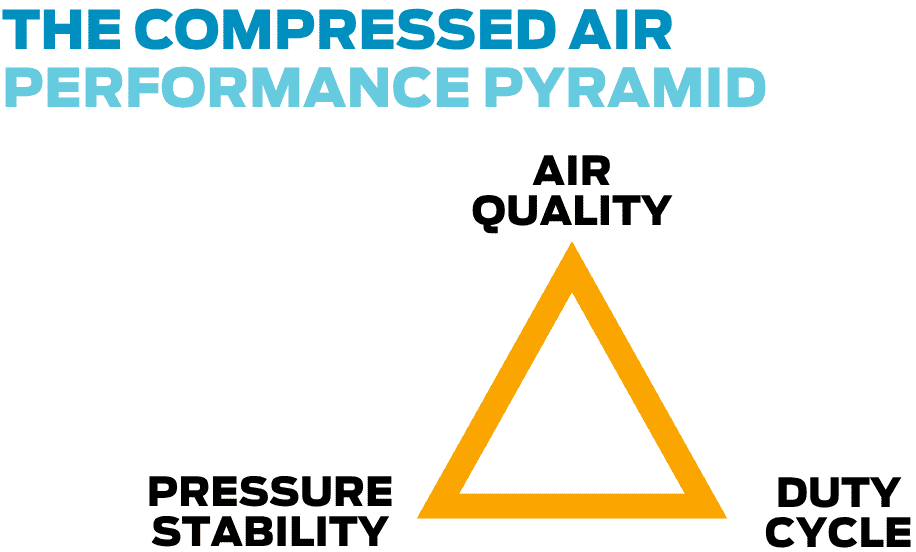
Most readers think of compressor performance as “How many CFM does it make?” That’s important, obviously, but it hides the three performance dimensions that separate a good installation from a bad one:
- Pressure stability. How tight is your pressure band at the point of use? Compressed Air Best Practices notes that a properly configured network can hold a pressure within a +/-1.5 PSIG band. A wide pressure band means inconsistent tool performance, more leaks and higher energy cost per unit of useful work.
- Duty cycle. What fraction of the operating hours can the unit run without overheating, short-cycling or experiencing excessive wear? Reciprocating compressors typically run 50% duty in industrial-grade form; rotary screws are designed for 100%. That difference has a huge impact on how you can use each type of compressor.
- Downstream air quality. What comes out of the discharge? Oil carryover, moisture, particulates—each one creates downstream problems that show up as compressed air performance issues elsewhere in the system.
Every compressor type trades one dimension against another. The right choice depends on how much each one matters to your operation. And, of course, air compressor performance is critical to overall compressed air efficiency.
The Compressed Air Performance Pyramid
The Three Industrial Workhorses
We’ll compare the performance characteristics of the main types of compressors in industrial use today: reciprocating, oil-flooded rotary screw and centrifugal compressors.
Reciprocating Compressors: Reach High Pressure, But Watch the Pulsations
The inexpensive, lighter-duty commercial units used in many small shops and manufacturing plants have a structural limitation: they can only run 50% of the time (about 30 minutes per hour) to allow them to cool down between cycles. They are the least expensive and least efficient option (except in intermittent uses). However, they can be very efficient when sized correctly and are well-suited to intermittent loads; a piston running intermittent duty with a properly sized receiver tank is hard to beat for a certain profile.
We should point out, however, that multi-stage, double-acting recips are available with a 100% duty cycle. A multi-stage reciprocating compressor can also hit very high pressures, which is why you see them in applications pushing 150 PSIG and beyond. They also handle partial load well. They can be the most energy-efficient choice, but they are only appropriate in specialized applications.
The performance weaknesses come from the same mechanical principle that makes a piston compressor simple: the piston pumping back and forth creates a pulse of pressurized air on every stroke, then a brief lull. A two-stage recip will deliver pulse after pulse into your header. A receiver tank dampens it but does not eliminate it.
Those pulsations cause real problems in a shared header. Put a recip and a rotary screw on the same air line without proper check valves, and the reciprocating pulse can transfer backward into the rotary screw and damage the bearings. We have seen airends destroyed that way. The good news: an inexpensive check valve fixes it. A few hundred dollars of hardware versus a few thousand dollars’ worth of bearings.
Other performance limitations are inherent to the design:
- Pistons run hot. Far hotter than a screw compressor. Heat that high shortens oil life, increases carryover and degrades downstream air.
- Recips rarely have integrated after-coolers. Most operators crack a ball valve on the receiver tank to bleed off moisture.
Where they win: Reciprocating compressors win on intermittent duty and high pressure (in specialized applciations).
Where they lose: They lose on pulsations, shared-header installations and duty cycles that approach continuous operation (especially smaller, commercial-grade models).
Oil-Flooded Rotary Screw Compressors: The Industrial Default
Rotary screw compressors are the workhorses of the industrial world, delivering more compressed air per horsepower than other types of compressors. They do not produce the pulsations that sometimes occur with other types of compressors, especially reciprocating or piston compressors.
They are known for generating steady streams of compressed air and can handle changes in demand better than most other types of compressors. They can also withstand extreme weather conditions and rugged industrial environments.
Based on a simple, time-tested design with relatively few moving parts, rotary screw compressors are highly reliable and cause less unexpected downtime. Many continue to operate efficiently for years if not decades and offer a lower total cost of ownership than other compressor types.
And, with a variable-speed drive, a single unit can cover a wide capacity range. We offer more detail on VSDs below.
In addition, two-stage designs push that efficiency further. By splitting the compression into two stages with interstage cooling in between, you extract more work from each kilowatt-hour. For example, a two-stage rotary screw, such as the KRSP2, generates 15%-20% more flow in the same physical footprint as a comparable single-stage compressor. The energy savings alone typically pay back the increased cost within two to three years.
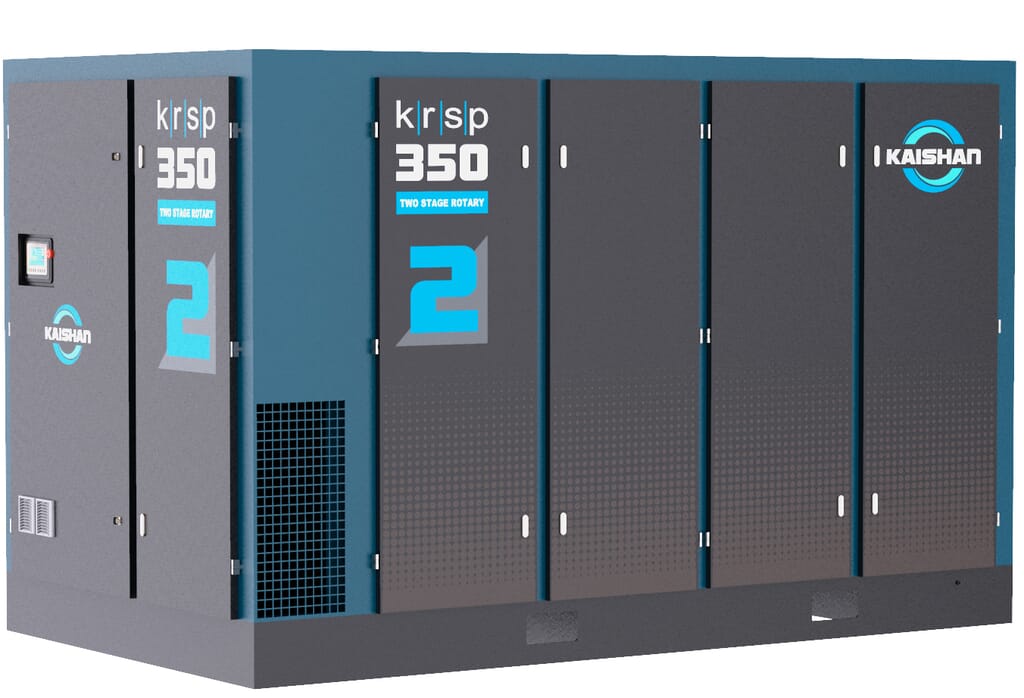
Where they win: Performance is smooth, pressure is stable and they are built for 100% continuous duty.
Where they lose: The performance trade-off is oil carryover into the downstream air. Even a well-tuned oil-flooded unit will pass some lubricant into the airstream, typically a few parts per million. Most plants won’t notice. But some plants will, especially in the food and beverage, electronics and healthcare industries. Those segments simply need the cleanest air we can provide.
Centrifugal Compressors: Massive Capacity, Narrow Operating Envelope
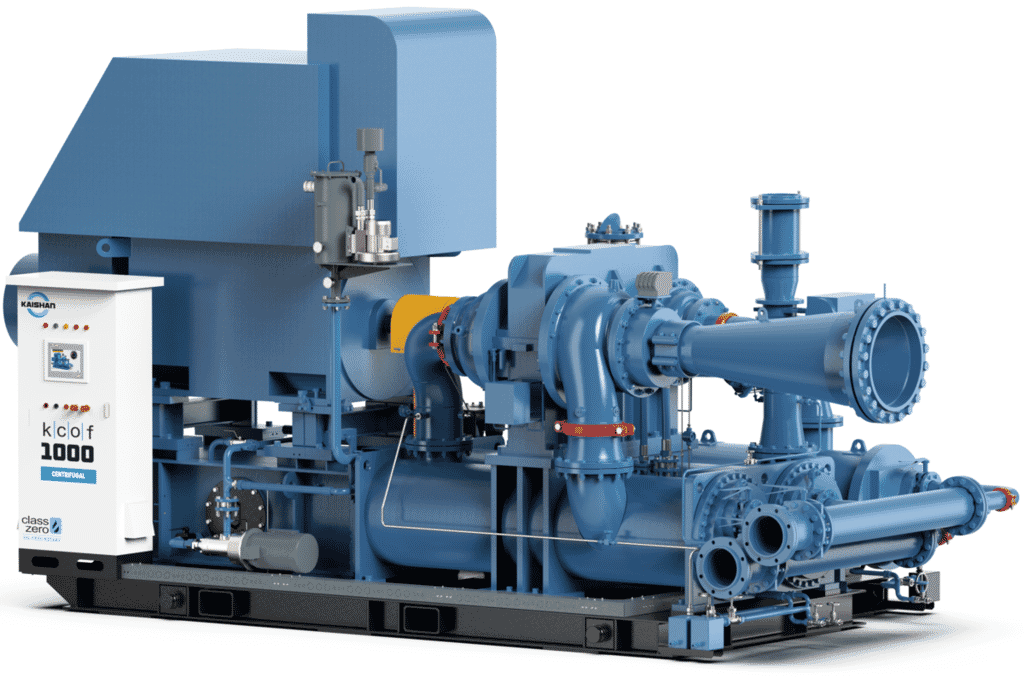
Centrifugal compressors are highly efficient at large volumes with steady demand, producing a lot of air from a small footprint. For a heavy, steady baseload in a large plant, no other technology touches it on capacity per square foot.
The performance is smooth. A dynamic compressor like a centrifugal doesn’t have pistons pumping; it just blows air continuously, so pulsation is non-existent. Combine that with inherently oil-free operation, and you get very clean air delivery at very high flow.
On the negative side, centrifugal compressors have limited turndown, typically only about 25%-35%, controlled by inlet guide vanes. Once demand drops below that range, the machine has to open a blow-off valve to vent compressed air to the atmosphere so it doesn’t cross the surge line, the minimum flow below which the air compressor discharge cannot overcome the head in the main header.
When blowing off, the compressor is still doing all the work of compressing 70% of the air, but for any load below 70% capacity of the compressor, that difference is just being dumped outside, instead of being put to use. The savings you achieved by using a centrifugal can easily go out the window.
That limited turndown range means they are intended for a steady workload and do not do well with constant demand variation. If you start chasing wide turndown on a centrifugal, you’re barking up the wrong tree. The technology was not built for it.
The smart play, when your application has varying load, is to deploy a centrifugal as your baseload machine and pair it with other compressor technologies to handle the trim. That way the centrifugal stays in its efficiency sweet spot and the other machines handle the swings.
Where they win: highly efficient at higher volumes with steady demand.
Where they lose: Not cost-effective for applications below 400 HP. Not recommended for part-load, variable-demand conditions.
Compressed Air Energy Efficiency: Which Type of Compressor Wins?
| Type | Reciprocating (light-duty commercial model)* | Rotary Screw | Centrifugal |
|---|---|---|---|
| Universal Issues |
Match the compressor to the application Lifetime cost is more important that initial cost Controls and system configuration are important Maintenance is non-negotiable |
||
| Specific Issues |
|
|
|
*Multi-stage, double-acting recips are available with a 100% duty cycle.
**Multi-stage, double-acting recips can be the most energy-efficient choice, but they are only appropriate in specialized applications.
Two Variations Worth Knowing
As mentioned, most plants focus on the three main types. However, two variations come up often enough that they deserve a mention.
Scroll Compressors: Smooth, Quiet, Clean
Scroll compressors are typically ISO 8573 Class 0 oil-free by design. They run with very low pulsation, very low noise and very smooth flow—which is why they are the default choice for dental offices, clinics, laboratories and small clean-air applications.
Where they win: Performance shines where the application requires clean, low-vibration air at modest scale.
Where they lose: Pressure and capacity are limited compared to rotary screws, which is why you rarely see them in heavy industrial service.
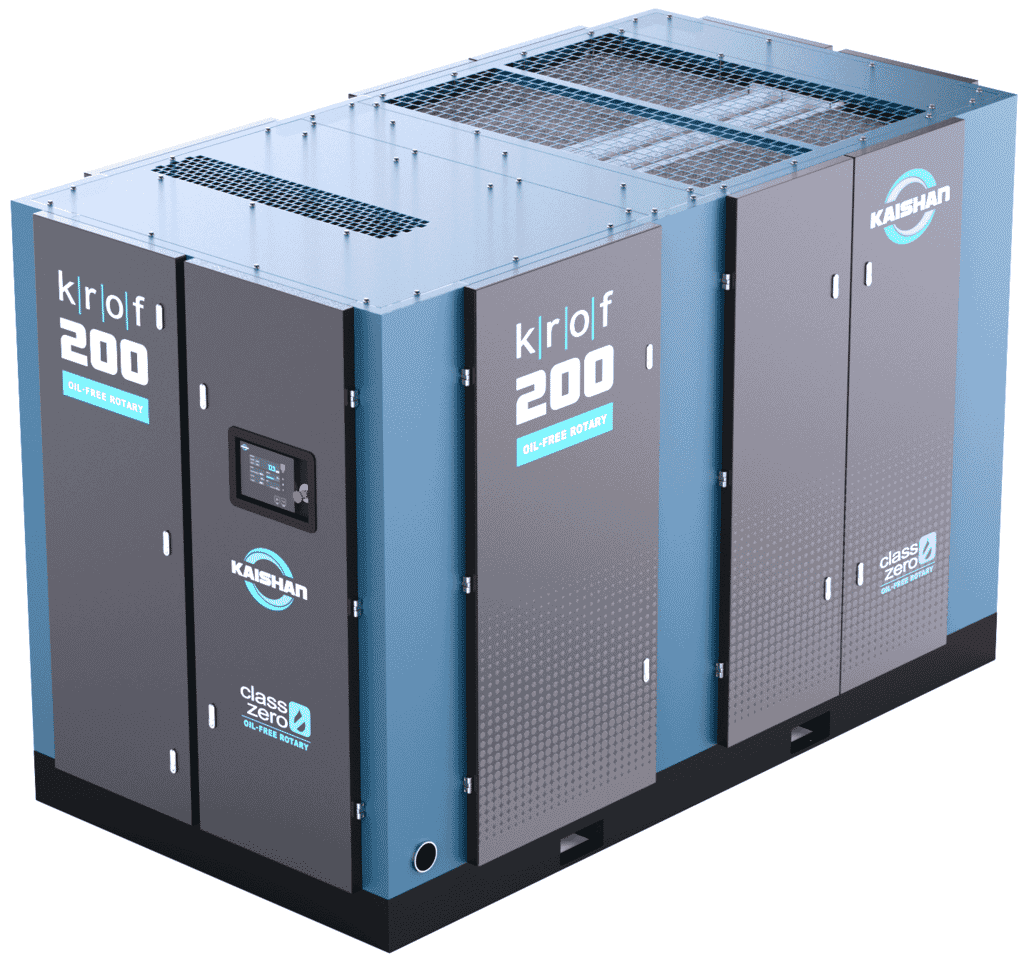
Oil-Free Rotary Screw Compressors: Continuous Duty Without the Carryover
For applications that need clean air and continuous duty, oil-free rotary screws fill the gap. They give you Class 0 air quality with the continuous-duty capability of a rotary screw compressor. There is no oil in the compression chamber to seal and cool the rotors, so they use a different mechanism—typically a coating on the rotors and tighter clearances—to do the work.
The performance trade-off is heat. Without oil to carry heat away, oil-free units run hotter. In addition, the rotors are sensitive to inlet contamination; a clogged inlet filter degrades the rotor coating and lets unfiltered air carry contaminants into the compression chamber.
The rotor coating is also a wear item. Performance drops as the coating degrades over time.
How VSD Changes the Performance Math
A variable-speed drive changes the performance characteristics of compressors so much that it deserves its own place.
The Compressed Air and Gas Institute (CAGI) reports that VSDs can reduce energy use by about a third in the right application. In addition to saving energy, VSDs add to reliability by allowing soft starts, qualifying for utility rebates, offering better control of compressed air systems and addressing rapid cycling.
With VSDs, the motor ramps up and down to match actual demand. Energy use tracks demand rather than cycling between full load and unload. In facilities with variable demand, those advantages move VSDs from an accessory to a necessity.
However, they are not for everyone: Oil-flooded VFDs/VSDs provide acceptable performance from 21%-40% and ideal performance from 41%-70%. Oil-free units are rated acceptable at 41%-70% and ideal at 71%-100%.
In facilities with a rock-steady 80-100% load that doesn’t need oil-free air, a fixed-speed unit usually is preferred.
Where they win: VSDs can cut energy use by a third in the right application.
Where they lose: In oil-flooded applications below 20% or above 70% of capacity. In oil-free applications, you shouldn’t use them below 40%.
Help in Pulling It All Together
The answer to “Which type of compressor wins?” depends on how you define air compressor performance in your facility. Each type wins in some categories and loses in others, and weighing the tradeoffs can sometimes be challenging.
That’s why we recommend working with your local compressed air professional to consider all the options and find the solution that is right for you and your company.
Key Takeaways
- Air compressor performance is more than CFM—pressure stability, duty cycle and air quality all matter.
- Reciprocating compressors win on high pressure and intermittent duty. Manage pulsations in a shared header.
- Oil-flooded rotary screws deliver stable pressure at 100% continuous duty. Two-stage designs add 15–20% more flow per kilowatt-hour.
- Centrifugals win on massive baseload capacity and lose badly on part load. Stay above the surge line.
- Scroll compressors deliver clean, quiet, pulsation-free output at small scale.
- Oil-free rotary screws deliver Class 0 air with continuous duty, at the cost of heat management and rotor-coating wear.
- Variable speed drive tightens pressure band, eliminates rapid cycling and tracks demand—when the application actually varies.
Let’s Find the Right Performer for Your Plant
The right compressor for your operation depends on your duty cycle, your pressure requirements, your air quality spec and how much your demand varies through the day. We’d rather help you figure that out than sell you the wrong unit.
We work with a nationwide network of independent distributors, who can provide on-site help and consultation as needed. They’ll look at your load profile, run the numbers on compressed air performance and point you to the configuration that wins for your plant.
We partner with independent, local distributors because it’s the best way to make sure you get the right system, reliable service and quick access to parts when you need them most.
When you buy through Kaishan, you’re getting more than a product—you’re getting a local partner who cares about your business and wants to see it succeed. Contact us today.
Frequently Asked Questions
It depends on the application, but for most continuous industrial use, a modern variable speed drive (VSD) rotary screw compressor is the most efficient option. VSD units match motor speed to actual air demand, which can cut energy use 20%–35% compared to fixed-speed units running unloaded.
That said, "most efficient" only matters in context. A VSD rotary screw is the wrong tool for an auto shop running 10 hours a week—a small reciprocating unit will be more efficient overall because the standby losses of a larger VSD will eat the savings (our small PK Screw compressors, however, can rival recips in many ways). Always match the compressor to the duty cycle, then optimize within that class.
For an honest comparison between two units, ask for the CAGI-verified data sheet and compare specific power and isentropic efficiency at your operating pressure.
The short version: rotary screw compressors use two interlocking helical screws to compress air continuously, with no contact between the rotors. Reciprocating (piston) compressors use a piston moving up and down in a cylinder, the same basic idea that powered air compressors used 150 years ago.
That mechanical difference has big consequences:
- Duty cycle: Rotary screws are built for continuous 100% duty. Reciprocating units need cool-down time and are better suited to intermittent use with a receiver tank.
- Operating temperature: Rotary screws run cooler inside (around 80–99°C). Pistons run much hotter (150–200°C at the cylinder wall) due to ring friction.
- Maintenance: Rotary screws need oil and filter changes on a schedule, as do recips. Reciprocating units also need valve and piston ring inspection, which is more involved.
- Pressure: Reciprocating compressors can hit higher pressures more easily, which is why you still see them in applications above 150 PSIG.
For most continuous industrial use above 50 CFM, the rotary screw wins. For high-pressure, intermittent work, the reciprocating compressor still earns its keep.
Choose oil-free when air quality matters more than efficiency or upfront cost. The classic use cases are:
- Food and beverage production—direct product contact
- Pharmaceutical manufacturing—contamination control
- Electronics assembly—sensitive components
- Medical and dental air—patient safety
- Any application with an air quality spec—like ISO 8573-1 Class 0
One important distinction: "oil-free" does not mean "technically oil-free." An oil-flooded compressor with good downstream filtration can produce very clean air, but it still has oil in the compression chamber. A true oil-free compressor never introduces oil into the air stream in the first place. For regulated industries, that distinction is the whole ballgame.
With proper maintenance, a well-built rotary screw compressor typically lasts 15–20 years or more, often running 50,000 to 100,000 hours before a major airend rebuild is needed. Some facilities push past that with attentive care.
Lifespan depends on a few factors:
- Operating hours per year—a 24/7 plant is going to hit that 50,000-hour mark much faster than a single-shift operation
- Ambient conditions—heat, dust and humidity all shorten life
- Maintenance discipline—oil changes, filter swaps and cooler cleaning on schedule
- Running at design pressure—over-pressurizing or running at high discharge temperatures kills bearings and rotors fast
The airend (the screw element itself) is the expensive part to replace, but it's also rebuildable. Many facilities get a second full life out of an airend with a quality rebuild.
Start with your actual CFM requirement, not your peak. The most common sizing mistake we see is oversizing—buying a compressor sized for theoretical peak demand that never actually materializes, then paying for it in energy costs for the next 15 years.
A practical approach:
- Audit your demand. Walk the plant and add up the CFM of every air-consuming device. Then check how many run at the same time.
- Add a margin. A 10%–20% buffer is plenty. A 50% buffer is just wasting money.
- Account for leaks. A typical plant loses 20%–30% of its compressed air to leaks. Fix the leaks first—you'll often find you don't need as much compressor as you thought.
- Check pressure. Make sure the unit can deliver your required CFM at your required pressure, not just at ideal conditions.
If you'd rather not do this alone, most compressor manufacturers (including Kaishan USA) will help you size correctly based on an audit of your facility.
In the right application, absolutely. VSD compressors match motor speed to actual air demand, so the unit isn't cycling on and off or running unloaded at full power. For facilities with variable demand (and most plants have at least some variation), the energy savings typically pay back the price premium in 2–4 years.
The savings come from:
- No unload power waste—a fixed-speed compressor running unloaded can use 25–30% of full-load power while producing no useful air
- Better match to demand—no short-cycling or pressure spikes
- Lower peak demand charges—your electric bill may go down across the board
Where VSD doesn't make sense:
- Very stable, near-constant demand—there's no variation to optimize
- Very small units—the controller cost doesn't pencil out below roughly 20 HP
- Harsh environments—some VSD electronics are sensitive to dust, heat or vibration
Run the numbers with CAGI-verified data at your actual operating profile, not at full load, before deciding.
Honestly? Ignoring the compressor until it fails. The compressor is the second-biggest energy user in most industrial facilities, and the maintenance often gets deferred because "it's still running." By the time it stops, you've usually got a much more expensive problem than you would have had with preventive care.
The most common specific mistakes:
- Oversizing at install—paying energy costs for capacity you never use
- Skipping leak detection—losing 20–30% of produced air to leaks no one is looking for
- Running at higher pressure than needed—every 2 psi of extra pressure costs about 1% in energy
- Deferring oil and filter changes—the single biggest controllable factor in airend life
- Not verifying efficiency claims—trusting the brochure over the CAGI data sheet
The plants that run the smoothest aren't the ones with the best compressors—they're the ones that pay attention to the ones they have.
Listen to the Podcast Version



The Lifetime TCO Reality and the Big Three Compressor Designs
If you walk into pretty much any plant manager office and ask how their air system is doing, nine times out of ten they will just throw a CFM number at you. Like, oh yeah, we make twelve hundred CFM, we are good.
Right, like cubic feet per minute is the only metric that matters.
Exactly! But CFM is just volume. It doesn't tell you if your tools are starving, if your air is full of moisture, or if your machine is about to overheat and blow itself up. That is why on this episode of The Big Dog Podcast, we have got to talk about the real performance pyramid.
Okay, so what actually makes up that pyramid then? Beyond just raw volume?
It comes down to three things. Pressure stability, duty cycle, and downstream air quality. If any one of those three is off, your plant productivity takes a hit.
Wait, let's break down pressure stability first. What does a good pressure band even look like at the point of use?
In a properly configured network, you ought to be holding your pressure within a tight plus or minus 1.5 PSIG band. When you swing wildly below that, air tools bog down, automated cylinders misfire, and you end up turning the whole system pressure up higher just to compensate, which wastes a ton of energy.
Ah, so you are paying for extra power just to mask a control problem.
Every single day, yeah. And then you hit duty cycle, which is where people get really caught off guard, especially with light duty reciprocating piston compressors.
Recips, right. I mean, small shops run recips all the time. What is the issue with running them hard?
They are structurally limited to a 50 percent duty cycle. That means for every 30 minutes it runs, it needs 30 minutes of sit down, shut off cooling time. If you push a light duty recip past that 30 minute mark in an hour, the pistons run blazing hot.
And compare that to a rotary screw compressor, right?
Right! Industrial rotary screw air compressors are engineered for 100 percent continuous duty. They are built to run flat out, non stop, without overheating.
Okay, but what happens when somebody tries to mix those two technologies on the same line? Like putting an old piston unit in as a backup next to a newer screw unit?
Oh, man. That is where you run straight into the two hundred dollar check valve disaster.
Wait, the two hundred dollar check valve disaster? What is that?
So, every time a recip piston strokes, it shoots a pulse of air into the header. Pulse, lull, pulse, lull. A receiver tank dampens it, but it does not get rid of it. If you tee a recip into the same header as a rotary screw and you forget a simple check valve...
The pulse travels backward?
It hammers backward right into the rotary screw airend. The pressure spikes slam into the bearings. I have personally seen multi thousand dollar airends completely destroyed, bearings chewed to pieces, all because nobody put in a two hundred dollar backflow check valve.
Wow. A couple hundred bucks in hardware vs thousands in destroyed bearings. That is a brutal oversight.
It really is. And those recips run so hot, too. I was on a shop floor a while back, and the operators were literally cracking open the manual ball valve on the bottom of the receiver tank, leaving it hissed open all day just to bleed off water.
Wait, they left a valve open continuously just to drain moisture?
Continuous air leak, on purpose! Because the recip did not have an integrated aftercooler. That extreme cylinder heat degrades the oil super fast, increases oil carryover, and sends wet, dirty air downstream to ruin the tools.
So you are leaking compressed air that you paid to generate, just to fix a heat and moisture problem caused by the wrong compressor choice.
You nailed it.
Rotary Screw Trade offs and the Centrifugal Surge Trap
Okay, so if reciprocating units have those duty cycle limits and pulsation issues, rotary screws seem like the logical default for most manufacturing plants.They are the absolute workhorse of modern industry, no question. Especially when you get into two stage rotary screw designs.
How does the two stage setup improve the efficiency numbers?
By splitting compression into two distinct steps with cooling in between, a two stage rotary screw delivers about 15 to 20 percent more flow per kilowatt hour compared to a single stage unit of the same size. The energy savings alone usually pay off the higher initial purchase price in about 2 to 3 years.
That is a pretty quick payback. But there is a trade off, right? What about downstream air quality?
Yeah, with oil flooded rotary screws, you will get a tiny bit of oil carryover. We are talking a few parts per million. For metal fabrication or general assembly, nobody cares. But if you are in semiconductor, pharmaceuticals, or food and beverage, even a fraction of a PPM of oil can ruin an entire batch.
Which is why those sensitive plants often look at oil free options or large centrifugals. But centrifugals have their own hidden trap, don't they?
They really do. Centrifugal compressors are dynamic machines. They don't trap air in chambers; they blow it with high speed impellers. So for massive, steady baseload demand, say above 400 horsepower, they are smooth, efficient, and completely oil free.
Zero pulsation, oil free air, huge flow. That sounds ideal on paper.
It is ideal, until your plant demand dips. Centrifugals have a very narrow turndown range, usually only about 25 to 35 percent, managed by inlet guide vanes. If plant air demand drops below that range, the compressor approaches what is called the surge line.
What happens at the surge line?
If flow gets too low, the pressure in the plant header overcomes the output of the impeller, and air tries to flow backward through the compressor. To prevent that violent surging, the controller opens a blow off valve and vents air straight out to the atmosphere.
Wait, so it is just dumping compressed air outside?
Dumping it straight to the birds! And here is the kicker: the compressor is still drawing around 70 percent of its full power while dumping that air. You are paying for all that electricity, and almost half of what you produce is just blowing into the parking lot.
That is an energy nightmare if your demand fluctuates wildly during a shift.
It will wipe out all your efficiency gains in a heartbeat. That is why there is no single winning compressor type for every factory. If you need massive steady baseload, centrifugal wins. If you need high continuous duty with variable demand, a rotary screw with variable speed drive wins. If you have tiny, intermittent high pressure demands, a recip wins.
So performance isn't about buying the biggest or most expensive machine on the market. It is about balancing pressure stability, duty cycle, and air quality against how your facility actually operates day to day.
Exactly. Understand your load profile first, align it with the right compressor design, and protect your system with proper controls and check valves.
That wraps up our quick take for today. Thanks for tuning into The Big Dog Podcast. We will see you next time.
Take care, everyone.