

When you develop a plan to upgrade your facility’s compressed air system, you already know the questions that are on the minds of your management team: “What’s the break-even point? How long will it take for us to recoup our investment?”
And while purchasing new equipment is a significant investment, it is only a fraction of the cost of operating an air compressor. A U.S. Department of Energy study found that those costs are only 12% of a compressor’s total cost of ownership, while energy costs are at 76%.
As a result, an equipment purchase not only requires an initial investment, but it also impacts energy bills for years or decades. So, the choices you make could affect your company’s bottom line for a long time.
In addition, regulatory changes will also play a role in calculating compressed air payback periods in the coming months. In 2027, the U.S. Department of Energy is raising the minimum efficiency tier (mid-range motors move from IE3 to IE4).
Motors that drive new compressors will be required to use less energy to produce the same amount of air. On machines with mid-range motors that are a decade old or older, that wider gap between the old efficiency level and the new one will shorten the air compressor payback, making older motors (and compressors) a likely target for replacement.
While energy savings anchor most air compressor payback calculations, they are not the only factor. A realistic model also accounts for the plant’s load profile, the age of the equipment, the condition of the filters and dryers downstream and the shape of the operating year.
And then there’s the issue of downtime. Most companies struggle to include a projection of downtime costs, because it may seem speculative to enter “downtime avoidance” in a spreadsheet of hard costs. But it is a real issue, make no mistake about it. And it also includes intangibles such as labor hours and the availability of maintenance personnel. Not to mention the “peace of mind” mentioned by our customers Leslie Controls, Hiller Carbon and Tallgrass Energy.
The good news is that it’s easier than ever to calculate that compressed air payback period. We’ll discuss two categories of payback opportunity: high-level changes that redesign the system and smaller-scale, operational changes that recover value from the system already in service.
We’ll start with the strategic, higher-level projects.
Strategic, High-Level Compressed Air Upgrades
Compressed air systems are mission-critical in many facilities across a wide range of industries. So major system upgrades can certainly rise to the strategic level.
Replacing Rotary Screw Compressors
Year after year, manufacturers of rotary screw compressors continue to refine rotor profiles, bearing configurations and oil flow for their machines, with each change reducing the energy needed to produce compressed air. As a result, a unit built today differs markedly from one manufactured only a decade ago.
That improved performance may easily justify replacing an otherwise solid compressor. Especially considering the IE4 upgrades. As a result:
- If a rotary screw compressor is less than ten years old, you’re almost always going to fix it, as long as the parts you need are readily accessible. Even if it’s an expensive repair. But age isn’t always the deciding factor. We’ve seen compressors installed 20 years ago that are still flourishing, looking like they were no more than five years old.
- If it’s more than ten years old, the situation is straightforward. Because of a variety of technical advances, it’s time for an upgrade. We’ll discuss those issues shortly. In many cases, you’ll find a new rotary screw compressor will have an excellent total cost of ownership.
One trusty rule of thumb: if a repair is more than half the cost of a new compressor, it’s time to consider an upgrade. And there are several other, less obvious “costs of delaying an upgrade.”
Centrifugal Consolidation at Scale
As you grow and add new capabilities, your compressor lineup often expands as well, spreading outward to fill the room as capacity expands.
A plant that starts with a single 50-horsepower unit could quickly add 75-HP, 100-HP and even 200-HP units as production grows and soon find itself with six to eight oil-flooded rotary screws, each sized to meet the demand of a particular expansion. For a facility with that history, it may be time to take stock.
At that level of usage, a centrifugal air compressor may make sense. One primary and one standby unit could rotate to carry similar flow from a much smaller footprint. Consolidated, the system would draw noticeably less power and deliver payback in three to five years.
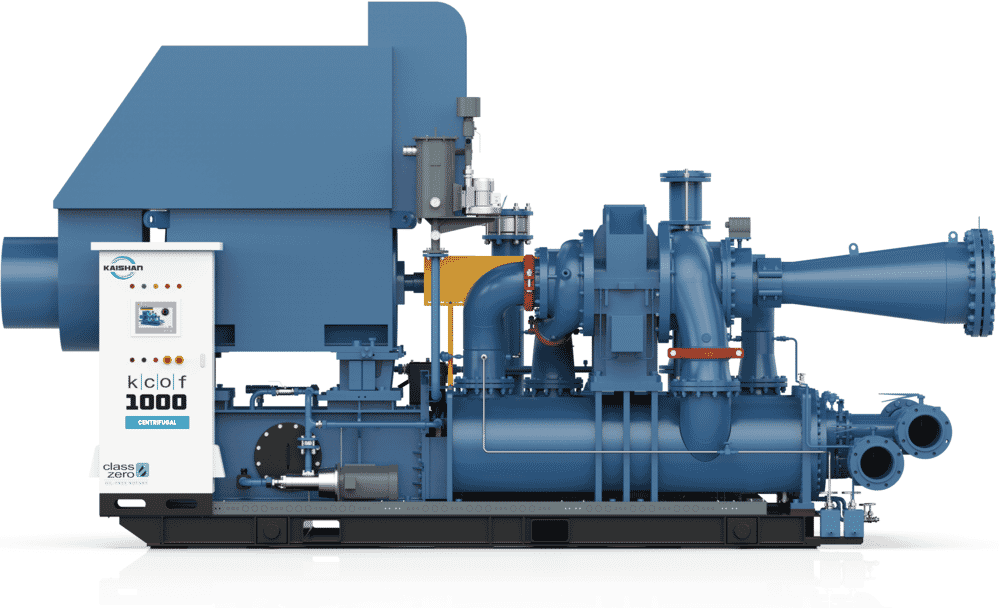
Centrifugals are the go-to for chemical, petrochemical and automotive plants—anywhere you need a lot of clean air delivered steadily for long stretches. They deliver excellent longevity, low maintenance and the ability to handle very high volumes efficiently.
A centrifugal compressor is not a universal solution, however. It serves large users, typically above 400 horsepower, where the flow is steady and predictable. A plant whose demand surges and cycles through the day is better served by paired rotary screw compressors in a cascade setup, described below.
Two-Stage Compressor
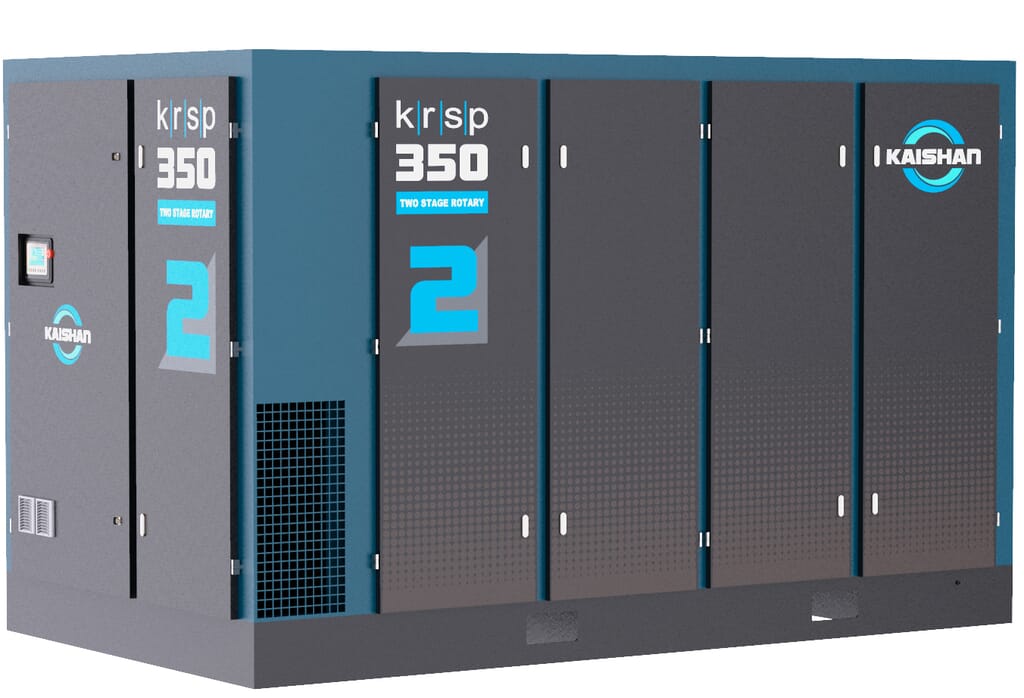
A two-stage air compressor like the KRSP2 premium rotary screw air compressor splits the workload into two separate stages, dividing that work into a first stage with a compression ratio of 2.8 to 1, followed by a second stage, also at 2.8 to 1. Plus, before the second stage, the air passes through an interstage cooling step, removing some of the heat of compression and building efficiency. Paybacks on energy costs alone may be less than two to three years.
A two-stage air compressor offers many advantages when compared to a single-stage unit. It is:
- More energy efficient
- More reliable and long-lasting
- More efficient (it generates more capacity with the same energy)
- Less costly to own
Variable-Speed Drive
The Compressed Air and Gas Institute (CAGI) reports that variable-speed drives can reduce energy use by about a third in the right application. In addition to saving energy, VSDs add to reliability by allowing soft starts, qualifying for utility rebates, offering better control of compressed air systems and addressing rapid cycling.
However, they are not for everyone: Oil-flooded VFDs/VSDs provide acceptable performance from 21%-40% and ideal performance from 41%-70%. Oil-free units are rated acceptable at 41%-70% and ideal at 71%-100%.
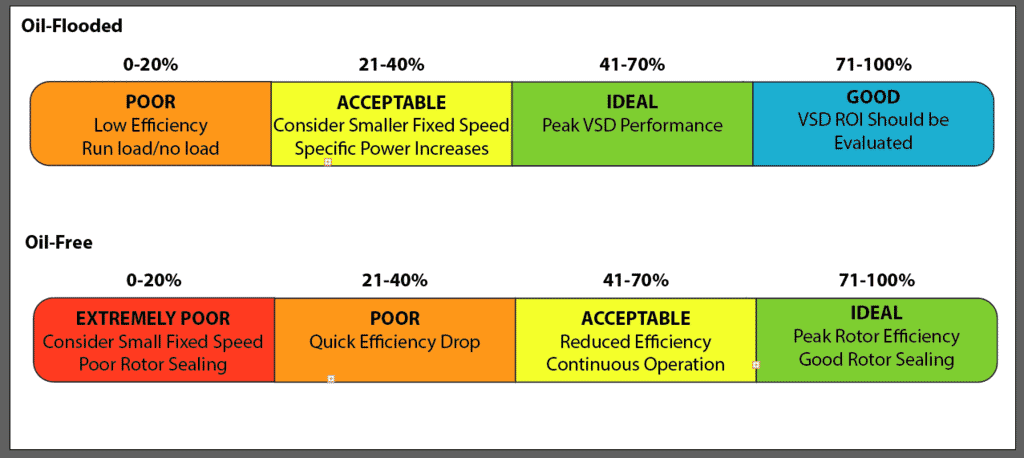
In facilities with a rock-steady 80-100% load that doesn’t need oil-free air, a fixed-speed unit usually is preferred.
Master Control and Flow Control
Many compressed air users have turned to system master controls to network air compressors throughout their plants, operating them in a preprogrammed sequence. The units do not have to be from the same manufacturer, though, of course, they can be.
Properly configured, these advanced controls can allow you to operate your compressed air supply within a relatively tight band, as low as +/-2 PSIG, avoiding the inefficiency of cascading multiple compressors at staggered pressure levels (and a wider pressure band). That’s great news for both operating costs and energy use.
While the system master controls constantly readjust the compressor discharge pressure, a pressure-flow control monitors the air pressure at the control valve, releasing air from the receiver tanks as needed to keep the system stable. It thus buffers the compressors from the ups and downs of system demands.
Pressure-flow control thus allows system master control to deploy compressors in the most efficient sequence, with the combination of the two approaches in one example saving about 20%.
Get True Backup with a Multi-Compressor System
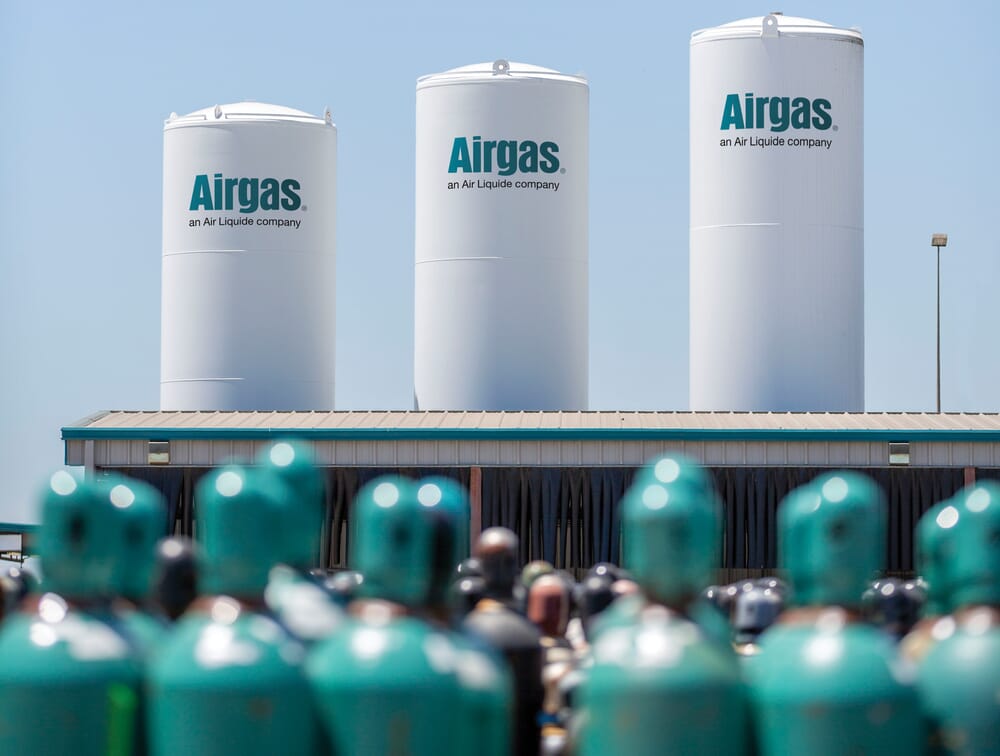
Facilities that adopt a multi-compressor approach involving base, trim and backup units often find the payback period is incredibly short if they factor in reliability issues.
Configuring your compressed air system in this manner virtually eliminates unplanned downtime, which, in the real world, is the biggest (and most avoidable) expense associated with your compressed air system.
Next, let’s talk about small-scale, operational changes.
Operational, Smaller-Scale Changes
You can make many smaller changes to your compressed air system, with a relatively fast break-even point.
Lowering System Pressure
A critical factor in the efficiency and effectiveness of your compressed air system is setting your header pressure.
- Set it too low, and your end-use applications will suffer.
- Set it too high, and you’ll sacrifice air compressor energy efficiency, also reducing reliability and damaging machinery. And make any air leaks even worse.
Plus, a stable header pressure is critical in delivering the even flows of compressed air needed in the semiconductor, healthcare, and electronics industries for sensitive applications such as pneumatic controls and robotics.
We often recommend reducing the setting by about one PSIG per week and checking after each step for an operation that complains. In one example, the pressure was lowered by 15 PSIG before any end users had an issue, clearly demonstrating that the original setting had been compressing more air than the plant used. The target is the lowest pressure that meets production needs; a higher setting adds cost and wastes energy without adding flow. Or value.
Heat Recovery
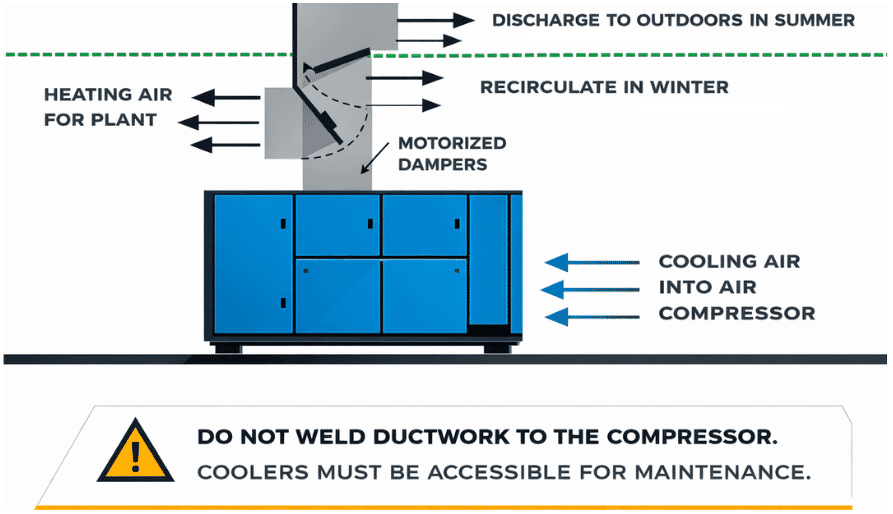
In northern climates, you can save significant energy by recovering heat removed from the compressed air system in winter. After all, as much as 80%-93% of the energy used to compress the air becomes waste heat, and 50%-90% of that can be recovered.
A damper directs the air toward an outside vent in the summer. In the winter, the air is directed toward space heating or preheating for other operations.
Maintain Filters, Drains and Dryers
When the plant runs short on flow, the compressor is not always the cause. A clogged filter or a drain that leaks air can reduce the effective pressure at the point of use.
The goal is to keep the filters, drains and dryers on a regular maintenance schedule. Plus, an oil analysis taken during service is inexpensive and can reveal wear or contamination before a component fails at a far higher cost.
Fixing Leaks
Fixing leaks is one of the least expensive and most effective steps you can take to improve system operation.
After all, compressed air systems can lose as much as 30% of their volume to air compressor leaks, with poorly maintained systems running even higher.
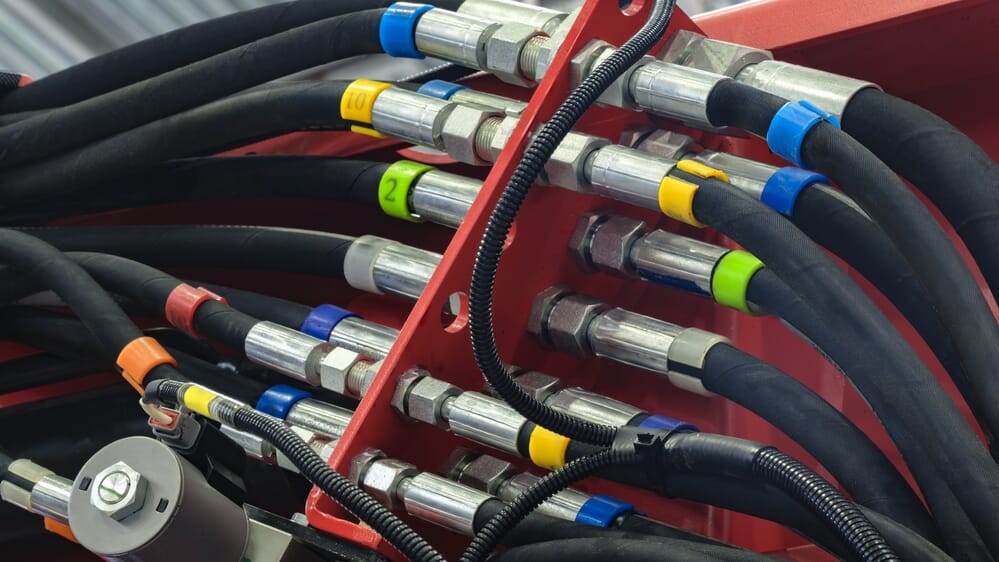
With the sheer volume of individual connections that happen in many applications, it’s not surprising that 30%-40% of compressed air energy losses occur in the “dirty 30”—the last 30 feet before the end-use application.
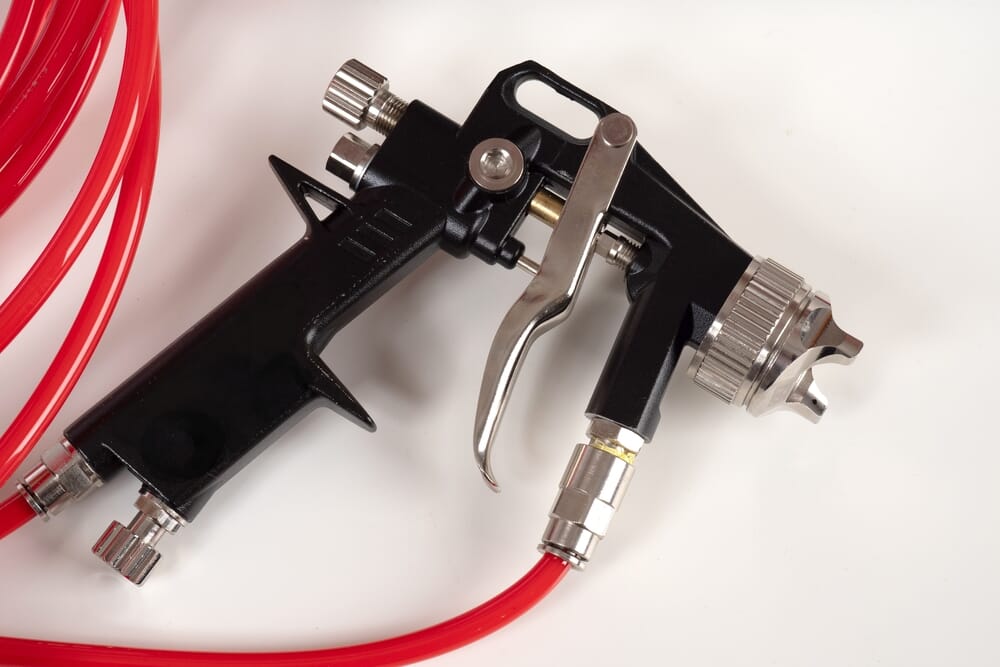
You’ll find those leaks in the hoses, reels, filters, regulators or lubricators that connect the air supply to your machinery. And don’t forget the end-use tools, which can have internal leaks, especially if they’re old or poorly maintained.
Point-of-Use Air
A single high-pressure operation in the plant does not require that the entire system run at that pressure.
A point-of-use compressor can serve that one operation at higher pressure, while the rest of the system continues to run at the lower pressure the other operations need.
Heat-of-Compression Dryers
A heat-of-compression dryer uses a small amount of discharge air from an oil-free rotary screw or centrifugal compressor to remove moisture from a desiccant dryer. As a result, the dryer needs no separate heating energy.
On some Kaishan units, the aftercooler can also be removed from the loop. The drying step then uses less total energy and the payback for the whole package shortens.
Budget for an Annual Audit
You’ll get the most consistent return on your compressed air budget with an annual audit and the leak study that goes with it. Schedule the audit in the same month each year so the operating and weather conditions are comparable between visits and any change is visible.
The audit also supports the rest of the compressed air upgrades on this list. Its data can be run through a simulation that compares the running cost of the current compressor with the cost of a newer unit or a different control scheme, and the result is the payback figure for the larger capital project. That is a number a facility can present to management.
An air compressor audit can produce significant benefits for your organization:
- Saving time and money
- Improving reliability
- Ensuring higher-quality air
- Lengthening equipment lifespan
- Enhancing system performance
Our customer, Berry Global, a $12 billion manufacturer of innovative packaging solutions, has commissioned regular audits for many years. The company told Compressed Air Best Practices magazine it has audited 40% of its plants over the past three years. Some of these audits helped the company achieve dramatic improvements in operational efficiency and cost savings.
The good news is that an audit will require little, if any, interruption in your operation. Once installed, the dataloggers chug away, recording critical parameters in your system and quantifying air flow, pressure drops, humidity, temperature and energy consumption.
Breaking Even; Getting Started
The best place to start is with a compressed air specialist who knows the actual installation. They’ll probably recommend starting with an audit, designed to produce the information you need to get management buy-in for your plan.
Key Takeaways: Where the Break-Even Lands
| Upgrade | Where the break-even tends to land |
|---|---|
| Rotating screw replacement | Shorter once IE4 raises the motor-efficiency bar in 2027. |
| Centrifugal consolidation | The longest, typically years, and cost-effective only at scale with steady load. |
| Two-stage compressor | Compressed air energy savings alone deliver a payback of two to three years. |
| Variable-speed drive | Best with varying load, with a payback of two to five years. |
| Multi-compressor system and controls | Short payback in a plant with reliability issues. |
| Lowering system pressure | Near-immediate. Cut a PSIG, watch the process; nothing else is required. |
| Heat recovery | Using reclaimed energy for space heating and process heat. |
| Maintaining drains, filters and dryers | Short. Low outlay and oil sampling guards against a much larger failure. |
| Fixing leaks | Quick, low-cost cycle that stops invisible leaks. |
| Point-of-use air | Avoids compressing all the system air at the highest level. |
| Heat of compression dryers | It works on energy the compressor already spent. |
| Annual audit and leak study | Months, not years. The best buy on the compressed air budget and the model under every other line. |
Get Off to a Good Start
There’s no better way to get started in calculating the break-even point for your compressed air upgrades than to have a trusted compressed air professional walk through your plant for an initial assessment.
Kaishan USA works with a nationwide network of independent distributors, who can provide that kind of on-site help and consultation.
We partner with independent, local distributors because it’s the best way to make sure you get the right system, reliable service and quick access to parts when you need them most.
They have factory-trained technicians and a deep understanding of industrial applications and can help you review your options and gather the data you need to establish the break-even point for any system upgrades you’re considering.
When you buy through Kaishan, you’re getting more than a product—you’re getting a local partner who cares about your business and wants to see it succeed. Contact us today.
Further Reading
“How an Air Compressor Audit Can Help You Build Competitive Advantage.” We cite actual case studies showing the benefits customers achieved with air audits.
“How a Multi-Compressor System Can Help You Reduce Compressor Downtime.” This post explains how a multiple-compressor system can help you build reliability and lengthen compressor life.
“Finding the Hidden Factors to Do a Cost-Benefit Analysis for a New Air Compressor.” Walking through the process of analyzing a compressor purchase.
“Compressor Upgrade Benefits vs. the Hidden Costs of Waiting.” We list the various factors that determine whether it’s time to upgrade your compressor.
Frequently Asked Questions
Listen to the Podcast Version



The 12 Percent Trap and the 2027 Efficiency Cliff
Welcome to The Big Dog Podcast. I am Jason Reed, sitting here with Lisa Saunders, and today we are tackling a massive financial paradox happening right on plant floors everywhere.Yeah, welcome everybody. Jason, it blows my mind how many plant managers will spend weeks dickering over a few thousand bucks on the upfront purchase price of a compressor, but then completely ignore what happens the second it gets wired up.
It is what I call the twelve percent trap. A Department of Energy study showed that the initial purchase price of an air compressor accounts for only about twelve percent of its total cost of ownership. Twelve percent! Meanwhile, electricity swallows a massive seventy six percent.
Seventy six percent! So, so you are essentially arguing over the small change at the cash register while throwing hundred dollar bills right out the window every single month in power bills.
Precisely. And look, the timeline on this math is about to get even tighter because of the Department of Energy regulations coming up in 2027.
Right, the motor efficiency tiers. Explain what is actually changing there in 2027.
So in 2027, the Department of Energy is raising the minimum efficiency standard for mid range electric motors. They are moving from the IE3 tier up to IE4. That means new motors driving compressors will produce the exact same volume of air while drawing significantly less energy.
Which means if you are running a machine that is ten years old or older, the efficiency gap between your old unit and a new IE4 unit just blew wide open.
Exactly. That gap shortens your payback period dramatically. Over the last decade, manufacturers like Kaishan have refined rotor profiles, bearing setups, and oil flow dynamics. So even before 2027, today's rotary screw machines are fundamentally different beasts than what was built ten years ago.
Okay, but let us talk real world shop floor decisions. I talk to maintenance managers who treat these machines like old farm trucks. You know, if it turns over, keep running it. When a big ten year old hundred horsepower unit breaks down, their knee jerk reaction is to rebuild it.
And that is where our rule of thumb comes in. If a major repair costs more than fifty percent of what a brand new compressor would cost, you really need to upgrade. Think about it, if you drop fifteen thousand dollars to rebuild a legacy machine, sure, it runs again, but you just locked in an extra fifteen to twenty thousand dollars a year in wasted power compared to a modern machine.
So by trying to save money on the repair, you are actually funding a new compressor for the power company instead of yourself! In under three years, the extra electrical waste alone could have paid for a brand new installation.
High Level Math Two Stage VSDs and System Paybacks
That is the reality. And when you look at capital upgrades, the payback timelines can be shockingly short if you pick the right technology for your load.Let us break those options down. What about two stage rotary screw compressors?
Two stage compressors are incredible energy savers. Instead of forcing air through one massive compression step, a two stage unit like a Kaishan KRSP2 splits the workload. It does a 2.8 to 1 compression ratio in the first stage, passes the air through interstage cooling to strip out heat, and then hits another 2.8 to 1 ratio in the second stage.
Because air is easier to compress when it is cooler, right?
Spot on. Basic thermodynamics. That efficiency gain is so pronounced that energy savings alone can yield a complete payback in under two to three years.
What about Variable Speed Drives? The Compressed Air and Gas Institute, or CAGI, highlights VSDs constantly.
CAGI benchmark data shows that a properly sized VSD can trim overall system energy use by about a third when you have fluctuating plant demand. An ASME study pegged the break even point for a VSD at two to five years. But, Lisa, VSDs are not a magic wand for every floor.
Right, because if your facility runs flat out at eighty to one hundred percent capacity all day long, a fixed speed compressor is actually more efficient. VSDs shine when demand swings around.
Exactly. Now, what if you have grown over the years and suddenly realize you have six or eight separate small rotary screw units scattered across the compressor room?
Ah, the patchwork setup! That is where centrifugal consolidation comes in.
Yeah. If your plant demand is steady and pushing above four hundred horsepower, consolidating those six or eight smaller rotary screws into one main centrifugal unit, plus one standby, compresses your physical footprint and slashes power draw. You are looking at a payback period of three to five years there.
And we cannot forget the invisible cost in all this math, downtime. It is so hard to put a line item on a spreadsheet for downtime avoidance, but when a line goes dark, labor costs roll on and maintenance crews are scrambled.
Airgas Puritan Medical installed two thirty horsepower direct drive Kaishan rotary screws in a multi compressor system for exactly that reason. Their supervisor put it bluntly, if the air goes down, nine guys stand around doing nothing. Unplanned downtime is the single most expensive risk you face.
Having a proper base, trim, and backup setup virtually eliminates that risk while giving you total peace of mind.
It really does. Well, that wraps up our quick take for today. Thank you so much for tuning in to The Big Dog Podcast.
Thanks everyone. Catch you next time!