

Two critical facts make your compressed air system fertile ground for energy savings. And logically, one of the best places to turn to improve your overall energy efficiency.
- First, we’ve found that the largest motor in most manufacturing plants is typically on an air compressor.
- Second, your compressor is frequently one of the largest (if not the largest) energy consumers in your plant.
And those compressed air energy savings go right to the bottom line: if your company’s margins are, say, 2%, a savings of even $10,000 would work out the same as $500,000 in additional sales. That’s why air compressor energy efficiency is one of the pillars of compressed air efficiency.
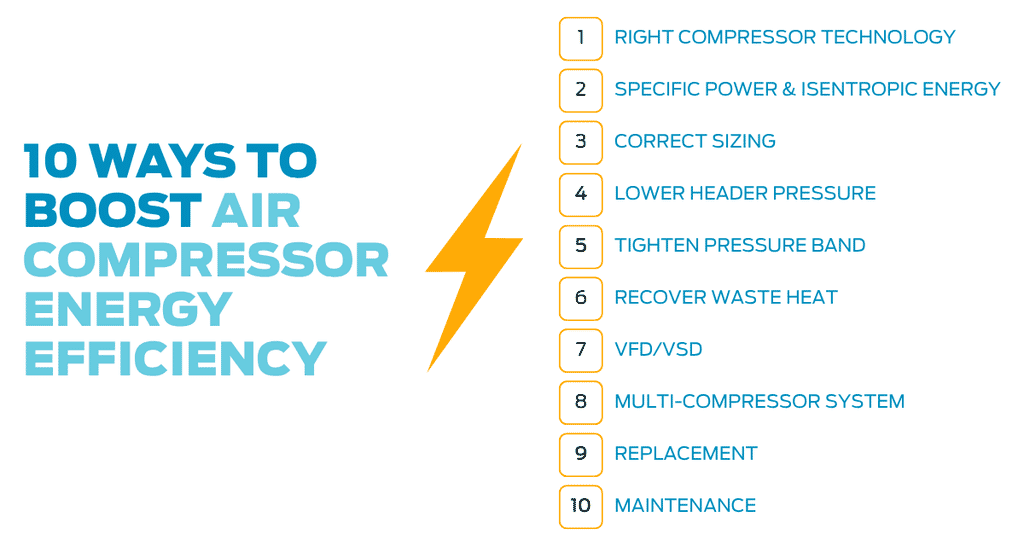
We’ve compiled a list of 10 ways to boost compressed air energy efficiency in your system and plant. Not to mention your bottom line.
10 Ways to Boost Air Compressor Energy Efficiency
We’ll start with selecting the right compressor.
1. Select the Right Compressor
There are three main types of compressors used in most industrial plants today:
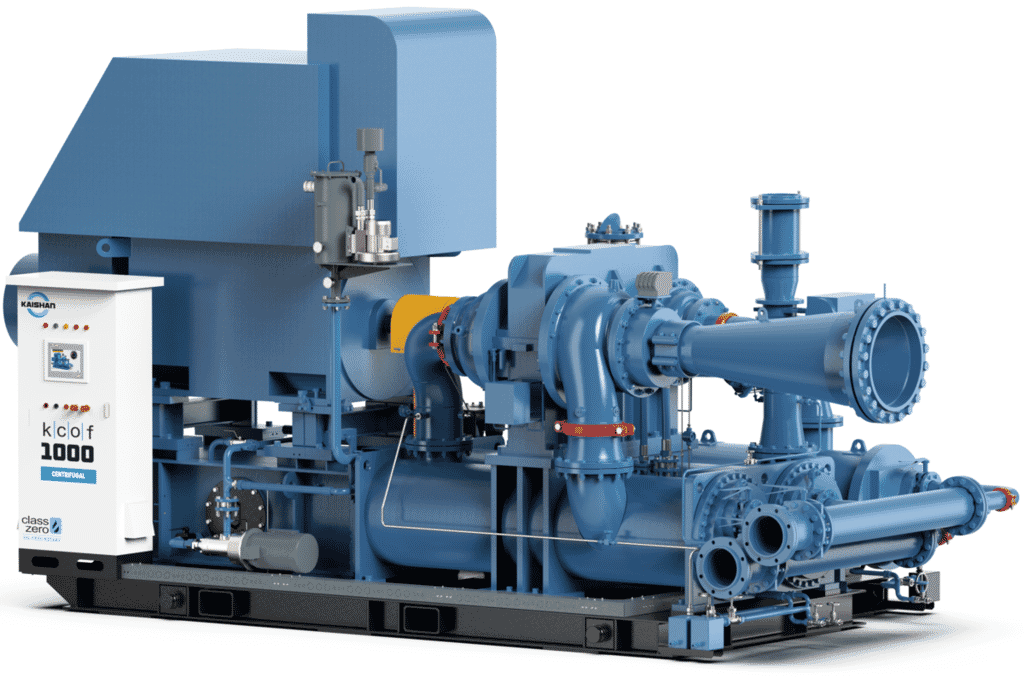
- Centrifugal compressors, such as Kaishan’s KCOF centrifugal air compressor,are most efficient in applications that need large amounts of continuous flow.
- Reciprocating compressors are generally the most cost-effective choice for smaller applications.
- Rotary screw compressorsare used in most industrial and commercial facilities today because of their efficiency, long life and low cost of ownership.
Generally, a centrifugal air compressor is most cost-effective for high-volume applications (above 2,500 CFM). A small, reciprocating compressor is the best choice for low-volume applications (less than 20 CFM). Screw compressors are the best for everything in between, because they delivermore compressed air per horsepower, have a 100% duty cycle and are known for their dependability, long life and low cost of ownership.
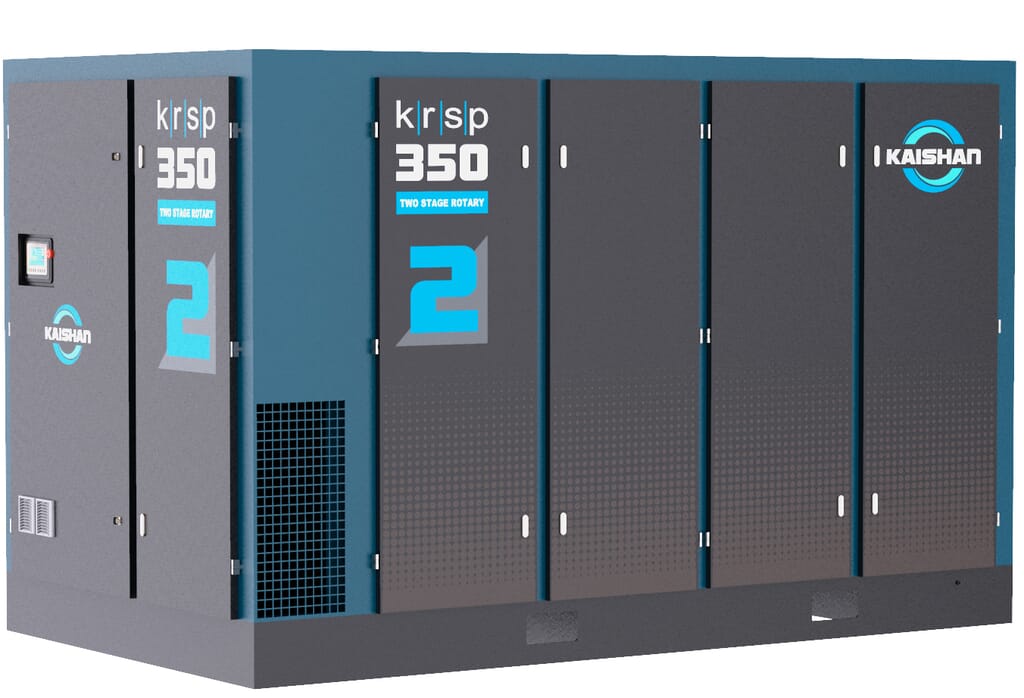
You may also want to consider two-stage compressors. By dividing the compression cycle into two stages, a two-stage model such as Kaishan’s KRSP2 premium rotary screw air compressor will generate 15-20% more flow in the same-sized air compressor, resulting in a payback that quickly recoups the price difference.
For more on the pros and cons of different compressor types, read our blog post, “Which Type of Air Compressor Is Best for Your Application?”
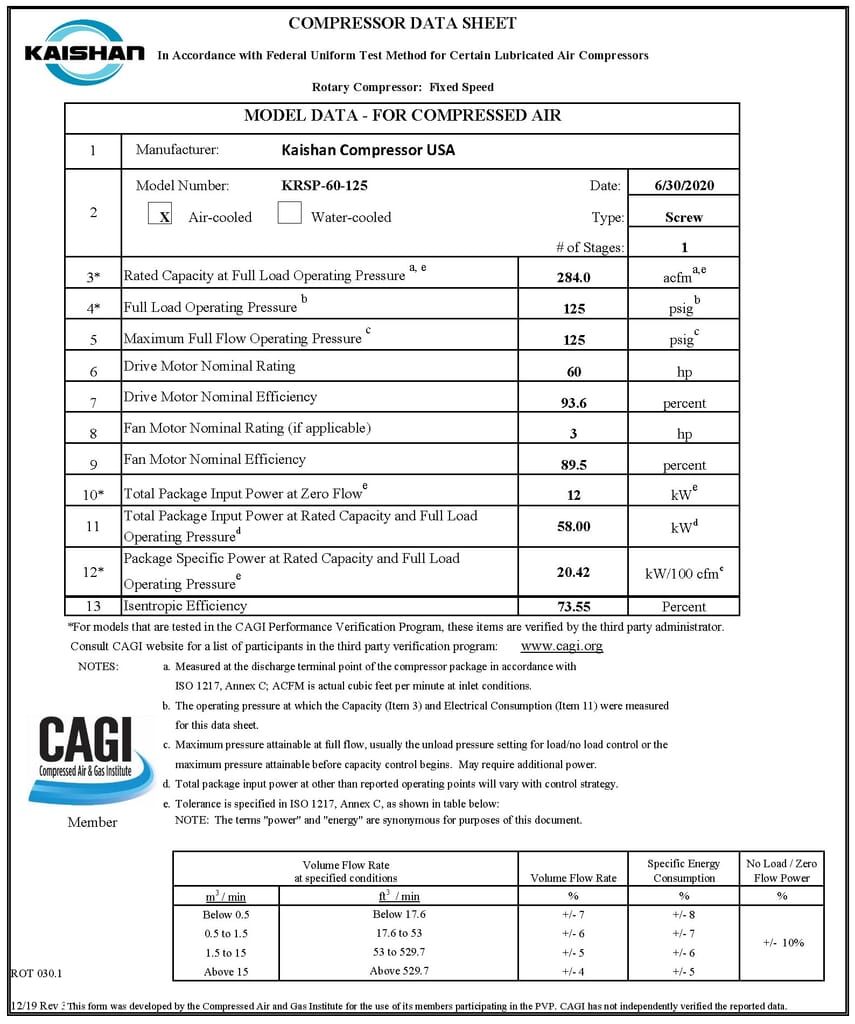
The new forms from CAGI can help you choose the most energy-efficient air compressor.
2. Understand Specific Power and Isentropic Energy
When you’re comparing compressors, the fastest way to be misled is to look at nameplate horsepower alone. Two compressors can both be 200 HP and deliver very different real-world air compressor energy efficiency. What you want is a measure of how effectively the compressor turns electric power into delivered air at your required pressure.
The two terms used most frequently in describing a compressor’s energy efficiency are:
- Specific power: The established standard, typically expressed as kW per 100 CFM(or similar), tells you how much electrical power a compressor consumes to make a unit of air. The lower the number, the better.
- Isentropic efficiency/energy rating: The new standardized way to evaluate compressor performance, with a 100% rating indicating no mechanical losses or heat generation. The higher the number, the better.
Isentropic efficiency has now become the new benchmark for air compressor energy savings and is especially important when comparing machines and configurations. No one currently reaches that 100% ideal and probably never will. But we’re all trying.
Find more details on these energy measurements in our blog post, “A Beginner’s Guide to Reading Rotary Screw Compressor Performance Curves.”
3. Size Your Air Compressor Correctly
Time and again, experience has shown that the most serious air compressor problems stem from mistakes in sizing or application.
With rotary screw air compressors, especially, that means oversizing. Or over-buying. Trying to add more “muscle” to your system or anticipate future needs.
It may seem counterintuitive, but with rotary screw air compressors, “too much” is almost as bad as “not enough.” Largely because oversizing is the leading cause of rapid cycling, which causes maintenance nightmares, equipment failures, downtime and unnecessariy high energy costs.
We recommend that you work with your compressed air consultant to audit your system. Then buy a compressor that matches your needs.
For more on correctly sizing your compressor, download our white paper, “Demystifying Air Compressor Sizing.”
4. Set Header Pressure as Low as Possible
A critical factor in the efficiency and effectiveness of your compressed air system is optimizing air compressor pressure. Especially in the semiconductor, healthcare, pharmaceutical and electronics industries.
- Set your header pressure too low, and your end-use applications will suffer.
- Set your header pressure too high, and you’ll sacrifice air compressor energy efficiency, reduce reliability and damage machinery. And increasing the amount of air escaping through leaks in your system.
A stable header pressure is critical in delivering the even flows of compressed air needed in many applications.
5. Tighten Your Pressure Band
If you set your compressor to load 115 PSIG and unload at 125 PSIG, that gap of 10 PSIG is called the pressure band.
The purpose of the pressure band is to prevent your compressor from loading and unloading too quickly, which can cause short or rapid cycling, increase thrust loads, reduce bearing life and damage electrical components.
Unfortunately, having a pressure band of 10 PSIG wastes a lot of energy. As a result, you should reduce the pressure band as low as possible without affecting end-use applications, according to Compressed Air Best Practices.
For more details on setting your pressure band correctly, read our blog post, “How Lowering the Pressure Band of Your Compressed Air System Can Save You Money.”
6. Recover Waste Heat
At least 70% to 80% of the energy your unit uses to compress air is wasted as heat. And Compressed Air Best Practices says you can recover up to 90% of that heat loss, using it for:
- Space heating, especially in northern climates
- Heating water
- Drying
- Warming or cooking food
For more information on configuring your compressed air system to maximize heat recovery, see our blog post, “Compressor Room Design.”
7. Consider Variable-Frequency/Variable-Speed Drives
The application of variable-speed/variable-frequency drives to rotary screw air compressors has enabled many companies to save significant amounts of energy. And energy savings are not the only benefit. VFD/VSD compressors can earn rebates, allow soft starts and offer better control of your compressed air system.
For maintenance managers and plant leaders who live and breathe uptime and operating costs, a VFD/VSD air compressor can be a game-changer. Increasing air compressor energy efficiency. Saving money. Meeting variable demand. Avoiding short cycling. Reducing your pressure band.
But they are not a good choice at the extremes—we encourage customers not to use a VFD/VSD compressor when the machine runs at 20% of its total capacity most of the time. Or more than 80%. As a result, you’ll want to work with a compressed-air professional to ensure a VFD/VSD is right for your application.
For more on the pros and cons of VFD/VSDs, see our blog post, “When To Use a VFD/VSD on a Rotary Screw Air Compressor.”
8. Adopt a Multi-Compressor Configuration
We often encourage customers to install a compressed air system design involving base, trim and backup units:
- A base-load compressor meets your system’s minimum compressed air load.
- A trim compressor handles fluctuations in demand above the base level.
- A backup compressor is on standby if a base or trim unit goes offline.
In addition to conserving energy, a multi-compressor approach virtually eliminates unplanned downtime, simplifies maintenance and reduces electricity usage.
For more on compressed air system design using a three-compressor configuration, read our blog post, “How a Multi-Compressor System Can Help You Reduce Compressor Downtime.” [Link to: https://kaishanusa.com/blog/how-a-multi-compressor-system-can-help-you-reduce-compressor-downtime/]
By the way, if you have more than one compressor, you’ll need controls. Especially a master controller. Without coordination, machines may fight each other: one loads, another unloads, pressure bounces and power spikes. And you end up paying for air you do not need.
A master controller helps by:
- Sequencing machines efficiently
- Maintaining stable header pressure with fewer swings
- Reducing unload time and inefficient part-load operation
- Managing trim response
Properly configured, these advanced controls can allow you to operate your compressed air supply with a pressure band as low as +/-2 PSIG. And that’s great news both in operating costs and energy use.
There are, of course, a wide range of control options you may want to consider. For more information on controls, read our blog post, “Everything You Need to Know About Compressed Air Controls.”
9. Replace Aging Equipment
Even if your air compressor is working well, you may want to consider replacing it if it’s more than 10 years old.
Today’s cutting-edge compressors can deliver energy savings of at least 20% and up to 40% compared to the aging units they replace. Other benefits include:
- Better performance
- Greater insight and better decision-making
- Easier compressed air system maintenance
- Less downtime
- Lower costs
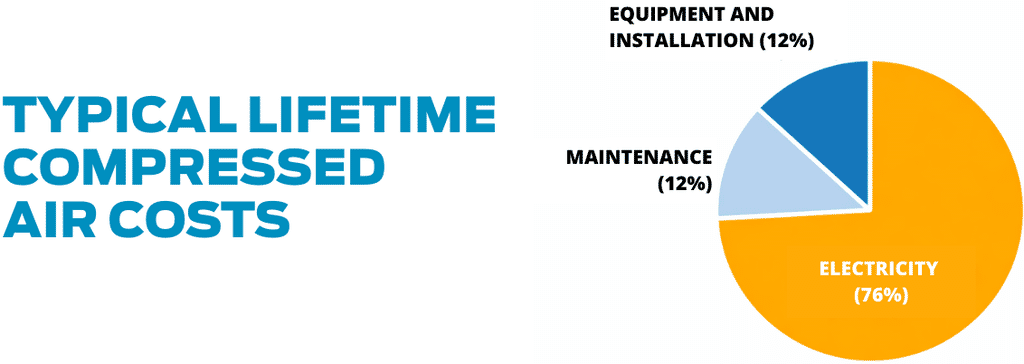
And remember that energy savings far outweigh initial cost in any calculation of lifetime costs.
10. Maintain, Maintain, Maintain
Good maintenance can help you improve the operation and performance of your compressed air system in the following ways:
- Keeping costs under control
- Managing the risk of unplanned downtime
- Improving reliability
- Maximizing investment
- Extending the life of your equipment
- Eliminating costs associated with emergency replacements
You can do all that and more with a comprehensive, well-planned maintenance program that includes preventive and predictive maintenance. In fact, research shows that a proactive maintenance strategy can reduce maintenance costs by as much as 70%.
A related issue is preventing leaks. The average compressed air system loses 30-50% of its volume to leaks, according to Compressed Air Best Practices. So, finding and fixing leaks contributes greatly to compressed air energy efficiency.
For more information, visit our recent blog post, “Eight Causes of Compressed Air Leaks and How to Find Them.”
And, for more details on maintenance in general, read our post, “Ten Need-To-Know Rotary Screw Air Compressor Maintenance Tips.” Or download our white paper, “Air Compressor Maintenance: Ultimate Guide and Checklist.”
Implementing a comprehensive maintenance and leak-repair program can be challenging. And initiating a comprehensive energy savings program, even more so.
The good news is that help is available nearby.
Your Local Resource for Air Compressor Energy Savings
When you combine advances in equipment technology with declining maintenance resources, you can see that facility managers are increasingly hard-pressed to implement programs to improve compressed-air energy efficiency.
But help is available. Kaishan USA works with a nationwide network of independent distributors, who can provide on-site help and consultation as needed.
Ten Powerful Ways to Boost Air Compressor Energy Efficiency
1. Select the right compressor.
2. Understand specific power and isentropic energy.
3. Size your air compressor correctly.
4. Set header pressure as low as possible.
5. Tighten your pressure band.
6. Recover waste heat.
7. Consider variable-frequency/variable-speed drives.
8. Adopt a multi-compressor configuration.
9. Replace aging equipment.
10. Maintain, maintain, maintain.
Your Partner in Compressed Air Energy Efficiency
We work with local distributors because it’s the best way to ensure you get the right system, reliable service and quick access to parts when you need them most.
They have factory-trained technicians and a deep understanding of industrial applications, helping you maximize efficiency and minimize downtime. They offer expert guidance, faster response times and personalized support tailored to your needs.
They are uniquely qualified to be more than a vendor. They can be a partner in helping you build compressed air energy efficiency and long-term success.
Find the one closest to you. Or, feel free to contact us directly.
Further Reading
“Which Type of Air Compressor Is Best for Your Application?” More on the pros and cons of different compressor types.
“A Beginner’s Guide to Reading Rotary Screw Compressor Performance Curves.” Isentropic energy ratings explained.
“Measuring For Air Compressor Energy Efficiency: What To Track, Why It Matters, What To Do Next.” A listing of the measurements you can track to improve compressed air energy efficiency.
“Five Questions You Need To Answer To Get Compressed Air Header Pressure Right.” We walk you through the process of setting header pressure.
“Your Gameplan for Optimizing Rotary Screw Air Compressors For Maximum Energy Savings.” Eight steps you can take to maximize compressed air energy savings.
“Demystifying Air Compressor Sizing.” More information on sizing your compressor correctly.
“How Lowering the Pressure Band of Your Compressed Air System Can Save You Money.” Details on setting your pressure band correctly.
“When To Use a VFD/VSD on a Rotary Screw Air Compressor.” More information on the pros and cons of VFD/VSDs.
“Everything You Need to Know About Compressed Air Controls.” More information on the wide range of control options you may want to consider.
“Want To Boost Your Plant’s Energy Efficiency? Start With Your Compressed Air System.” We emphasize the important role compressed air can play in your plantwide energy efficiency program. ,
“Eight Causes of Compressed Air Leaks and How to Find Them.” More on finding and fixing leaks.
“Ten Need-To-Know Rotary Screw Air Compressor Maintenance Tips.” More details on maintenance in general.
“Air Compressor Maintenance: Ultimate Guide and Checklist.” A white paper with a full checklist of air compressor maintenance tips.
“Three Reasons Rotary Screw Air Compressors Win At Total Cost Of Ownership.” Explains why rotary screw compressors are such an attractive long-term investment for your company.
“Energy Efficiency Unleashed: The Advantages Of Rotary Screw Air Compressors.” A list of the advantages of rotary screw compressors.
“Leveraging Industrial Air Compressors for Energy Cost Reduction.” A comprehensive guide to the energy conservation opportunities the industrial air compressor industry provides.
“How a Multi-Compressor System Can Help You Reduce Compressor Downtime.” How a multi-compressor system can help you conserve energy, save electricity, avoid emergency services and extend equipment life.
Frequently Asked Questions
Start with a compressed air audit (often available free or at low cost through energy providers). Key areas to assess include:
- Leak detection using ultrasonic equipment or soapy water
- Pressure drop analysis across the system
- Condensate management and cooler efficiency
- Clogged filters can increase energy usage
- End-use assessment to identify demand patterns
Most facilities discover 20-30% energy waste through these non-invasive methods before considering capital upgrades.
- Pressure optimization: 1-3 months payback
- Leak repairs: 2-6 months payback
- Variable frequency drives (VFDs): 1-3 years payback
- Equipment replacement: 2-5 years payback
- Cooler cleaning/maintenance: Immediate savings (free/low-cost).
Essential maintenance includes:
- Replace intake filters every 6-12 months
- Change compressor oil and sample oil per the manufacturer’s specifications
- Clean air coolers quarterly to maintain heat transfer efficiency
- Drain condensate regularly (manual or automatic traps)
- Inspect and replace hoses/fittings to prevent leaks
- Check valve performance to ensure proper operation
Well-maintained systems operate 10-15% more efficiently than neglected ones.
Most industrial facilities operate 2-5 PSI higher than necessary. Best practice:
- Conduct a pressure-mapping study to identify actual minimum requirements by department
- Set compressor discharge pressure to meet peak demand + 5-10 PSI buffer
- Use pressure regulators at the point of use for equipment requiring lower pressures
- Lowering discharge pressure by just 2 PSI reduces energy consumption by approximately 1%
This optimization typically requires no equipment changes and maintains production quality.
Modern solutions include:
- Real-time energy monitoring systems that track kW consumption and CFM output
- Automated pressure controls that adjust discharge pressure based on demand
- Flow meters to measure actual air usage and identify waste
- SCADA integration for centralized system monitoring
- Data analytics platforms that provide historical trends and optimization recommendations
These technologies typically cost $5,000-$15,000 but deliver continuous insights for ongoing efficiency improvements and can reduce energy consumption by an additional 5-15%.
Listen to the Podcast Version



The hidden cost of free air
Welcome to the show, everyone! Lisa, here’s the number that ought to make any plant manager sit up: in a lot of facilities, the air compressor is either the biggest motor in the building or awfully close to it. And the ugly part is, compressed air feels free once it’s in the pipe. So leaks, oversizing, bad settings -- all that stuff hides in plain sight on the power bill.That “feels free” part is the trap. Because nobody watches air the way they watch scrap or overtime. But if compressed air can eat 10% to 30% of a plant’s electricity, that’s not background noise. That’s a budget line with steel-toed boots on.
Exactly. And I wanna make one thing clear right out of the gate: a compressor running fine is NOT the same thing as a compressor running efficiently. If it starts, makes pressure, and the line keeps moving, people say, “We’re good.” Maybe. But maybe you’re burning money every hour and calling it normal.
So let’s start where people usually don’t. Not with leaks, actually, but with buying the machine in the first place. Because once the wrong compressor is on the pad, you kind of inherit that mistake every day after.
Right. Different jobs, different compressor types. If you need really high, continuous flow -- think above about 2,500 CFM -- centrifugal can make sense. Tiny demand, under 20 CFM, reciprocating is often the economical choice. Most industrial plants live in the middle, and that’s where rotary screw usually wins because you get solid efficiency, long life, and a 100% duty cycle.
That 2,500 CFM versus 20 CFM split is actually helpful, because people hear “best compressor” like there’s one champion. There isn’t. It’s more like footwear -- steel toes for the floor, running shoes for the track. Wrong tool, wrong outcome.
And if you’re in rotary screw territory, two-stage is worth a hard look. Split the compression into two stages and you can see 15% to 20% more flow out of the same size machine. That can change the economics fast.
Okay, but this is where I push back on the shop-floor instinct to just buy bigger and “be safe.” Because I hear that all the time. “Let’s plan for future growth.” Sounds responsible. Sometimes it’s just expensive optimism.
Expensive optimism -- that’s good. And you’re right. Especially with rotary screw compressors, oversizing is a killer. People think too much capacity is harmless. It’s not. Oversizing drives rapid cycling, which beats up bearings, electrical components, controls -- and it pushes energy cost up for no good reason.
So let me try to say it back. If the machine is too small, production suffers. But if it’s too big, you can get that load-unload, load-unload nonsense, and now the compressor spends its life twitching instead of working.
That’s it. “Too much” is almost as bad as “not enough.” Size to actual demand, not the version of the plant you hope exists in three years. Audit the system. Measure the load. Then buy what matches reality.
And while we’re on measurement -- because this is where spec sheets get slippery -- nameplate horsepower by itself tells you almost nothing useful, right?
Right. Two 200-horsepower compressors can perform very differently. The better way to compare them is specific power -- usually kilowatts per 100 CFM. Lower is better. You’re asking, how much electrical power does it take to make a unit of air? Then there’s isentropic efficiency, which is the newer benchmark. Higher is better there. One hundred percent would mean no losses to heat or mechanics, which nobody hits, but it’s still a much better comparison tool.
I like that because it forces the conversation away from “how big is the motor?” and toward “how well does this thing turn electricity into useful air?” That’s the real question. Horsepower is bragging rights. Specific power and isentropic efficiency are the report card.
Yep. And if you only remember one thing from this first half, it’s this: energy efficiency starts before the install. Pick the right technology, compare machines with the right metrics, and don’t oversize the compressor just to make yourself feel safe.
Where the real energy savings show up
Then once the machine is in, the real game starts. And this is where the boring settings turn into real money. Header pressure, pressure band, controls, maintenance -- the stuff nobody brags about at lunch.Let’s hit header pressure first. Most plants run higher than they need to. And every extra bit of pressure costs you. Best practice is set it as low as possible without hurting the end use. There’s a handy rule of thumb here: cut discharge pressure by 2 PSI, and you trim energy use by roughly 1%.
That 2 PSI for 1% is one of those numbers that sticks. Because it means “just a little high” is not little over a full year. But go too low and now tools, valves, robotics, whatever’s downstream, start misbehaving.
That’s why you map the system. Find the actual minimum pressure the plant needs. Then don’t run 5 PSI or 10 PSI above that just because nobody wants a complaint call.
And right beside header pressure is pressure band. If a compressor loads at 115 PSIG and unloads at 125 PSIG, that 10-PSIG spread is the band. Necessary? Yes. Efficient? Usually not.
Exactly. Big pressure bands waste energy. You want that band as tight as you can get it without causing short cycling. With good controls -- especially master controls in multi-compressor setups -- you can get pressure stability down around plus or minus 2 PSIG. That is a much calmer, cheaper system.
And “machines fighting each other” is real. One loads, another unloads, pressure bounces, power spikes. It’s like three people trying to steer one pickup truck from different seats.
Not a great road trip. Which gets us to multi-compressor systems. Base, trim, backup. Base-load unit handles the minimum demand. Trim machine handles the swings. Backup sits ready in case somebody goes down. Done right, that setup cuts waste and protects uptime.
I think the trim part is where people suddenly see it. Because plants aren’t flat demand all day. Shift change, one line goes idle, another kicks on. If your system can’t flex, you pay to make air nobody needs.
And that’s where VFDs or VSDs can be great -- IF the demand profile fits. They help with variable demand, soft starts, better control, less short cycling. But I’m gonna be the wet blanket here: they’re not magic. If the machine runs under 20% most of the time, or over 80% most of the time, a VFD may not be the right answer.
Thank you. Because VFD gets thrown around like holy water. Useful, yes. Universal, no. If your load is basically steady, don’t force a variable-speed solution onto a fixed-demand problem.
Another big one people miss: heat recovery. About 70% to 80% of the energy used to compress air ends up as heat. And you can recover up to 90% of that waste heat for space heating, water heating, drying -- even food warming in the right process.
The “70% to 80% becomes heat” stat is the one that always gets me. Because that means your compressor room is basically telling on itself. If it’s hot enough to make you miserable in there, there’s probably useful energy going up as waste.
Then we get to aging equipment. If your compressor is more than 10 years old, even if it still runs, it may be costing you. Newer equipment can cut energy use by at least 20% and sometimes as much as 40% compared with older units.
And that matters because over a compressor’s life, electricity is the monster cost. Not the purchase price. Electricity is roughly 76% of lifetime cost, while equipment and installation are around 12%, and maintenance around 12%. So the cheap machine can turn out very, very expensive.
Last one, and honestly maybe the least glamorous and most important: maintenance. Preventive, predictive, and leak repair. Research shows proactive maintenance can cut maintenance costs by as much as 70%. And leaks? Average systems lose 30% to 50% of their volume to leaks. Thirty to fifty!
Imagine buying 100 pounds of material and quietly throwing 50 pounds in the dumpster. Nobody would tolerate that. But with air, because you can’t see it, plants tolerate it for years.
That’s why the best savings almost never come from one dramatic fix. It’s system thinking. Right machine. Right pressure. Tight controls. Useful heat recovery. Smart sequencing. Fresh eyes on old equipment. And maintenance that treats leaks like lost money -- because that’s what they are.
Yeah. The punchline is kind of unsexy: discipline beats drama. If your compressor room feels boring, stable, and well-controlled... that’s probably what savings sounds like. Thanks for listening.