


Air Compressor Turndown Capability: The Less-Than-Perfect Way to Deal with Compressed Air Demand Variation
April 22, 2026Managing Your Compressed Air System as an Asset
By John Schmitt, Marketing Product Manager | April 29, 2026 | Uncategorized
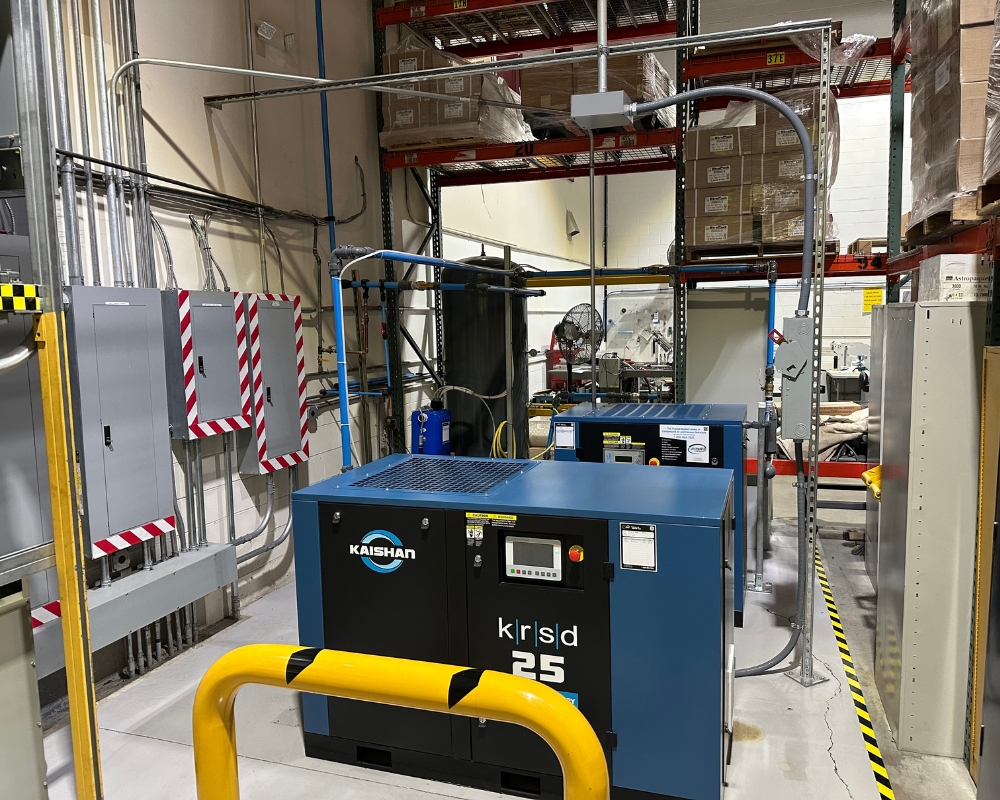
When Adams Direct & Media Services in East Hanover, NJ, upgraded to new equipment, the company discovered its existing compressors couldn’t provide the clean air its advanced new printer required. It replaced its two “dirty, old compressors” with a multi-compressor system that balances the workload between two Kaishan rotary screw compressors, a KRSD direct-drive unit with variable-speed drive and a KRSB direct-drive, fixed-speed compressor.
It’s a fact of life in the compressed air segment that too many facility managers don’t pay attention to their compressed air systems until they break.
Unfortunately, that’s often too late to avoid a host of negative consequences, including downtime, product contamination, equipment damage and more.
That “out-of-sight, out-of-mind” attitude misses an important reality in today’s industrial enterprise.
Your air compressor didn’t cost as much as that $2 million, brand-new piece of production equipment on the main shop floor.
But that showpiece machinery may be more closely connected to your air compressor than you initially realize. Without a clean, reliable source of compressed air, your technological marvel doesn’t run. It’s a $2 million doorstop.
That production dependency gives compressed air much more importance in today’s factory than it had when it was just running hand tools like grinders, nail guns and paint sprayers.
You might point out that you don’t have to pay the same level of attention to electricity, water and natural gas that we are asking for your fourth utility, compressed air. That’s true, of course. But it misses a key point: compressed air is the only utility you produce entirely on-site.
As a result, plant managers who find themselves in this situation would be well advised to adjust their thinking about compressed air: they need to remember that crucial aspects of their operations depend on it. Making it as mission-critical as that new equipment their companies acquired.
To address that new reality, they need to be thinking in broader terms. And be thinking of their compressed air systems with the same rigor as their production machines.
They need to adopt a compressed air asset management mindset: treating their air compressor and its associated peripherals as assets, not expenses.
So, what would it look like to manage compressed air as an asset?
Compressed Air as an Asset
Considering compressed air as an asset requires long-term rather than short-term thinking. Being proactive, rather than reactive. Converting from preventive to predictive maintenance. Planning not over hours or even weeks. But over years. In short, giving your compressed air system more long-term attention.
Key elements include data collection, maintenance and remote monitoring. We’ll start with data collection.
Data Collection
Today’s compressors are equipped with sensors that track a significant amount of information, including the following:
- Temperature
- Discharge pressure
- Specific power
- Differential pressure across filters
- Pressure dew point
- Power consumption
You’re missing a huge opportunity if you’re not capturing and using that information. Putting that information to good use can help you save money, optimize performance, lengthen equipment life, enhance safety, improve reliability and reduce or even eliminate downtime.
As we note in our blog post, “The Five Pillars of Air Compressor Efficiency”, you can’t improve air compressor efficiency without tracking the relevant data. For instance, you won’t know if you’re using more or less energy, delivering consistent pressures or extending your compressor’s lifespan if you don’t have a true picture of where you are today. And that starts with the numbers.
Plus, top management requires you to provide data to support requests for upgrades or new equipment. And it helps you convince your bosses that you are taking an efficient, business-oriented approach.
Learn more about the value of that data in our blog post, “Twelve Reasons Why You Should Be Monitoring Air Compressor Data.”
It’s that data that enables you to plan and manage your compressor with predictive maintenance. So you’re not simply reacting when things go south.
Predictive vs. Preventive Maintenance
The first step in compressor maintenance is always to start with the original equipment manufacturer’s user manual. You will find the manufacturer’s preventive maintenance recommendations about lubrication, filter changes, troubleshooting tips and so on.
Unfortunately, most compressor owners don’t realize that those are the minimum recommendations.
The OEM may say you should change your air filters at least every 4,000 hours or six months. But if your shop environment is dusty or dirty, that interval might be 2,000 hours or three months.
That’s where predictive maintenance comes in. Rather than being driven by a watch or a calendar, preventive maintenance is based on real-world conditions.
By capturing empirical data from your compressed air system, a preventive maintenance approach harnesses the information it is already collecting. Allowing you to tailor your maintenance interventions to what is truly needed.
Two good examples of the kind of data collection that can drive predictive maintenance include:
- Vibration monitoring. An increase in vibration may be your first indication that your compressor is experiencing bearing wear. And that, in turn, may give you time to react before you experience catastrophic bearing failure. To make this work, however, you need to start monitoring vibration early. To create a baseline.
- Oil sampling. The presence of metal fragments in your oil sampling may be the final confirmation of bearing problems.
For more on predictive and preventive maintenance, read our blog post, “The Differences Between Air Compressor Preventive Maintenance and Predictive Maintenance. And Why You Should Care.”
Unfortunately, you have to be paying attention to that data to take fullest advantage of the information that’s available to you.
Remote Monitoring: Listen Up, People!
All that data collection goes to waste if you’re not looking at it and putting it to work for you.
That’s why today’s most advanced systems rely on remote monitoring systems to capture and analyze the data collected from your compressor and your air distribution system.
When first introduced, remote monitoring systems were prohibitively expensive. Now, however, prices have come down. And we’re finding that more small- and moderately-sized companies are doing remote monitoring. Largely because they don’t run three shifts, have widely varying demand profiles and don’t have maintenance people on staff 24/7 to make sure their compressors are running (or not running) correctly.
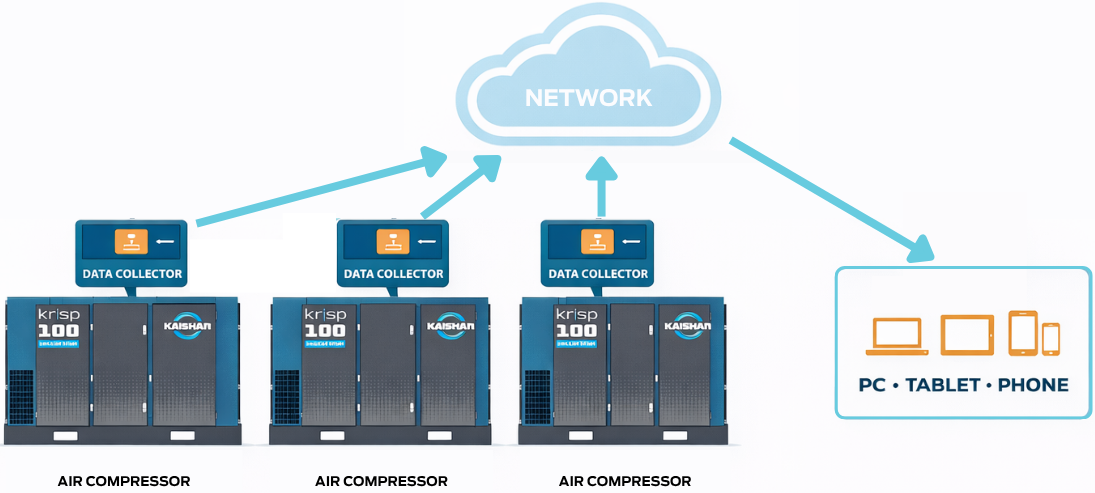
Our AirWatch remote monitoring system allows you to view data collected from your compressed air system on a PC, tablet or smartphone.
Find out more about the advantages of our AirWatch remote monitoring system and the benefits it has delivered in our blog post, “Remote Monitoring as a Competitive Advantage.”
Now let’s talk about how you can future-proof your system.
Future-Proofing Your System
The industrial environment is changing rapidly, with techniques emerging, such as the Industrial Internet of Things and artificial intelligence.
There’s even the possibility that compressors will be linked directly into the electrical grid. Or that local utilities or distributors will begin offering compressed air as a service, with initial cost, maintenance and upgrades covered by an established fee.
And while that future is still unfolding, there’s one key thing you can do to get ready.
And that is to insist that any new equipment you buy is equipped with Modbus connections. Modbus is a communications protocol widely used in industrial settings to exchange data between devices. It is brand-agnostic, creating a standard, low-cost data format to link equipment from different manufacturers.
You can connect all parts of your air compressor system, including compressors, dryers and other equipment, using a Modbus interface. Then, control your devices with the software of your choice.
Kaishan equips its KRSP and KRSP2 premium rotary screw air compressors with a Modbus-compatible control system, allowing them to work with almost any communications protocol. As a result, they are fully compatible with virtually any remote monitoring system.
And they’ll be ready for the next generation of building management and factory automation systems, as they become available.
The last step in transitioning to managing your compressor as an asset is to find a local compressed air professional you can trust.
A Local Partner and Expert
If you’re ready to change your mindset from reactive to proactive air compressor asset management, it’s helpful to have a compressed air professional in your corner.
That’s why Kaishan works with a nationwide network of independent distributors, who can provide on-site help and consultation as needed.
The critical thing is to be honest with yourself and your local consultant about the true nature of your in-house capabilities. What tasks can your staff handle, and what should be left to the pros?
Unlike the service contracts offered by other manufacturers, our distributors are uniquely equipped to provide flexible, even hybrid, arrangements that deliver the maintenance your equipment needs.
Whether you need help with oil and filter changes or can handle those yourself, your local distributor can work with you to find a balance between external and internal resources. One that is both effective and affordable.
Some of our customers even grant their distributors access to their remote monitoring systems, ensuring their systems receive 24/7 professional supervision.

With our AirWatch system, you can even grant your compressed air consultant access to your air compressor data. And have knowledgeable eyes on your system 24/7.
If your operation depends on compressed air, that level of partnership may provide the reliability and performance you need. And pay for itself quickly in avoiding costly downtime or repairs.
As a result, making the transition to viewing your compressed air system as an asset could well determine your company’s success in achieving broader objectives such as reliability, energy efficiency and cost efficiency. Both Kaishan and our team of independent distributors would love to help.
Find a compressed air professional near you. Or contact us directly.
Key Takeaways
- Considering compressed air as an asset requires long-term rather than short-term thinking.
- Key elements in making the transition to air compressor asset management include data collection, maintenance and remote monitoring.
- Today’s compressors are equipped with sensors that track a significant amount of information.
- Rather than being driven by a watch or a calendar, preventive maintenance is based on real-world conditions.
- Today’s most advanced systems rely on remote monitoring to capture and analyze data from compressors and air distribution systems.
- To be compatible with emerging technologies, such as the Industrial Internet of Things and artificial intelligence, ensure that any new equipment you buy has Modbus connections.
- Your distributors are uniquely equipped to offer flexible, even hybrid arrangements to help you manage your compressed air system as an asset.
Further Reading
“Twelve Reasons Why You Should Be Monitoring Air Compressor Data.” Find out all the ways you can use your compressor’s data to save money, optimize performance, lengthen equipment life, enhance safety, improve reliability and reduce or even eliminate downtime.
“The Differences Between Air Compressor Preventive Maintenance and Predictive Maintenance. And Why You Should Care.” Learn how the right balance of preventive and predictive maintenance can help you enhance the reliability and performance of your compressed air system.
“Remote Monitoring as a Competitive Advantage.” More information about our AirWatch remote monitoring system and the benefits it can deliver.
Frequently Asked Questions
Monitoring the right metrics helps you understand system health and identify improvement opportunities:
- Energy consumption (kWh): Track monthly or quarterly energy use. Increases indicate efficiency losses due to leaks or equipment degradation.
- System pressure (PSIG): Monitor your operating pressure. Creeping pressure increases waste energy. Track both discharge pressure and demand-side pressure.
- Air flow (CFM): Measure cubic feet per minute delivered to your system. Compare against nameplate capacity to identify capacity shortfalls.
- Compressor runtime (hours): Track how many hours your compressor runs daily. High runtime relative to demand suggests oversized capacity or inefficient operation.
- Temperature (°F): Monitor the compressor discharge and cooler outlet temperatures. Abnormal temperatures indicate cooling system issues.
- Maintenance costs: Track repair and maintenance spending. Increasing costs suggest equipment aging or deteriorating reliability.
- Unplanned downtime (hours): Measure how often emergency repairs interrupt production. Declining downtime validates your preventive maintenance program.
Use these metrics to identify trends rather than focusing on individual data points. A 5-PSIG increase over six months suggests a developing problem worth investigating.
This is a common design question that affects both initial investment and operating costs.
Multiple smaller units offer advantages:
- Redundancy: If one compressor fails, others maintain partial production capacity.
- Flexibility: You can run fewer compressors during low-demand periods, reducing energy consumption.
- Maintenance: Taking one compressor offline for maintenance doesn't stop production.
- Scalability: Adding capacity is simpler with modular equipment.
One large compressor offers advantages:
- Lower initial cost: One larger unit typically costs less than multiple smaller units with equivalent total capacity.
- Simpler operation: A single system is easier to monitor and maintain.
- Higher efficiency: Larger compressors often operate more efficiently.
The best answer: Most modern facilities benefit from a combination approach—a primary compressor sized for average demand with a smaller backup unit for peak demand and redundancy. This balances efficiency, reliability, and flexibility.
Your specific answer depends on your facility's production variability, reliability requirements and budget constraints. Discuss your needs with a compressed air professional who can model the total cost of ownership for different configurations.
Listen to the Podcast Version



Episode 70 and why compressed air is not just equipment
Welcome to the show! I’m Jason Reed here with Lisa Saunders, and somehow -- somehow -- this is episode 70. Seven-zero. Which means either we’re doing something right, or people really, really enjoy hearing us talk about compressors.Seventy is a real number, though. It’s not, like, “hey mom, we made six episodes.” Seventy says there are a lot of people out there who know compressed air is not some side issue. It’s the thing behind the thing.
That’s exactly it. And I want to start with one image because it’s the cleanest way to frame this whole episode: you can have a brand-new 2 million dollar production machine sitting on the floor, shiny, automated, probably the pride of the capital budget... and if it doesn’t get clean, reliable compressed air, it is a 2 million dollar DOORSTOP.
The "2 million dollar doorstop” line is gonna stick. Because that’s the insult, right? All that investment, all that planning, all the rollout meetings -- and then the weak link is the compressor nobody wanted to think about.
Yep. Too many plants still treat compressed air like background noise. It’s out of sight, so it’s out of mind until it breaks. Then everybody notices real fast -- downtime, bad product, equipment issues, contamination problems, the whole mess.
And that “out of sight, out of mind” thing used to be easier to get away with when air was mostly running tools -- grinders, nail guns, paint sprayers, that kind of stuff. But that’s not the whole world anymore. Now compressed air is tied directly into higher-end production equipment, tighter quality standards, cleaner processes.
Right. People call compressed air the fourth utility, and that matters. But here’s the part I think gets missed: electricity, water, natural gas -- those show up from outside. Compressed air is the only utility you’re producing entirely on-site. You own the performance. You also own the failure.
Wait -- “the only utility you produce entirely on-site” -- that’s the sentence. Because it changes the mindset. You can’t shrug and blame the grid if your own system is dirty, unstable, oversized, undersized, or just neglected.
Exactly. And when managers still look at a compressor as just an expense, they make cheap, short-term decisions. They delay service. They skip monitoring. They wait for alarms. Then they act surprised when production goes sideways.
Give me a real-world picture of that. Because “manage it like an asset” can sound like consultant wallpaper if we’re not careful.
Fair. Here’s one. A print operation in East Hanover, New Jersey upgraded its equipment and found out its two old compressors couldn’t provide the clean air the new printer needed. So those “dirty, old compressors” had to go. They replaced them with a multi-compressor setup: one Kaishan KRSD direct-drive unit with a variable-speed drive, and one KRSB direct-drive fixed-speed compressor. That system balanced the workload between the two machines.
So the trigger wasn’t “our old compressors finally died.” It was “our production changed, and the air system had to keep up.” That’s asset thinking. The air system has to match the process, not just exist near it.
That’s it. Compressed air isn’t just equipment sitting in a corner. It’s infrastructure tied directly to reliability, product quality, and uptime. If the plant depends on air, then the compressor room deserves the same seriousness as the main production line.
And maybe that’s the challenge for episode 70. Not “do you have a compressor?” Obviously you do. The question is: are you treating it like a mission-critical asset... or are you waiting for your next very expensive doorstop?
From reactive fixes to real asset management
So if we stop treating compressed air like a forgotten expense, what changes? To me the first shift is time horizon. You stop planning over the next shutdown or the next week, and you start planning over YEARS -- equipment life, energy use, reliability, expansion, backup strategy.Yep. Long-term instead of short-term. Proactive instead of reactive. And this is where people hear “asset management” and assume it means more paperwork. It doesn’t have to. It means fewer surprises. It means making decisions before the machine makes them for you.
Okay, but I want to challenge one assumption because I hear it all the time: “We’re good. We do preventive maintenance.” That sounds responsible. It sounds organized. It sounds gold-star maintenance-team stuff. But that can still be way off, right?
Absolutely. And this is where people get tripped up. The first place to start is always the OEM manual -- lubrication, filters, troubleshooting, service intervals, all of it. But those intervals are the MINIMUM recommendations. Minimum. Not gospel.
That word “minimum” does a lot of work there. If the manual says change filters every 4,000 hours or six months, people hear “great, see you at 4,000.”
Exactly. But if your shop is dusty or dirty, that same filter interval might really be 2,000 hours or three months. Same machine. Different reality. That’s why calendar-based maintenance can look disciplined and still miss what the equipment actually needs.
So let me try to say it back. Preventive maintenance is basically: follow the watch, follow the calendar, do the scheduled work. Predictive maintenance is: watch the machine itself and let real conditions tell you when something’s changing.
Pretty much. I’d tighten one thing: predictive maintenance still respects the preventive schedule. It just doesn’t stop there. It uses actual operating data to tailor interventions. So instead of waiting for failure or blindly following a date on a spreadsheet, you respond to what the system is telling you.
And that’s the part I think plant teams can miss, because a neat maintenance calendar FEELS like control. But if the room is hot, dirty, humid, or the duty cycle changes, the calendar may just be giving you false confidence.
Right. Two good examples: vibration monitoring and oil sampling. If vibration starts rising, that can be your first clue of bearing wear. But only if you started monitoring early enough to build a baseline. Then oil sampling can confirm it -- metal fragments in the oil, now you’ve got a very different conversation.
Wait -- “baseline” is important there. Because without that first healthy reference point, a vibration number is just... a number. You don’t know if it’s normal for that machine or the beginning of a bad month.
Exactly. And once you’ve got that baseline, you can catch problems before catastrophic bearing failure. That’s the whole win. Predictive doesn’t mean fancy for the sake of fancy. It means maybe not blowing up a machine and production schedule because you waited until something sounded awful.
The old maintenance strategy of “it’ll tell us when it’s unhappy” is not, in fact, a strategy.
Nope. That’s just gambling with louder consequences. Real asset management means you use the information the system gives you, you adjust for real-world conditions, and you think beyond the next emergency call. That’s how compressors stop being a cost center people resent and start being assets people actually manage.
From reactive fixes to real asset management
And all of that depends on data. Modern compressors are already tracking a lot more than people realize: temperature, discharge pressure, specific power, differential pressure across filters, pressure dew point, power consumption. That’s not trivia. That’s the health report.“Pressure dew point” is one of those phrases that sounds technical until bad air quality wrecks your day. And the list you just gave -- temperature, discharge pressure, power consumption -- those are not exotic lab metrics. Those are practical indicators of whether you’re spending too much, running unstable, or drifting toward a problem.
Right. If you don’t capture and use that information, you’re missing a huge opportunity. The data can help save money, optimize performance, extend equipment life, improve safety, improve reliability, and reduce downtime -- maybe even eliminate some of it.
But here’s where the pushback comes in. A lot of smaller facilities hear “data collection” and “remote monitoring” and think, that sounds expensive, complicated, and built for giant plants with a control room and three shifts.
That used to be more true. Remote monitoring systems were expensive when they first showed up. But costs have come down, and they’re making a lot of sense for small and mid-sized operations too -- especially places that do NOT run 24/7, have widely varying demand, and don’t have maintenance staff on site around the clock.
That “widely varying demand” part is the sneaky one. If demand swings and nobody’s watching, you can spend money making air you don’t need... or miss the warning signs when pressure, flow, or power use start behaving differently.
Exactly. A remote system takes data from the compressors and air distribution system and makes it visible on a PC, tablet, or smartphone. So now somebody can actually SEE what’s happening instead of walking in Monday morning and discovering the weekend made decisions for them.
“The weekend made decisions for them” -- every plant person just winced. But that’s real. And if somebody can view that data remotely, a supervisor, a manager, even a service partner can catch changes earlier.
And that connects to future-proofing. Industrial systems are getting more connected -- Industrial Internet of Things, AI, building automation, all of it. The smartest simple move when you buy new equipment is to insist on Modbus connections. Modbus is widely used, brand-agnostic, low-cost, and it gives you a standard way to exchange data between devices from different manufacturers.
So “Modbus” is not some shiny buzzword purchase. It’s more like buying equipment that can actually talk to the rest of your plant later, instead of trapping yourself in a dead-end island.
That’s it. Compressors, dryers, peripherals -- if they can connect through Modbus, you’ve got options. Your software choice stays open. Your monitoring options stay open. Your next automation layer gets easier instead of harder.
And even with all that connectivity, you still need actual humans who know what they’re looking at. A trusted local compressed air partner matters because most plants have to be honest about what their in-house team can handle and what should go to the pros.
Yeah. Sometimes the right answer is hybrid. Maybe your team handles oil and filter changes. Maybe your distributor handles deeper diagnostics, planning, or 24/7 oversight through remote access. That flexibility is useful because the goal isn’t to outsource your brain. It’s to keep the system online.
And that’s probably the thought to leave people with: if compressed air is truly part of production, then the future isn’t just more technology. It’s better visibility, better decisions, and better partnerships around a system most plants still underestimate.
That’ll do it for episode 70. I’m Jason Reed.
And I’m Lisa Saunders. Go take a harder look at the room that keeps the rest of the plant moving.