


Five New Air Compressors Trends to Watch in 2026 and Beyond
April 1, 2026Remote Monitoring as a Competitive Advantage
By John Wilkerson, Technical Training Manager | April 8, 2026 | Uncategorized

Remote monitoring can give you a competitive advantage, helping you cut energy use, unplanned downtime and maintenance hours and costs.
Cutting energy consumption. Slashing or even eliminating unplanned downtime. Reducing maintenance hours and costs. Avoiding the need to rent diesel compressors in an emergency. Fine-tuning your entire compressed air system so it runs like a well-oiled machine.
Imagine what kind of advantage you’d gain in your marketplace if you could do all those things. Especially if your competitors are slow to respond.
They are all possible with the right remote monitoring solutions. Here’s how that works.
What Happens on the Third Shift …
A customer consistently faced a recurring problem. Every year, almost like clockwork, they had to replace the bearings in their rotary screw compressor.
Then they made a smart decision: they installed remote monitoring capability.
When they pulled up the data, they quickly identified the problem. Something had changed on their third shift. Their machine was running unloaded, accumulating water, wasting energy. And killing their bearings.
Originally, the compressor was set to shut down when it wasn’t needed so that it wouldn’t run unloaded. But apparently, someone had changed a setting,
The company revised the settings, enabling the compressor to shut off when demand dropped.
The results? No running unloaded. No water buildup. No bearing failure. Reduced electricity cost. And greater energy efficiency in compressed air.
Load-Sharing Woes
A different company had a problem with a multi-compressor setup, in which its compressors weren’t sharing the loads properly. As a result, energy was wasted. And there even was operational conflict.
Remote alerts revealed that a desiccant dryer tower was not switching properly. The company retuned a valve and the problem was resolved.
In the days before remote monitoring solutions, uncovering the problem could well require costly part replacements and weeks or even months of trial-and-error troubleshooting.
But with remote monitoring, the problem was solved. The real-time fault detection saved energy, plus a lot of time. Not only the months of excess energy consumption. But also the labor cost of 24-hour manual monitoring.
Can Remote Monitoring Become Your Competitive Edge?
Strange occurrences on the third shift and curveballs from desiccant dryers are just a few examples of the issues a good remote monitor system can identify. And why more compressed air system operators are installing them.
If you’re not already using remote monitoring, it’s certainly worth exploring. Let’s look at these devices in greater detail, starting with an explanation.
Remote Monitoring: What Is It?
As illustrated in the examples above, remote monitoring provides real-time troubleshooting and fault detection. A classic application of the Internet of Things, remote monitoring relies on sensors in your compressor and throughout your compressed air system to identify issues.
That data is then compiled and made available in real time for remote access through connected devices, such as desktop or laptop computers, smartphones or tablets.
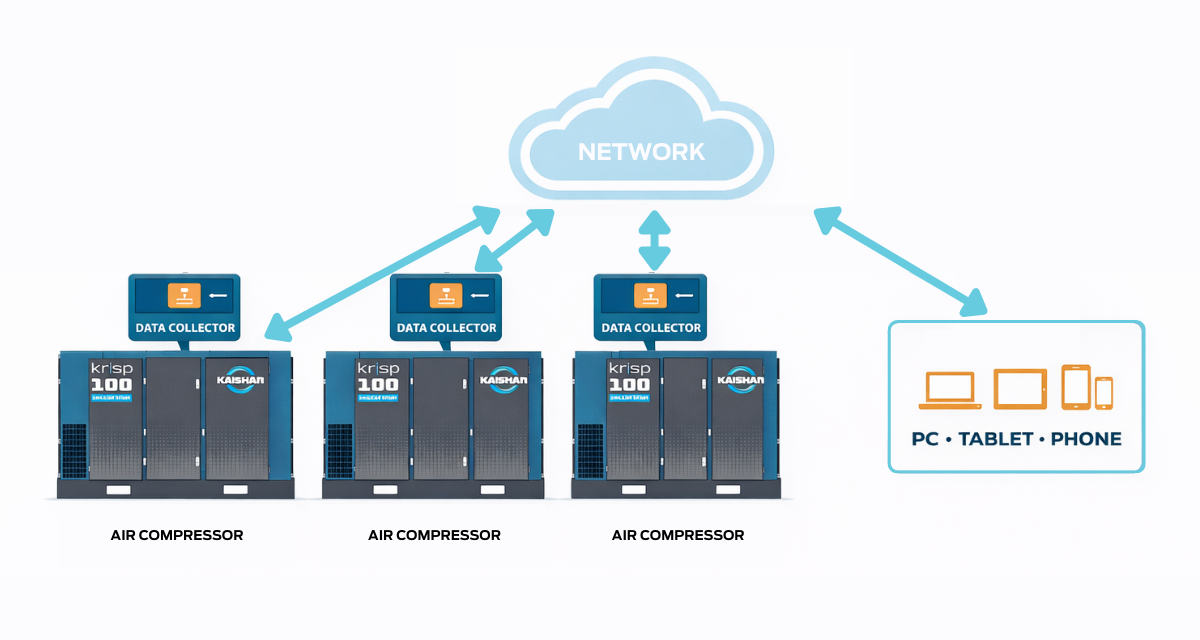
With remote monitoring solutions, data collected from your compressed air system is visible on a PC, tablet or smartphone.
We’ve found that the technology pays for itself in many different ways.
The Advantages of Remote Monitoring
- Save energy. Zero in on the problems that waste energy and help your company achieve quick wins in energy efficiency in compressed air.
- Cut downtime. Maintain your system to its highest level of performance, enable compressed air system optimization and avoid costly breakdowns that damage equipment and shut down your plant.
- Enhance efficiency. Identify issues limiting system performance—your pressure band is set too high, or your system is rapid cycling, wasting energy and shortening equipment life.
- Enhance safety. Find equipment issues well before they reach the breaking point. And avoid accidents that can result in damage, lost production and even injuries to your staff.
- Optimize performance. Tweak system operation and get everything running according to design.
- Cut downtime. Maintain your system to its highest level of performance, enable compressed air system optimization and avoid costly breakdowns that damage equipment and shut down your plant.
- Improve reliability. Improve the operation of your air compressor and related equipment, including filters, dryers and coolers.
- Lengthen equipment life. Receive an alert when oil changes and oil sampling are required, or your compressor is not operating within its design parameters.
- Be proactive. Schedule preventive maintenance at a convenient time, such as a plantwide maintenance shutdown, before an issue becomes a problem.
- Save money. Enable compressed air system optimization, cut downtime, increase equipment life and create a safer environment for your team. All those things pay off financially.
For more on how you can use data to improve system operating, read our blog post, “Twelve Reasons Why You Should Be Monitoring Air Compressor Data.”
Who Should Be Considering Remote Monitoring?
While you might think remote monitoring solutions would only be of interest to larger facilities with ample resources, we’ve found that they're extremely attractive to small- and medium-sized companies.
The reason? Small companies often do not operate three shifts and do not have consistent staffing, usage or maintenance available 24/7. As a result, the usage of their systems may vary significantly. And there won’t be a full maintenance crew on staff to observe and make critical adjustments.
Usually, a compressed air system’s operating parameters are set by the day shift to handle the bulk of a plant’s production. Meanwhile, the production levels for the evening and overnight shifts are a fraction of that amount. But nobody tells the compressor.
Larger companies, on the other hand, could well have three equal shifts operating at much the same level of output. With a full maintenance staff on hand to adjust as needed.
The small skeleton crew working the night shift in a small manufacturing plant may not notice that a compressor is overheating, your compressor is rapid cycling or the air quality or pressure is varying widely. That’s why remote monitoring is so critical for smaller companies.
Next, we explain the types of systems you can use for remote monitoring of your compressed air system.
How Kaishan Compressors Communicate
There are three main ways to capture the data your Kaishan air compressor is generating:
- Basic air compressor system monitoring. At the simplest level, you can pull alarms and warnings off your compressor controller to track system pressure. The cost is small, and the demands on your IT department are minimal.
- Modbus remote monitoring and controls. You can also connect the parts of your air compressor system, including compressors, dryers and other equipment, using a Modbus interface. Modbus is a communications protocol widely used in industrial settings to exchange data between devices. It is brand-agnostic, creating a standard, low-cost data format to link equipment from different manufacturers.
- AirWatch. Our most advanced connection is through our AirWatch system, which uses a wireless cellular modem to enable real-time equipment monitoring of the air compressor system on any connected device, including desktops and smartphones.
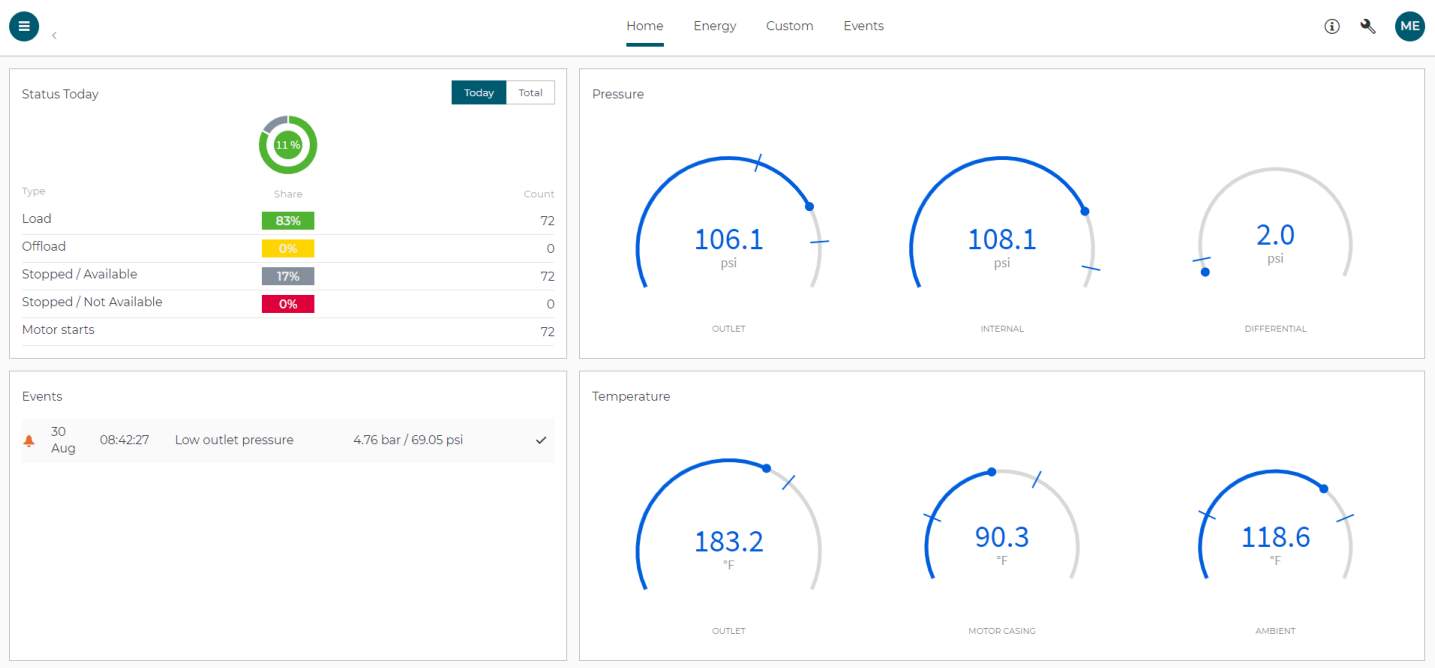
The dashboard of an AirWatch monitoring system displays key measurements indicating the status of your compressor.
Our AirWatch system communicates through a cellular connection and thus does not require crossover into your system. It digitally creates an online twin using the Modbus protocol to display pressure, temperature, faults, status and other key indicators, alerting you when components are showing signs of wear and it’s time to replace them. Before they begin to fail.
The wireless approach avoids the nightmare of going through your IT department, enterprise software system and factory automation infrastructure.
AirWatch gives you 24/7 remote access to your air compressor data, tracking system performance and identifying readings that are out of spec. So you can fix problems before they start.
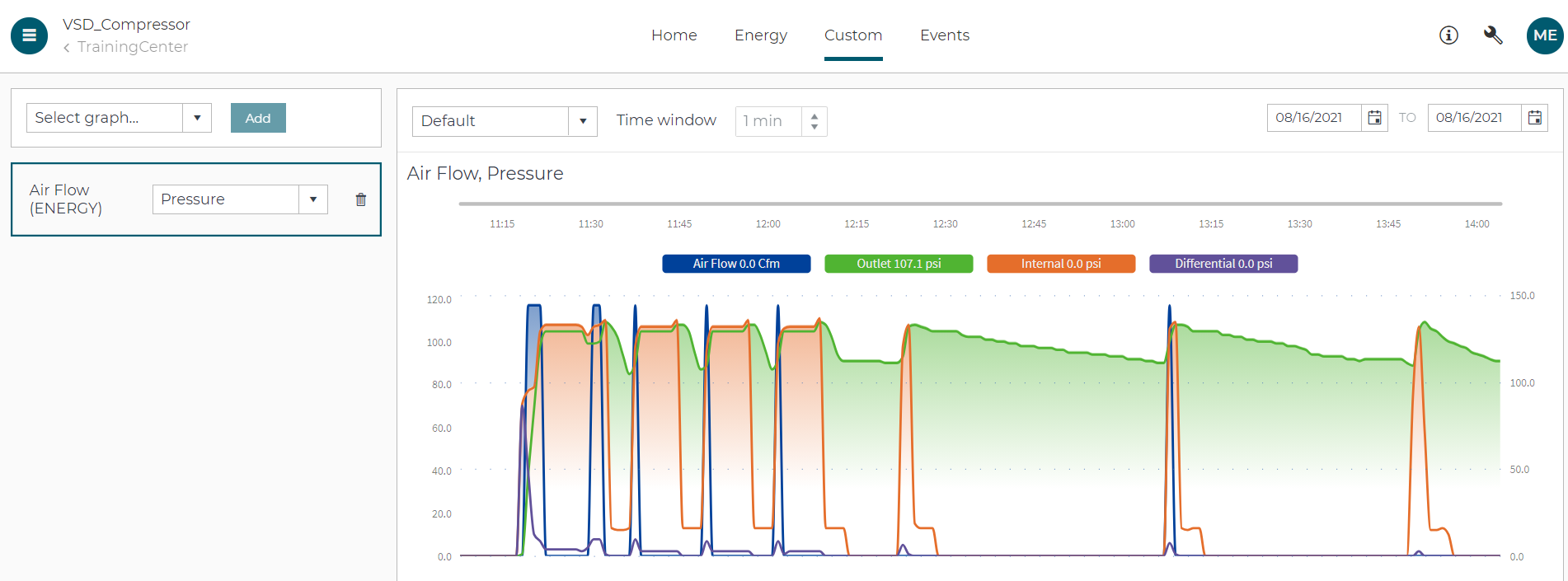
AirWatch allows you to monitor an individual compressor, such as this VSD-equipped unit, to determine if it’s being used effectively.
Plus, you can get alerts when your pressure drops, electricity consumption rises too rapidly or air quality begins to deteriorate. Giving you time to take corrective action. And your system’s trend logs can help identify anomalies such as excessive leaks or misuse of pneumatic equipment.
With AirWatch, you can customize alerts and format trend analysis according to your preferences. You can even give your local distributor or air compressor professional access to the system, allowing them to respond if needed.
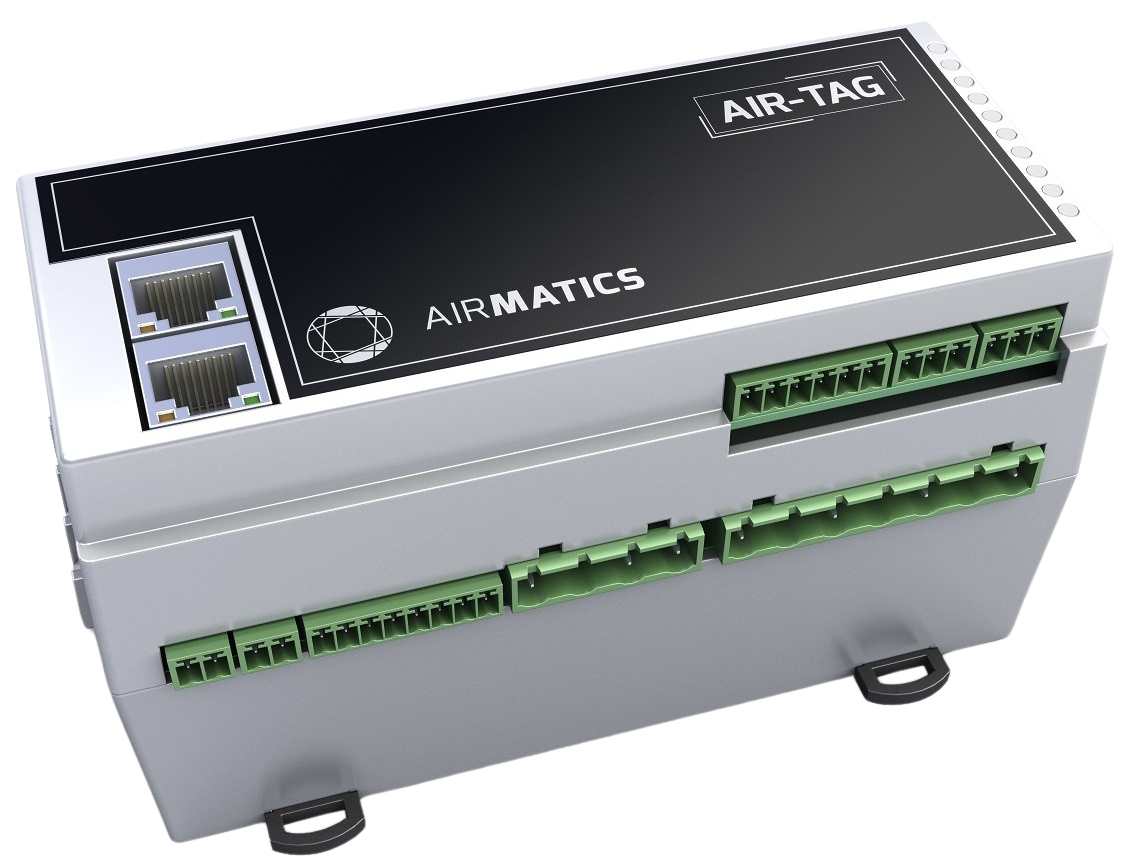
The AirWatch base unit is available on our KRSD, KRSP, KRSP2, KRSL and KROF two-stage, oil-free rotary screw air compressors and our KRSV rotary screw vacuum pump.
Because the connection is an isolated unit communicating via cellular, there’s no threat of a security breach.
Ready to get started with remote monitoring? The best way is to work with your local compressed air professional.
Your Local Resource for a Complete Remote Monitoring Package
Your local compressed air experts can offer you the full range of equipment mentioned previously, help you set up the system and even provide some supervision and monitoring.
Many of our customers, in fact, give their local Kaishan distributor full access to their remote monitoring system, allowing them to view the data and even respond when a problem occurs. Perhaps even checking in with the experts at Kaishan if a problem is particularly thorny.
Jump-starting the process in this way gives you a complete package of support and expertise, putting troubleshooting and fault detection on steroids.
The result is unprecedented speed and efficiency that saves energy, cuts costs, slashes downtime, improves safety, reduces maintenance expenses and lengthens equipment life. And leaves your competition in the dust.
Turning Remote Monitoring into Competitive Advantage
Other compressor manufacturers with less-experienced local service teams will not be able to offer the complete package mentioned above. Especially when their technical experts are on a different continent.
That’s the added benefit you get from working with our nationwide network of independent distributors. They can provide on-site help and consultation as needed. For more information, reach out to your local Kaishan distributor. Or, feel free to contact us directly.
Frequently Asked Questions
Listen to the Podcast Version



Why Remote Monitoring Changes the Game
Welcome back to The Big Dog Podcast. This is episode 67. I'm Jason Reed, here with Lisa Saunders.Six, seven!
Yeah, because that's the trap, right? People hear remote monitoring and think, oh great, another screen, another login, another thing to ignore. But if you're running rotary screw compressors, dryers, filters, all the supporting equipment, this is really about visibility. Real-time visibility.
Exactly. Pressure, temperature, operating status, faults, load and unload behavior—what the machine is doing, when it's doing it, and whether it's doing something dumb at two in the morning when nobody's standing there to catch it.
That's really the heart of it. A lot of compressed air problems are not dramatic at first. They don't start with smoke pouring out of a cabinet. They start small. Pressure drifts a little. A compressor runs unloaded longer than it should. A machine starts rapid cycling. Air quality starts moving around. Nothing feels urgent... until it is.
And meanwhile you're paying for it the whole time. That's the part I think gets missed. Hidden issues in compressed air are expensive even before they become failures. Unloaded running wastes energy. Pressure set too high wastes energy. Rapid cycling beats up components. Running outside design parameters shortens equipment life. So if you only respond when production gets hit, you're already late.
Right. Remote monitoring gives you a way to see operating behavior across the system, not just whether the compressor is technically on. That's a huge difference. A machine can be running and still be running badly.
Let me put it the blunt way. If you only know your compressor tripped, you've got bad news. If you know it spent the last three shifts drifting out of spec, cycling too fast, or unloading when demand dropped off, now you've got something useful. You can act before the trip, before the bearing damage, before the plant manager starts asking why the line's down.
And this is where it becomes an operational advantage, not just maintenance convenience. Teams that see problems earlier can schedule work instead of reacting to emergencies. They can tune the system. They can correct settings. They can catch misuse. They can find out if the issue is the compressor, the dryer, the controls, or just a shift pattern nobody accounted for.
What happens on third shift stays on third shift—unless you've got monitoring.
Exactly. Off-shift problems are real. A lot of systems are basically set up by day shift for day-shift demand. Then nights and weekends come around, demand drops, and the system keeps acting like the plant is still fully loaded. That's where you get unloaded running, unstable pressure, waste, heat, moisture issues... all that fun stuff.
And if you're a smaller plant, it's even more important. Maybe you don't have a full maintenance crew on nights. Maybe nobody's walking past the compressor room every hour. So remote monitoring becomes your eyes and ears. Not a replacement for good people—just a way to make sure the system isn't left unsupervised.
I like that. It's not magic, and it's not gonna fix bad practices by itself. But it does make bad practices visible. And once you can see them in real time, or in trends, you can do something about them before production suffers.
So that's the game change. It's earlier detection, faster response, and better decisions. Not guessing. Not waiting for failure. Actually knowing how the compressed air system is behaving.
What the Data Actually Tells You
So let's get into the practical part—what the data actually tells you. Because if all we're saying is, hey, data is good, that's not enough. What matters is root cause.Yeah. Here's a classic one: recurring bearing failure. If a compressor is chewing through bearings on a regular basis, a lot of teams start replacing parts and hoping for the best. That's expensive, and honestly it's lazy troubleshooting.
And sometimes the root cause isn't where people first look. You pull the operating data and suddenly you see the compressor was running unloaded during low demand periods, maybe overnight, maybe on the weekend. That unloaded running can let water build up, wastes electricity, and over time it's rough on the machine. So the bearing failure isn't the first problem. It's the end result.
Right. The fix might be as simple as correcting settings so the compressor shuts down when demand drops instead of sitting there unloaded. But without the data, you're just throwing parts at symptoms.
Another good example is when something changes off-shift and nobody tells anybody. New operating pattern, different air use, a setting got changed, a sequence isn't behaving the way it used to. If you've got remote visibility, you don't have to wait for someone to notice a weird sound on Monday morning. The trend logs show you when behavior changed.
And that matters in multi-compressor systems too. If load sharing is off, you're wasting energy fast. One machine may carry more than it should, another may conflict, and now the whole setup is less stable than it ought to be.
This is where alerts earn their keep. Say a dryer tower isn't switching properly. That can create all kinds of trouble downstream, and it's not always obvious right away. But an alert tied to abnormal operation points you to the problem a lot faster than weeks of trial-and-error part swapping.
And let's be honest, before remote dashboards and trend logs, plenty of troubleshooting was basically, "Well... replace this and see what happens." That's expensive labor. That's downtime risk. And sometimes it's 24-hour manual watching just to catch an intermittent issue.
Remote monitoring shifts that whole approach. You get alerts, you get historical trends, and you get a dashboard that shows pressure, temperature, status, faults, events. So instead of reactive maintenance—something broke, now go chase it—you move toward predictive maintenance. Not perfect prediction. But better timing, better evidence.
Yeah, and predictive maintenance doesn't mean you wait forever. It means you can see when readings move out of spec, when wear is building, when oil changes or oil sampling are due, when components are trending the wrong direction. You're planning work before failure, not after failure.
Which is a big deal for small and medium-size operations. They may not have somebody dedicated to compressed air around the clock. Nights might be a skeleton crew. Weekends might be lighter production. Remote visibility gives those teams a way to maintain reliability without physically babysitting the compressor room.
And and this part matters too—you can give access to the people who need it. Plant team, maintenance lead, maybe your service support if that's how you run. So if pressure drops too low, power use jumps, air quality starts drifting, or something's overheating, somebody can respond before it turns into a production outage.
So the short version is: the data tells you what changed, when it changed, how often it's happening, and whether it's part of a pattern. That's how you get to root cause faster.
Where the Payoff Shows Up First
Alright, so where does the payoff show up first? Usually the answer is energy. Compressed air is expensive, and the system can waste a lot quietly. If monitoring helps you catch unloaded running, pressure set too high, rapid cycling, leaks, or bad sequencing, those are quick wins.Yep. Energy efficiency is usually the first thing people feel because it shows up over and over. Every hour the system runs the wrong way, you're paying for it. Fixing that isn't theoretical. It's operational.
Then downtime. If you can spot faults early, catch abnormal temperatures, deal with wear before failure, and schedule maintenance during a planned shutdown instead of during a crisis, that's huge. It protects production, and it avoids those miserable emergency rentals and scramble situations.
Maintenance labor is another one. Remote monitoring cuts down on constant manual checks and on blind troubleshooting. Your team spends less time hunting and more time fixing the actual issue. That's a better use of skilled people.
Safety too. If equipment is moving toward a breaking point, you'd rather know before somebody's sent into a bad situation to react under pressure. Real-time alerts give you a chance to deal with hazardous conditions earlier.
And longer equipment life. That's maybe less flashy, but it's real. If your compressor isn't operating outside its design parameters, if it's not rapid cycling, if moisture issues get caught, if service intervals are handled on time, the machine has a better chance of lasting.
Now, in terms of how you monitor, there are levels to this. Basic level: pull alarms and warnings off the compressor controller. That can give you pressure and fault visibility with pretty low complexity.
Then you've got integrated connections through Modbus. That's useful because it lets compressors, dryers, and other equipment communicate in a standard format, even across different manufacturers. So you're not just watching one asset—you start seeing the system.
And the most advanced level is a full remote platform with mobile access. Desktop, tablet, phone, whatever. Real-time dashboard, alerts, trend analysis, remote access around the clock. Some setups use a cellular connection, which can simplify things because you're not trying to wedge the whole thing through a plant network.
I was gonna say, that's one reason these systems appeal to people. Less friction. If it's easier to deploy and easier to access, it actually gets used.
But here's the key point: the value is not just watching one compressor spin. It's better decision-making across the whole compressed air system. Compressor, dryer, controls, pressure behavior, off-shift demand, maintenance timing, energy use—the whole picture.
Exactly. Because a compressed air problem is often a system problem pretending to be a machine problem. If remote monitoring helps you see the system clearly, you're gonna make better calls, faster.
And that's the competitive advantage. Lower waste, fewer surprises, more control.
That's a good place to leave it. Jason, this was a solid one.
Sure was. Alright folks, thanks for listening to The Big Dog Podcast. For Lisa Saunders, I'm Jason Reed. We'll catch you next time.
See you soon. Bye, Jason.
See ya.