



Compressor Upgrade Benefits vs. the Hidden Costs of Waiting
March 11, 2026
Three Myths about Centrifugal Compressor Manufacturing and Testing
March 25, 2026Why Your Old Unit Won’t Make a Good Backup Air Compressor
By Israel Hearn, Senior Tech Support Representative | March 18, 2026 | Uncategorized
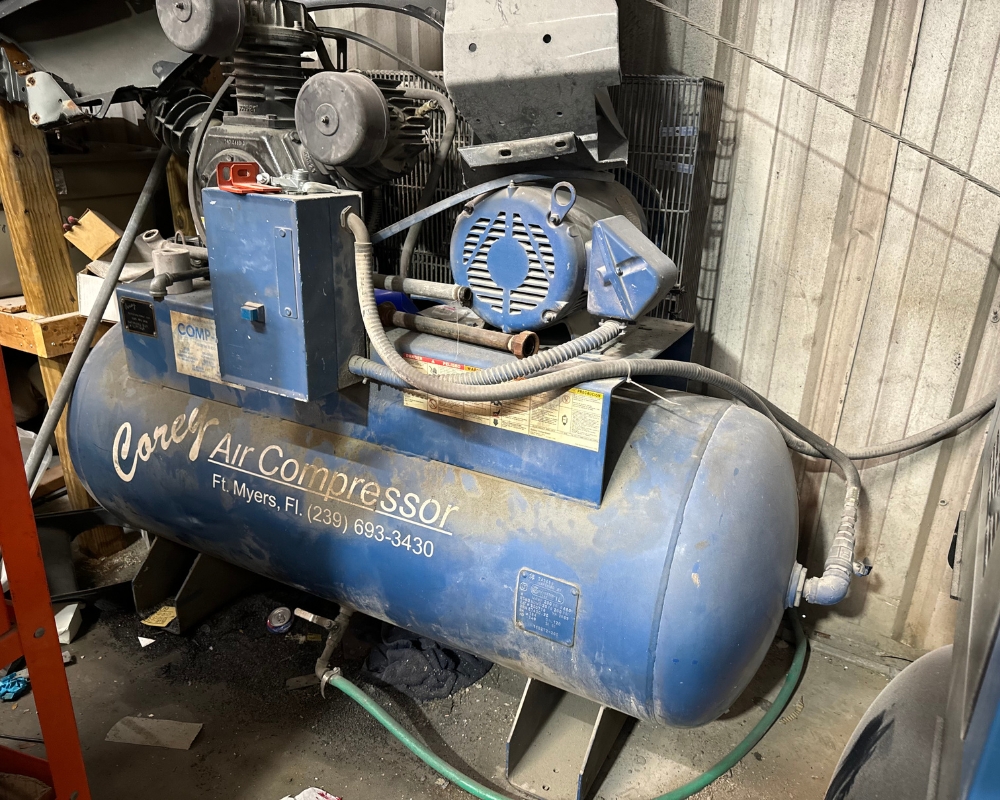
Do you really want to count on that aging unit in the corner as a backup air compressor system?
When they buy a new air compressor, many customers automatically think of keeping their old unit in place as a backup.
And, I get it, the thing still works. It’s a pain to haul it out. And it just seems as if you’re being a good steward of your company’s resources to get every last ounce of service out of an asset.
But there are some good reasons not to do that:
- You’re retiring it for a reason. You’re not replacing your compressor because you’re suddenly consumed by the desire to redecorate your equipment room. For some reason, it’s not meeting your needs: it breaks down too often. It doesn’t provide the air quality you need. It’s not giving you enough pressure or flow. You have trouble getting parts from the manufacturer. Most likely, those shortcomings won’t improve when it’s sitting idle.
- It gives you a false sense of security. Having an old compressor waiting in the wings may look good on paper. Your boss may nod approvingly, appreciating your good sense and concern for company assets. But what happens when you have a failure with one of your main units? It is inevitable, after all.
- It may not start. Once again, it was having some sort of problem. After sitting idle for months, it may not start. When you need it in an emergency, will it rise to the occasion? All too often, an aging compressor will disappoint when pressed into service in an emergency. When you need it most.
- It may be riskier. If you’re relying on that backup compressor, you may find out its limitations the hard way. Expecting that machine to come through in a pinch may mean you’re assuming even more risk than not having anything at all.
- It’s keeping you from having true compressed air redundancy. Counting on your old machine is standing in the way of an important transition.
That all-important next step is true redundancy.
True Compressed Air Redundancy
Having an ironclad backup system in place requires true redundancy, which can only come from multiple compressors operating in rotation, working within their most efficient ranges, tested under load, with hours balanced across the fleet. Usually, each unit is sized to carry the load on its own.
It’s what we call a multi-compressor system.
Multi-Compressor Systems
Here’s how a multi-compressor system works:
- A baseload compressor meets your system’s minimum compressed air load. Its output does not fluctuate as demand changes. Instead, the unit operates at full capacity (100%) or not at all, either remaining in an unloaded standby mode or shutting down when demand is not sufficient. Depending on variations in your demand, you may have more than one unit to fulfill that baseload function.
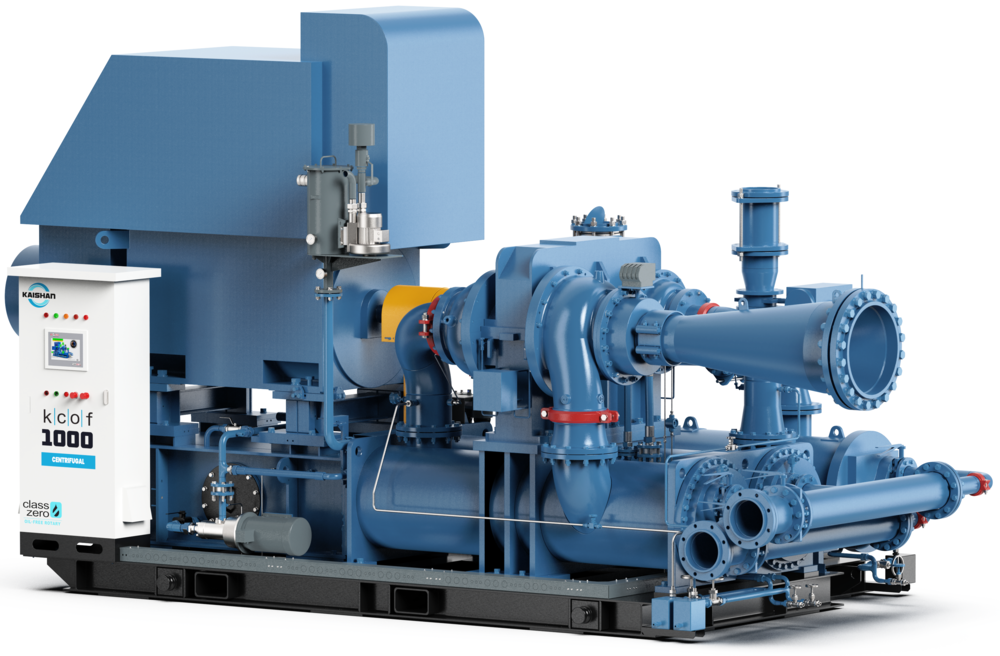
For facilities with high air volumes or air demands, Kaishan’s KCOF centrifugal air compressors are extremely efficient baseload compressors.
- A trim compressor handles fluctuations in demand above the base unit. Since the flow level needed will rise and fall depending on your system's needs, rotary screw compressors equipped with variable-speed drives are a natural fit for this application.
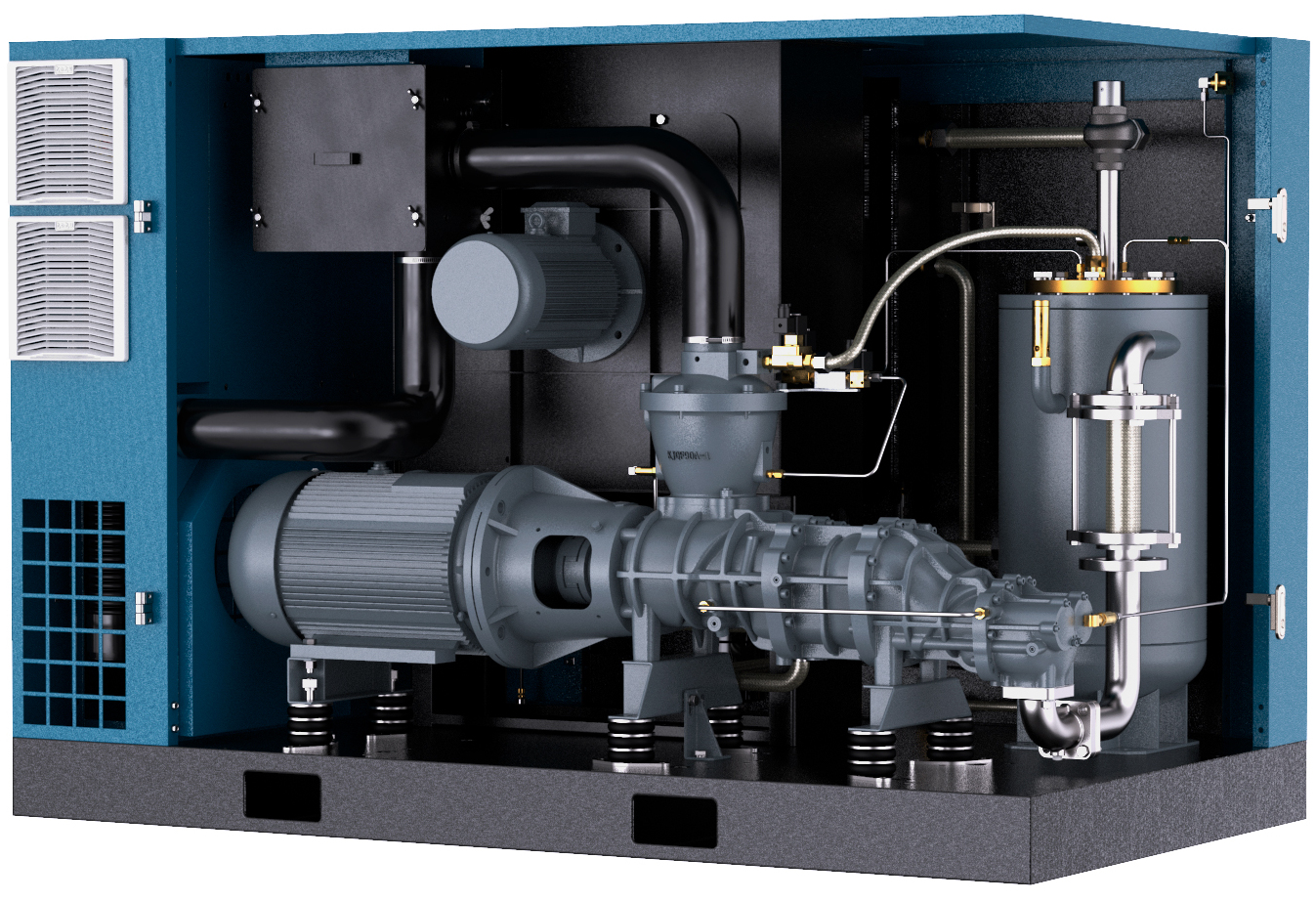
Kaishan’s KRSP2 premium, two-stage rotary screw air compressors equipped with variable-speed drives are an excellent choice for trim compressors. They are also a good selection for baseload units.
- A backup compressor is on standby if a baseload or trim unit goes offline. To fill in appropriately, it should be the same size as the baseload compressor.
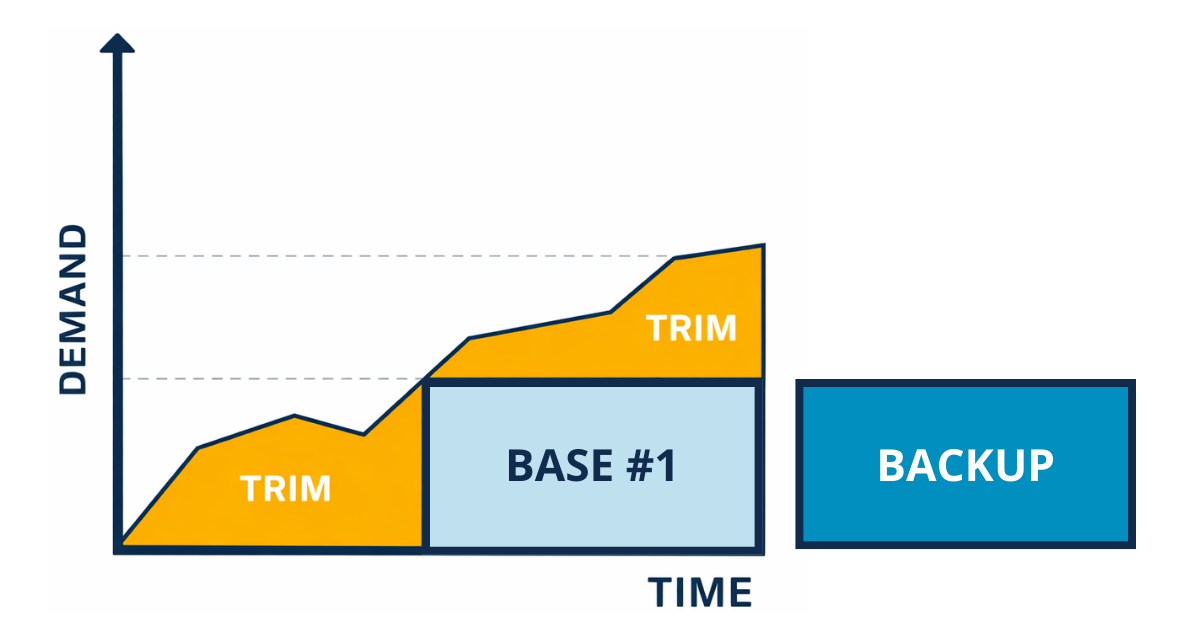
A multi-compressor system with a new compressor as the baseload unit and a rotary screw compressor as the trim. A backup is in place in case one of the other units fails.
Configuring your compressed air system in this way virtually eliminates unplanned downtime, which, in the real world, is the biggest (and most avoidable) expense associated with your compressed air system. A highly reliable backup, usually a rotary screw compressor, waits in the wings should a baseload or trim unit fail, keeping both pressure (PSIG) and flow (CFM) more consistent and reliable. Plus, the "backup" compressor is part of the normal operating rotation and thus stays in consistent working order, ready to operate when needed. (More on this below).
For most companies, avoiding a day of downtime more than justifies the additional expense of an air compressor backup system. Our client, Heritage Hosiery in East Ridge, TN, for example, bought two 100-HP KRSD direct-drive rotary screw compressors equipped with VSDs, using one as a backup to avoid downtime that can total as much as $5,500 per shift.
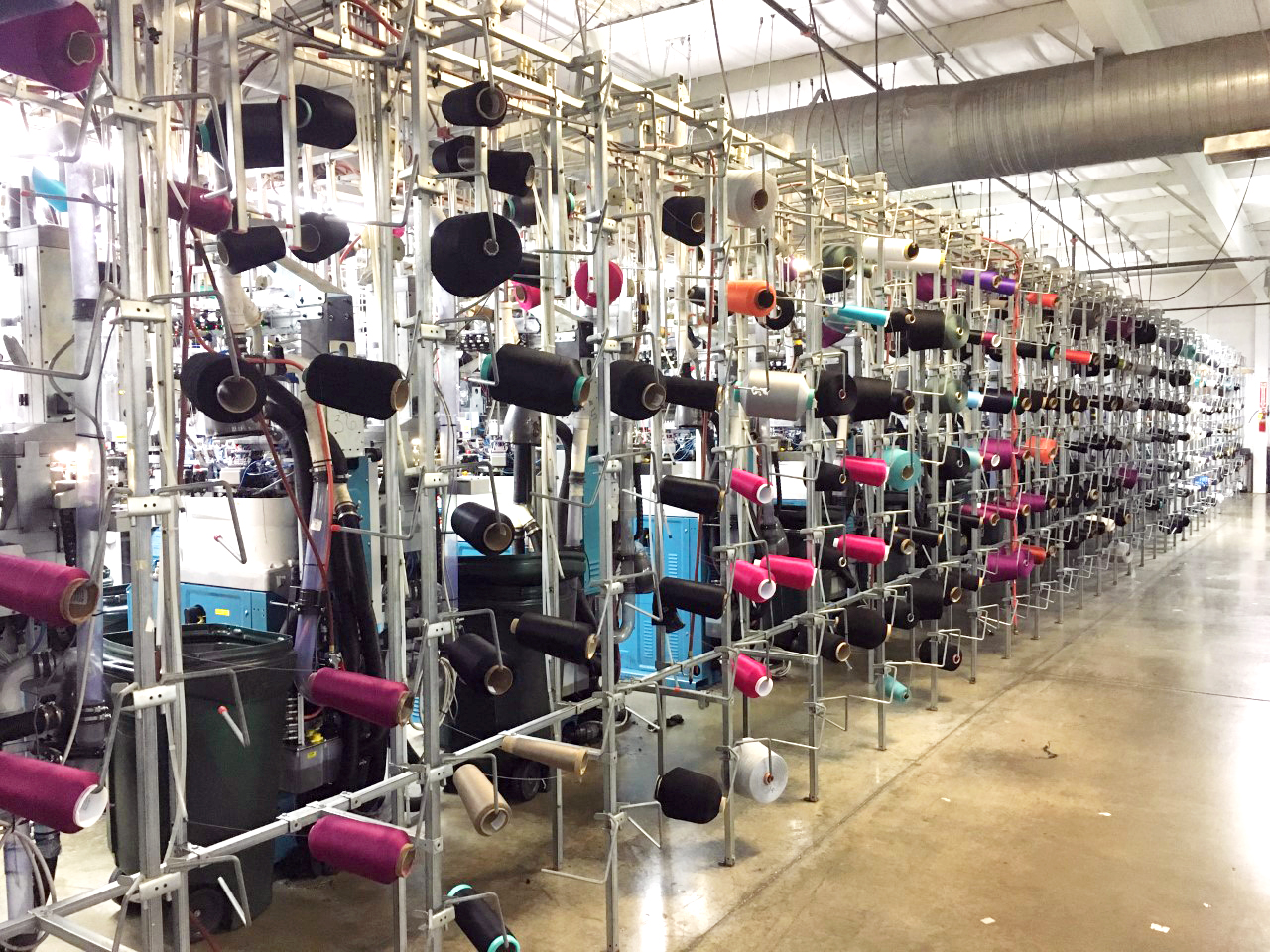
Heritage Hosiery in East Ridge, TN, avoids downtime that costs $5,500 per shift, with two 100-HP KRSD direct-drive rotary screw compressors equipped with VSDs.
In addition to rock-solid reliability, there are several other significant advantages of a multi-compressor system:
- Reduce maintenance costs. You can arrange your baseload, trim and backups as rotating compressor units to even out the hours. That will extend your service hours since the individual compressors will require service less frequently. Instead of quarterly, for example, you may be able to perform routine service semiannually. And you’ll be able to stagger service intervals so that one unit is always available.
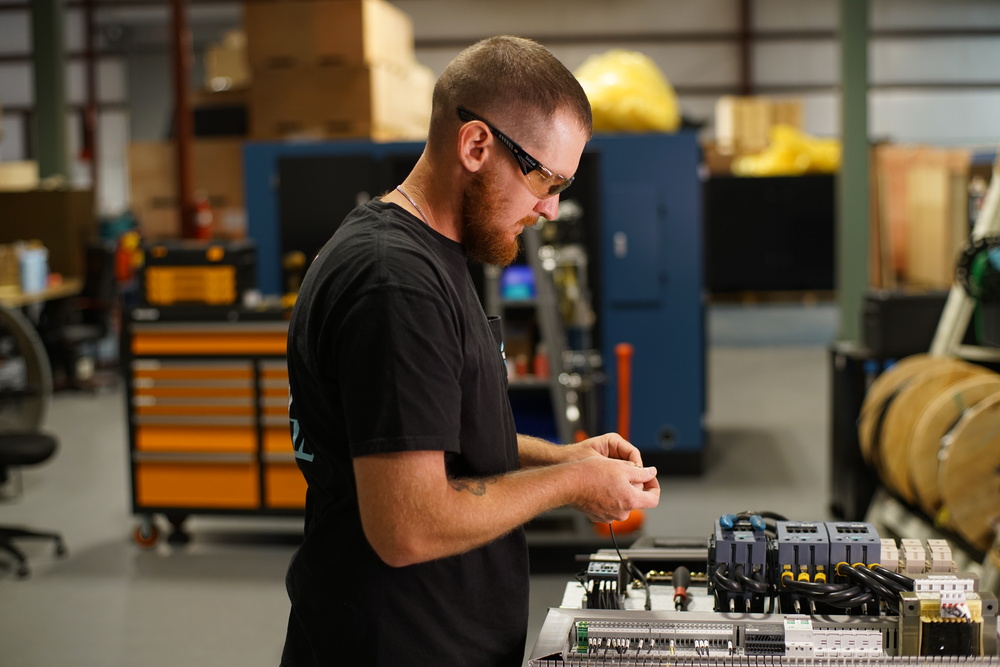
Configuring your units in a multi-compressor system may allow you to reduce maintenance costs.
- Save electricity. If your demand doesn’t vary much (staying above 80% of capacity), using a single fixed-speed compressor will be the most energy-efficient option, assuming you have adequate storage. But most plants experience more variation than that. In those instances, two smaller compressors may be more energy-efficient. Using a trim compressor will also allow you to maximize energy efficiency. Your system is designed to closely match demand, so you’re not wasting air or cycling your fixed-speed compressor.
- Avoid emergency services. Plants without backup units often rent portable diesel units when a main compressor breaks down. That’s expensive, not only in the rental cost but also in the logistics and cost of consuming diesel. And you’ll want to make sure the exhaust fumes won’t contaminate your process.
- Better pressure stability. Over time, older machines lose their ability to maintain pressures, forcing your operators to raise header pressure to keep servicing all your end uses. Newer machines have better pressure control.
- Extend equipment life. Today’s centralized systems include the deployment of lead-lag compressor control, reducing start/stop cycles. They distribute the hours more evenly, extending the lifespan of the motor and compressor.
For more details on multiple compressor systems, read our blog post, “How a Multi-Compressor System Can Help You Reduce Compressor Downtime.”
Multi-compressor systems rely on control systems that provide even more benefits.
Controls
Compressed Air Best Practices encourages compressed air users to move from the simple timers of the past to more advanced systems that monitor real-time performance. The article also notes that today’s compressed air controls provide condition-based monitoring that switches from the lead unit to the lag compressor when it senses an increase in temperature or vibration.
As a result, these new management systems ensure all units are regularly tested under load. Ensuring they’re ready to respond automatically.
Variable-speed drive compressors add even more flexibility to multi-compressor systems.
VSD vs. Trim Air Compressor
Some facility managers have capitalized on the unique flexibility of variable-speed drive compressors to offset the need for a trim compressor. It doesn’t hurt, of course, that they receive rebates and incentives from utilities and government agencies designed to reduce capital expenditures.
However, VSDs may not work for everyone.
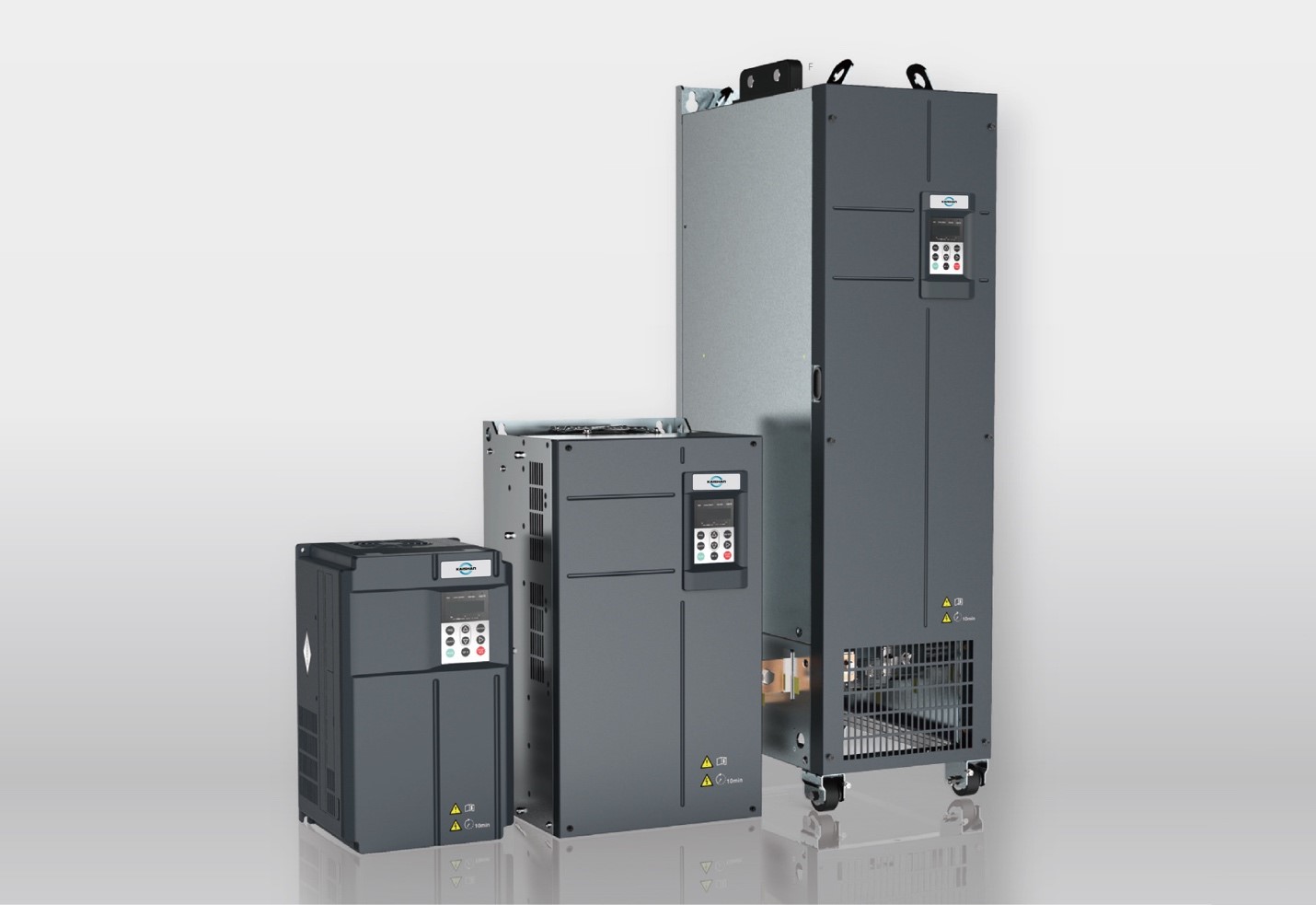
You may be tempted to use variable-speed drive compressors to offset the need for a trim compressor. That may not work for everyone, however.
You have to look at your demand profile:
- If you have varying demand (50-80% of capacity), a primary VSD will work well. You may not need a trim unit, since having a baseload compressor with a VSD may perform both baseload and trim functions.
- But if your demand exceeds 80% of capacity, you should go with a fixed-speed unit, since VSDs aren’t very efficient at higher levels. As a result, you will still need a trim unit as described above, along with a backup unit.
In addition, if your system is only using a VSD compressor for limited intervals, water may build up, and seals may dry out, leading to premature failure. As a result, in some applications, the company may find that multiple fixed-speed compressors perform better.
In most cases, you’ll need adequate storage and a well-designed system. As a result, it’s smart to get an expert analysis of your demand.
Help in Building Ironclad Redundancy
Implementing a multi-compressor system with a dependable backup compressor can make a major difference in your operation, allowing you to achieve greater reliability, energy efficiency and cost efficiency.
But it requires expert advice to accurately determine your needs and design a system that uses lead-lag compressor control and balances the compressed air load.
In addition, working with one of our distributors to stock your entire equipment with Kaishan compressors ensures you will have industry-leading parts availability and competitive pricing. And not have to duplicate service items such as oil filters, lubricants, air filters and coalescing filters.
Find a compressed air professional near you. Or contact us directly.
Key Takeaways
- Keeping an aging compressor in place as a backup may backfire, failing to start when you need it most and giving you a false sense of security.
- A multi-compressor system is the best way to add true redundancy to your compressed air system, reducing maintenance costs, saving electricity, avoiding emergency service, maintaining pressure stability and extending equipment life.
- A multi-compressor system usually consists of baseload, trim and backup compressors.
- While some companies are tempted to use a variable-speed drive on a baseload compressor to offset the need for a trim unit, that may not work for everyone.
Need Help Getting Reliable Backup in Your Plant?
If compressed air is mission-critical in your plant, having reliable backup is crucial. We can help. Kaishan USA works with a nationwide network of independent distributors, who can provide on-site help and consultation as needed. Find the one closest to you. Or, feel free to contact us directly.
Frequently Asked Questions about Air Compressor Longevity
Listen to the Podcast Version



Why That Old Compressor Isn’t Really a Backup
Alright, welcome back to The Big Dog Podcast. I’m Jason Reed.And I’m Lisa Saunders. Today we’re going after a sacred cow in a lot of plants: that old air compressor sitting in the corner “just in case.”
Yeah, the museum piece. The one everybody points at on the walkthrough and says, “Don’t worry, we’ve got backup.”
You see this all the time when a plant buys a new compressor. The old one technically still runs, it feels wasteful to haul it out, and somebody says, “Let’s keep it as backup, just to be safe.”
And on paper, it sounds reasonable. You already own it, it’s plumbed in, the boss likes that you’re “using all your assets.” But you retired that machine for a reason. You didn’t wake up one day and decide to redecorate the compressor room.
Right. Usually it was breaking down too often, or it couldn’t give you the pressure or flow your plant really needs, or it wasn’t hitting the air quality spec anymore. Sometimes it’s just getting hard to find parts for it. None of that magically improves once it’s parked in the corner.
If anything, it gets worse. Let’s walk through what actually happens in the real world with those “backups.” First one: it just doesn’t start. It’s been sitting for months, maybe more. You’ve got an emergency, you hit start, and… nothing. Or it faults out as soon as it loads.
Second one I hear a lot: okay, it does start, but it can’t hold pressure or flow. Maybe it could barely keep up when it was your main machine. Now, with more production and more demand, it’s just not sized to carry the load. So your header pressure falls, end uses start starving, and you’re still effectively down.
Or the pressure “looks” okay because somebody cranks the setpoint way up to mask the problem. That just stresses everything else in the system. And then there’s air quality. Older units that weren’t meeting spec before don’t suddenly start drying and cleaning air better just because they got demoted.
Yeah, if it was putting out wetter, dirtier air before, it’ll do the same as a backup—maybe worse after sitting. That’s a real issue if you’ve got sensitive processes or downstream equipment that doesn’t like contamination.
And don’t forget the parts problem. You’re already struggling to get OEM parts or even basic service items on that old unit. So now picture it: your primary compressor goes down, you spin up old faithful, and then realize the seal or valve you need is on six-week backorder—if anyone can even find it.
So instead of being safer, you’ve kinda increased your risk. You have this false sense of security: “We’re covered, we’ve got backup.” But when something really fails, that’s when you discover all the limitations the hard way.
I’d go further—sometimes counting on that old machine is riskier than admitting you don’t have backup at all. At least if you know you’ve got no net, you plan differently. You’re not rolling the dice assuming that backup will save you.
So let’s reframe what “backup” should mean. It’s not a dusty spare that looks good on an asset list. Real backup is proven capacity you’ve actually tested under load, that sees regular runtime, and that you know can carry the plant if it has to.
Exactly. True redundancy means the backup’s in the normal rotation, it’s working in its efficient range, hours are balanced, and you’ve seen it do the job—not just in theory, but in practice. That’s a very different picture from an aging unit in the corner with a sticky starter and mystery oil in the sump.
So if you’re listening and mentally picturing that old machine in your plant… this episode’s for you. We’re gonna talk about what real redundancy looks like and how to get there without crossing your fingers every time you hit start.
What True Redundancy Looks Like in a Modern Plant
Alright, let’s get into what a modern backup strategy actually looks like—because it’s not “one big compressor and a fossil in the corner.”Nope. The model we’re talking about is a multi-compressor system. Plain English: instead of one hero machine doing everything, you’ve got a small team—each compressor has a role. Baseload, trim, and backup.
Let’s break those down. Baseload compressor first. This is the workhorse that covers your minimum, steady demand. It runs at full capacity or it’s off—there’s no constant ramping up and down. In some bigger facilities, you might have more than one baseload unit to cover that core load.
Then you’ve got the trim compressor. That one handles the ups and downs above the base. Demand in a plant isn’t flat—it rises and falls. Trim fills that gap. Rotary screw compressors with variable-speed drives are a great fit here because they can follow that changing demand efficiently.
And then you’ve got the backup compressor. This is not a decorative item. It’s sized to step in if a baseload or a trim unit goes offline. Usually, it should be about the same size as the baseload so it can actually carry the plant if needed.
Now here’s the key: in a good system, that “backup” isn’t just sitting cold. You set the whole thing up as rotating compressor units. So over time, different machines take the lead, others run lag or standby. Hours get balanced, all the units are tested under load, and nothing gets forgotten.
And that’s where lead–lag control comes in. You’re not flipping switches by hand. Modern control systems decide which compressor is lead, which is lag, and they can automatically switch over if something starts to go wrong—like elevated temperature or vibration on the lead unit.
Yeah, think of it like this: the system’s watching all your compressors in real time. If the lead unit starts running hot, the controls can shift the load to the lag machine before you get a failure. That’s condition-based monitoring. You’re not waiting for a catastrophic trip; you’re moving the load proactively.
And because the backup takes real load on a regular basis, you’re not guessing if it’ll run when you need it. You already know. That’s why this kind of setup almost eliminates surprise downtime. Stuff can still fail, but you’ve got capacity and automation to keep the air on.
The cost side is where this really hits home. Take Heritage Hosiery over in East Ridge, Tennessee. They put in two 100-horsepower KRSD rotary screw compressors with variable-speed drives. One basically acts as backup so if something happens, they don’t lose the shift.
And a lost shift for them isn’t just “a bad day.” They’re looking at downtime costs up to about $5,500 per shift. So having that second compressor in a proper backup strategy—ready, tested, sized right—pays for itself the first time it saves them a single day of unplanned downtime.
Compare that to scrambling for a rental diesel unit when your only compressor dies. You’re paying rental fees, burning diesel, dealing with exhaust and logistics, and you still might be fighting to keep pressure where you need it. The multi-compressor approach is basically insurance that actually works.
So modern redundancy isn’t “extra metal on the floor.” It’s a system: baseload handling the steady demand, trim managing swings, backup in the rotation, and smart controls sharing hours and switching automatically when something’s off. It’s engineered to keep you out of emergency mode.
And that’s the mindset shift: you’re not buying a second or third compressor “just in case.” You’re designing a whole compressed air strategy so downtime is the exception, not something you cross your fingers about every Monday.
VSDs, Controls, and Practical Decisions for Your Plant
Let’s talk about the knobs you can actually turn—VSDs, controls, and how you decide what makes sense in your plant.Yeah, because a lot of people hear “variable-speed drive” and think it’s a magic bullet. Like, “If I buy one big VSD compressor, I don’t need trim or backup.” That’s not always how it plays out.
The key is your demand profile. If your demand varies but stays in that middle band—roughly, let’s say around half to maybe 80 percent of capacity—a primary VSD compressor can work really well. In some cases, that one VSD baseload can handle both the base and the trim function.
But once your demand is up in that higher range—above about 80 percent of capacity most of the time—a fixed-speed unit is usually more efficient. VSDs just aren’t as efficient running flat out all the time. In that world, you’re back to the classic setup: fixed-speed baseload, a trim compressor, and still a backup.
And storage matters too. If your demand doesn’t swing much and you’ve got enough air storage, one fixed-speed compressor can actually be the most efficient option. But most plants do have real variation, which is where that multi-compressor approach earns its keep.
There’s also a gotcha with VSDs that run only in short intervals. If the machine isn’t getting proper runtime, you can see water buildup, seals drying out, that kind of thing. So in some applications, multiple fixed-speed units, well controlled, can actually be more reliable long term.
Either way, when you go multi-compressor, you unlock a bunch of side benefits. Maintenance costs start to come down because you’re sharing hours. Instead of hammering one compressor and servicing it every quarter, you might stretch a unit’s service to twice a year by rotating roles and staggering service so something’s always available.
You also get better pressure stability. Older machines tend to struggle to hold pressure, so operators creep the header pressure up to hide the problem. Newer compressors with good controls can keep that pressure band tight, so you’re not wasting energy running higher than you need.
And we touched on this earlier—fewer emergency rentals. If you’ve got a real backup in the rotation, you’re not dragging in a portable diesel every time something hiccups. You avoid the rental bill, the fuel, and the headache of keeping exhaust away from your process.
Lead–lag control also extends equipment life. You cut down on start–stop cycles, you distribute hours evenly, and you’re not beating one motor to death while the others gather dust. That’s just smart use of what you paid for.
So if you’re listening and wondering, “Okay, what do I actually do Monday morning?” here’s a simple roadmap. First, go look at your so‑called backup. Is it old, hard to get parts for, hasn’t run under load in months? Be honest about whether you’d bet a shift on it.
Second, pull your runtime data if you have it. Look at when compressors start and stop, what your demand profile really looks like, how often you’re near max capacity. If you don’t have that data, that’s already your first clue you could use better controls.
Third, talk to a compressed air professional. This isn’t something you have to guess at. An audit or a real demand analysis can tell you if one VSD is enough, or if you need that baseload–trim–backup combo, plus storage and proper control.
And if compressed air is mission‑critical in your plant—and for a lot of folks it is—you want ironclad redundancy, not luck. Working with a good distributor, speccing a matched family of compressors, even standardizing on service items like filters and lubricants, all that makes the system easier to support.
Yeah, and you don’t have to design this in a vacuum. Kaishan’s got a nationwide network of independent distributors who can come on site, look at your setup, and help you design real backup instead of hoping that old unit in the corner will save the day.
Alright, let’s land this. Ditch the false sense of security from the antique in the corner, start thinking in terms of multi-compressor systems, good controls, and tested backup, and you’re gonna sleep a lot better when that primary compressor finally decides to take a day off.
Jason, thanks as always for cutting through the noise.
Anytime.
And thanks to all of you for listening to The Big Dog Podcast. I’m Lisa Saunders.
I’m Jason Reed. We’ll catch you next time.