


Why Your Old Unit Won’t Make a Good Backup Air Compressor
March 18, 2026
Five New Air Compressors Trends to Watch in 2026 and Beyond
April 1, 2026Three Myths about Centrifugal Compressor Manufacturing and Testing
By J. Howard, Director of Centrifugal Sales | March 25, 2026 | Uncategorized

Many large industries, such as aircraft manufacturing, rely on centrifugal compressors because of their reliability, efficiency and long life.
Centrifugal air compressors play a pivotal role in supplying compressed air, providing oil-free air with outstanding reliability, efficiency and longevity.
Because of the high initial cost, however, they aren’t for everyone. They become most cost-effective at higher air demand—typically starting at 300 HP to 600 HP, depending on the application. With centrifugal units becoming the most efficient option above this horsepower range.
But many facility managers look wistfully at the incredible opportunities centrifugals offer and wonder whether their plants will someday be able to justify the leap.
They’re most familiar with reciprocating and rotary screw compressors. So they may not know a lot about centrifugals, especially about their manufacture and testing.
That has led to some misconceptions about the technology. We want to dispel those myths.
Let’s start with the first idea, that centrifugal compressors are manufactured the same way.
Myth No. 1: All Centrifugal Compressor Manufacturing Is the Same
Centrifugal compressors indeed share many similarities across brands. There’s a reason for that: the technology is relatively straightforward—like huge fans, centrifugal compressors spin at high speeds to produce the high volumes of air they’re known for.
To achieve their performance and efficiency at high volumes, they need precise engineering, highly skilled manufacturing and thorough testing.
Following the automotive industry's business model, many compressor manufacturers buy individual parts and components from other companies and assemble them into finished products.
As a result, they are really assemblers, rather than manufacturers. They “assemble” your compressor parts supplied by third-party vendors.
So, it’s true that like today’s automobiles, many of today’s compressors are very similar, since they often are made from the same (or similar) components.
But not every company is like that.
Integrated Centrifugal Compressor Manufacturing
Kaishan is an integrated manufacturer. That means we make almost every component that goes into your system, including impellers, pinions, castings and filters, among others.
There are two main exceptions:
- Motors. We use motors from well-established manufacturers. So that your maintenance people will be looking at a motor plate branded by a name they know and trust. And making replacements and repairs easier.
- Controls. We use PLC-based controls from local, trusted vendors that specialize in non-OEM centrifugal controls. Because they are built on the industry-standard Allen-Bradley platform, it is easy to integrate our compressor into your factory automation system.
The point is that because we make most of the parts and components for our compressors in our own facilities, we have much more flexibility. And the opportunity to give you a compressor that is more reliable, longer-lasting, energy-efficient and cost-effective.
And because they are large capital investments, compressors are usually not assembled or manufactured in advance. They usually don’t come together before an order is placed. That allows them to be customized to your individual specifications.
Myth No. 2: All Centrifugal Compressors Are Custom Manufactured
As mentioned, virtually all centrifugal compressor manufacturers build your compressor when they receive the order. They typically do not have products sitting on the shelf, waiting to be shipped.
Because they are assemblers, not true manufacturers, many centrifugal compressor companies get pre-engineered impellers, castings, coolers and other parts from third-party suppliers. They then select the components that most closely match your needs and bolt them into your compressor.
That means if you need a 115-PSIG impeller, you must choose between a 100-PSIG and a 125-PSIG component. They slap on the 125-PSIG part and call it good to go.
As a result, they reduce their engineering and machining costs. But you pay a penalty in efficiency—admittedly, a tiny one—every time that impeller spins. And that impeller could spin trillions of times over its lifetime.
So, does the fact that they are made-to-order make these compressors custom-made? Not really.
Custom-Manufactured for Your Location
Every machine we make is built for your application, almost from scratch. All the major centrifugal compressor components, including impellers, pinions, castings, filters and lube oil systems, are manufactured and assembled in Kaishan’s factories.
That gives us greater flexibility to design and manufacture a compressor that meets your exact needs. And it gives you the most efficient machine possible. If you need a 115-PSIG impeller, a custom aero, that’s precisely what you get.
Custom Aeros
Rather than using standardized, premade impellers made by a third-party supplier, Kaishan designs custom aerodynamic impeller profiles tailored to each customer’s exact pressure requirements.
Each impeller and pinion is individually machined on a five-axis machining center, so you get the most efficient machine possible.
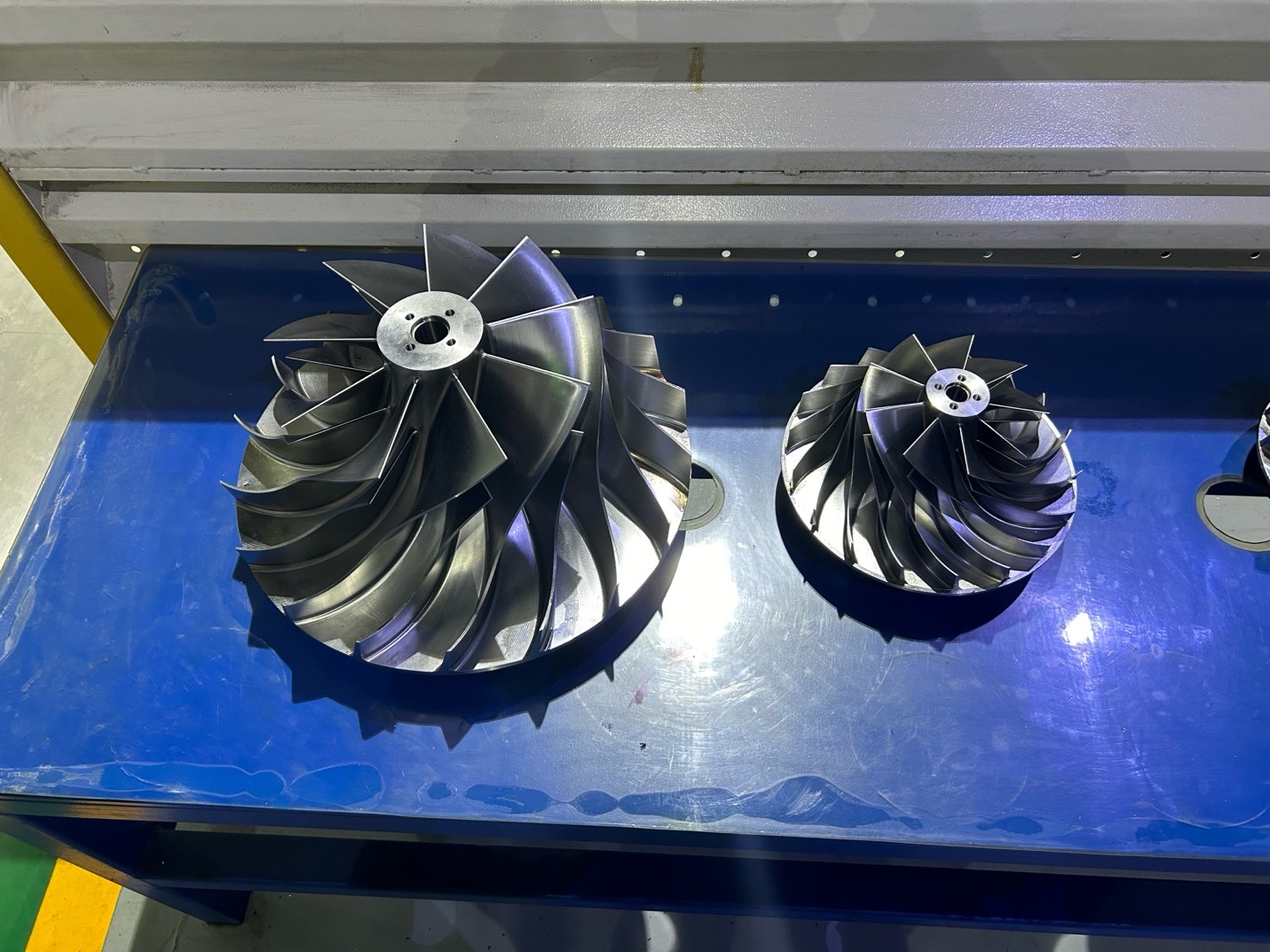
We custom-machine the impellers of our KCOF oil-free centrifugal compressors to match the needs of your application.
Three Stages, Give or Take a Few
Though we commonly manufacture three-stage models to meet industry needs, we also offer two-stage models for processes, such as glass manufacture, that require only 55 PSIG-70 PSIG for gentle shaping rather than high-pressure molding. And we do four-stage compressors for high-pressure applications such as blowing plastic bottles or testing aircraft engines.
And because impellers rotate at 25,000-60,000 revolutions per minute when installed (depending on their stage), we do extensive testing of individual components and the full rotating assembly.
Myth No. 3: All Manufacturers Conduct the Same Centrifugal Compressor Testing
In fact, most manufacturers of centrifugal air compressors use essentially the same testing processes. They generally conduct performance testing following the ASME PTC 10 standard as well as other tests, including:
- Multi-stage dynamic balancing, including separate calibration of the pinion, impellers and the overall rotating assembly to maintain vibration within acceptable limits at operational speeds.
- Inlet guide vane testing to ensure proper modulation.
- Mechanical run tests to check for vibrations, temperature and other operational parameters.
- Performance tests to assess the compressor's actual output against its rated performance.
Because everyone does them, these tests meet the minimum requirements. You really can’t play in this market unless you do this level of centrifugal compressor testing.
The good news is that most manufacturers run functional, mechanical and performance tests on a compressor’s individual components, including impellers, inlet guide vanes, controls, motors, lube oil systems and coolers.
The bad news is that these tests are often run only at the component’s manufacturing site, which is typically managed by a third-party vendor.
And the first time most compressors are run as a complete package is after they’re delivered. When they’re on your plant floor. When you press the start button.
Performance Testing on the Entire Package
What distinguishes Kaishan’s KCOF oil-free centrifugal compressors, however, is that we do performance testing on the entire package before it leaves our plant.
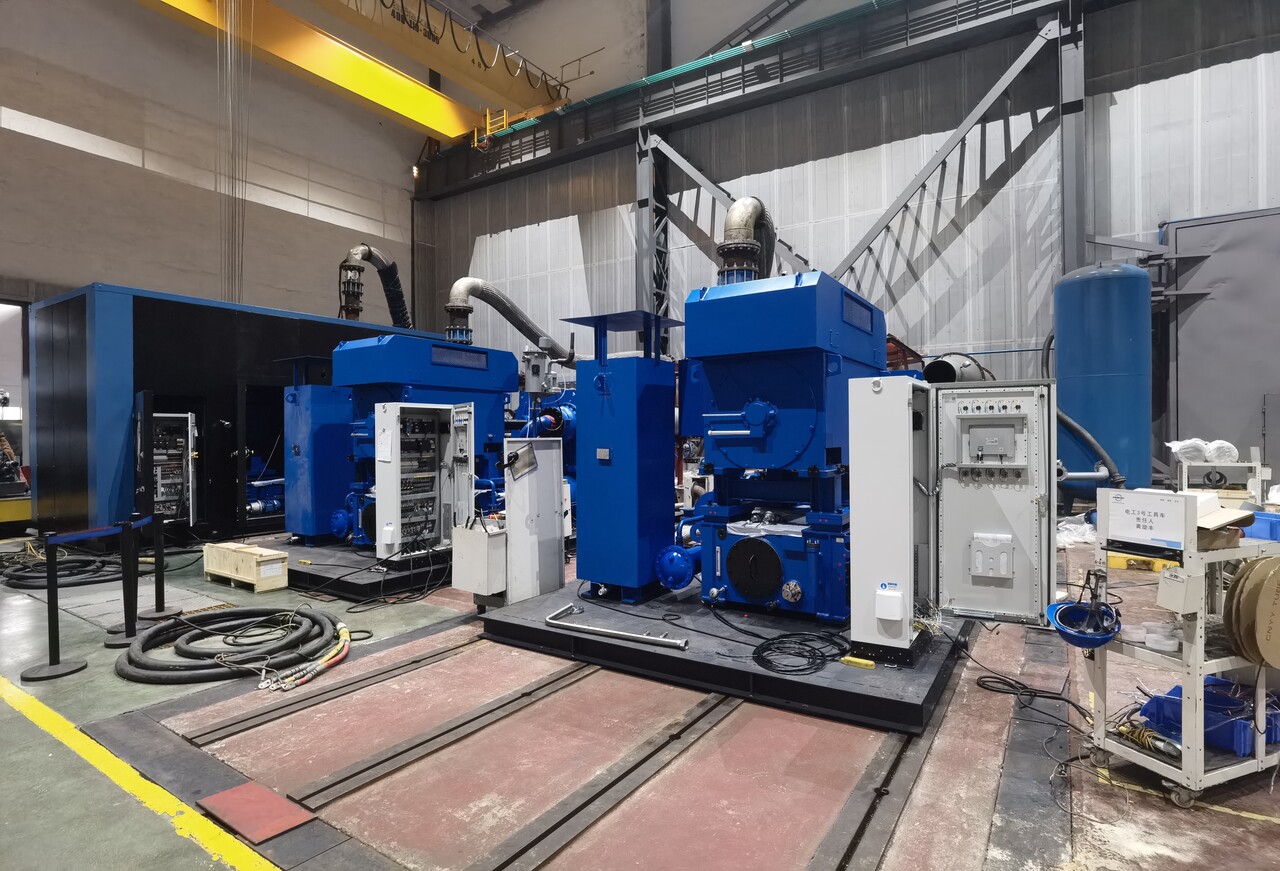
Kaishan is one of the few centrifugal compressor manufacturers that do performance testing on the entire package before it leaves our plant.
A True Performance Map
Kaishan performs full-package performance testing on our compressors after they’re fully assembled, also evaluating lube oil systems, coolers, controls and motors. The full test runs for about four hours, exceeding the industry norm.
Our competitors conduct what we call a three-point test, mapping out three key points on the performance curve: design flow, minimum flow-to-surge and the high-pressure surge point. The goal is to ensure the compressor meets its basic design specifications.
Not only does Kaishan test at the three points mentioned above, but we also perform an IGV (Inlet Guide Vane) test at seven points: 100% open, 90%, 80% and so on down to 50% open, then test the minimum surge point. That builds a detailed operational profile beyond the three-point tests our competitors use. It’s a true performance map that provides extensive data and ensures that performance matches what the customer bought and expected.
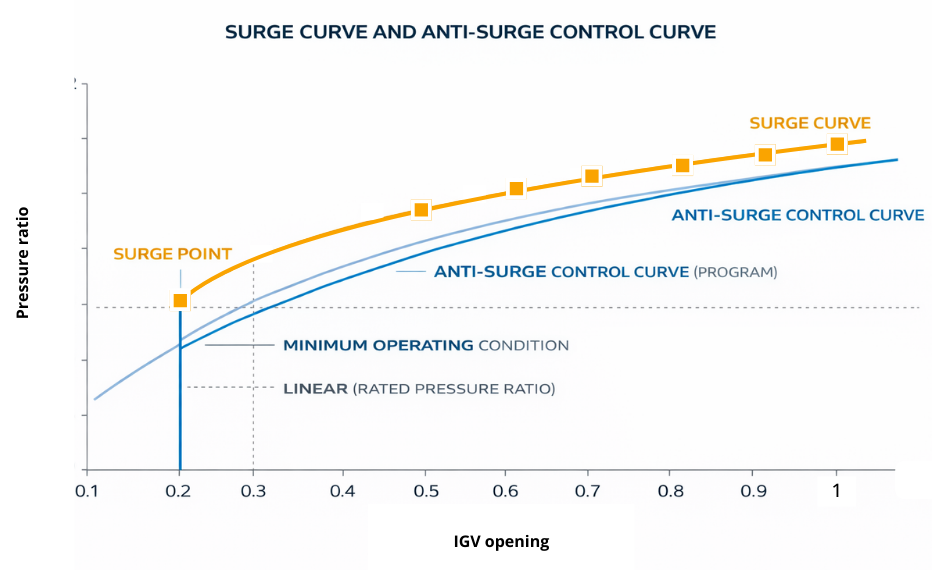
The graphic above shows the establishment of the surge point at seven different IGV positions.
Performance testing accounts for site-specific conditions by applying accepted data-correction factors and ensuring that test results accurately reflect real-world operating conditions. In previous blog posts, we’ve explained how important it is to consider your site’s elevation, temperature and humidity when sizing and specifying a compressor.
Kaishan’s full-package centrifugal compressor testing assures customers of integrated system performance before shipment, reducing on-site installation risks and centrifugal compressor troubleshooting time. It minimizes installation risks by verifying system integration before shipping, reducing field troubleshooting for vibration, lubrication pressure and alignment issues.
Plus, having comprehensive factory test data—our true performance map—allows the installing technicians to quickly pinpoint discrepancies between factory and field performance, making it easier to identify and resolve issues.
Centrifugal Compressor Installation
Installation of centrifugal compressors varies significantly by machine size, with smaller units offering near plug-and-play setups and larger units requiring some component disassembly and reassembly on-site, sometimes over a week or more.
Larger machines may involve complex logistics, such as removing motors, cooling manifolds and other components for transport, then reassembling them with cranes and specialized contractors.
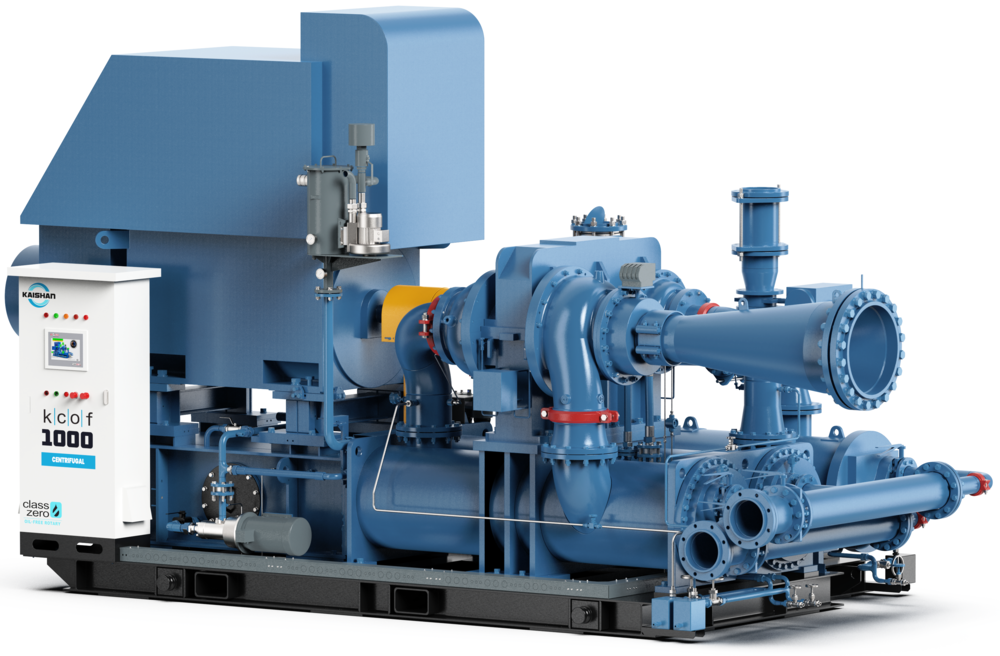
Kaishan’s KCOF oil-free centrifugal compressor is custom-manufactured for your application and is package-tested before it leaves our plant.
They range from 250 HP and 1,400 CFM to over 10,000 HP and 50,000 CFM. They are also available in a wide range of pressures, from 35 to 350 PSIG.
Other features and benefits our KCOF centrifugal air compressors offer include:
- State-of-the-art controls. Our KCOF centrifugals are equipped with a field-proven control and energy management software solution that provides dynamic machine and system throttling and a full-flow operating range. Kaishan offers a user-friendly, open-architecture solution that uses industry-standard Allen-Bradley PLC hardware.
- Easier maintenance. Like other centrifugal compressors, the KCOF requires less service inventory and minimal maintenance time. The KCOF has a self-cleaning inlet air filter as an option, reducing the need for filter change-outs in very dirty environments. As a result, filters do not clog as quickly. In addition, the KCOF has longer service intervals, requiring an oil change in many applications only after two years of continuous operation. Our coolers feature tube bundles made from corrosion-resistant stainless steel, with epoxy-coated water passages and housings to ensure excellent reliability and long life.
- Unmatched parts availability. Because we are one of the world’s few fully integrated manufacturers of centrifugal compressors, no other manufacturer matches our parts availability. And no one delivers the parts you need as quickly. While other manufacturers make you wait weeks or months (!) for replacements, our parts often ship directly from our warehouse in days, if not hours.
- Dedicated support team. We support our centrifugal compressor line with a team of local centrifugal experts whose daily duties include technical support, troubleshooting and field service support for centrifugal air compressors.
Help in Making the Transition to a Centrifugal Compressor
The choices you make about whether to move to a centrifugal compressor could well determine your company’s success in achieving broader objectives such as reliability, energy efficiency and cost efficiency.
That’s why it’s so important that you understand some of the fundamentals about these highly efficient, specialized units.
We work with a nationwide network of independent distributors, who can help you plan out and execute a successful centrifugal compressor installation.
Dispelling the Myths About Centrifugal Compressor Manufacturing and Testing
| The Myth | The Reality |
|---|---|
|
All centrifugal compressor manufacturing is the same |
Many compressor companies are assemblers. We are an integrated manufacturer that makes most of the components for our systems. |
|
All centrifugal compressors are custom-manufactured. |
Made-to-order is not the same as custom-manufactured. We won't select third-party parts "off the shelf" and assemble them into a package. All our compressors are custom-manufactured for your location and application. |
|
All manufacturers conduct the same centrifugal compressor testing. |
Most companies test individual components. We perform a full-package test on the entire package before it leaves our plant. |
Need Help in Understanding Centrifugal Compressor Manufacturing and Testing?
Knowing the ins and outs of centrifugal compressor manufacturing and centrifugal compressor testing is crucial if you’re considering a move to these larger, highly efficient compressors. We can help. Kaishan USA works with a nationwide network of independent distributors, who can help you determine whether a centrifugal unit would be cost-effective for your facility.
Frequently Asked Questions
Listen to the Podcast Version



Why Centrifugal Compressors Aren’t Just Big Fans
You’re listening to The Big Dog Podcast. I’m Jason Reed, and today we’re talking centrifugals—when they actually make sense, and why they are NOT just big fans in a box.And I’m Lisa Saunders. Jason, I feel like a lot of people look at these big shiny centrifugal packages and think, “Cool, but that’s for the plant across town, not for me.”
Yeah, or, “That’s what the jet engine guys use, I’ll stick with my screws.” [pauses] So let’s anchor this. If you’re running a small shop, or you’re under, say, 300 horsepower total air, you’re probably living in rotary screw land and that’s fine.
Right, but once you’re getting into that 300–600 horsepower range and up—especially if you’ve got steady demand and you need oil‑free air—that’s when you should at least look at a centrifugal.
Exactly. Above that range, centrifugals often become the most efficient option. You’re trading a higher upfront cost for better efficiency, big volumes, and long life. Think big automotive plants, glass, bottle blowing, aircraft manufacturing… anyone who needs a lot of clean air, day in, day out.
Let’s break down how the thing actually works, because people hear “centrifugal” and either glaze over or picture a desk fan on steroids.
Yeah, “big fan” is the lazy explanation. The simple version: you’ve got impellers—think of them like high‑precision wheels with blades—spinning at 25,000 to 60,000 rpm or more. They fling the air outward, which boosts the pressure. Then diffusers and casings slow the air down and convert that velocity into usable pressure.
And that speed is the key. When you’ve got metal spinning that fast, any little machining error, balance issue, or casting defect, it’s not a small problem. It’s a vibration problem, it’s a bearing problem, it’s a “why is my brand new machine screaming at me?” problem.
Yeah, that’s when the vibration probe becomes your best friend and worst enemy. [dry] Ask me how I know. Precision manufacturing and serious testing matter, because that rotor is going to spin trillions of times in its life. If it’s not right, it will tell you—loudly.
Okay, so let’s tee up Myth Number One: “All centrifugal compressor manufacturing is the same.” You hear that a lot in bids—people assume everybody’s building these things the same way.
They’re not. A lot of “manufacturers” are really assemblers. They buy impellers, pinions, castings, coolers from third‑party vendors. Then they bolt it all together, put their nameplate on it, and ship it.
And then there are integrated manufacturers. Kaishan’s one example—they machine their own impellers, pinions, castings, filters, lube systems, in‑house. They still buy motors and standard PLC controls from known brands, but the air end and a lot of the guts are theirs.
Why do you care? Couple of reasons. First is risk. If your supplier is assembling a bunch of third‑party parts, you’ve got more interfaces, more finger‑pointing if something’s off. “Is it the casting vendor?” “Is it the impeller shop?” You’ve seen that movie.
Second is lead time and support. If an integrated manufacturer makes most of the parts themselves, they usually have better parts availability. You don’t want to hear, “Yeah, that impeller is six weeks out because our vendor’s backed up.”
And third is lifecycle tuning. An integrated shop can tweak an aero design, adjust a casting, or update a lube skid and actually control the outcome. With assemblers, you’re often locked into whatever the catalog parts can do.
So when you’re evaluating suppliers, one simple question: “What do you actually manufacture yourselves, and what do you buy?” If they dodge that, that’s a data point.
Yep. Don’t get hung up on the logo on the door. Focus on who owns the core components, how they’re made, and how that affects your uptime and your ability to get parts when the machine’s down.
Myth vs Reality on Custom Centrifugals
Alright, let’s get into Myth Number Two: “All centrifugal compressors are custom‑manufactured.” This one sounds flattering, right? You sign a PO, and suddenly you’re getting a one‑of‑a‑kind machine handcrafted just for you.Yeah, the reality is most of them are “made‑to‑order,” not truly custom. There’s a difference. A lot of assemblers are pulling from pre‑engineered impellers, castings, coolers. They configure from a menu instead of designing around your exact point.
Give an example here. Let’s say your system really wants, I don’t know, 115 psig to run sweet. Many vendors might have a 100 psig impeller and a 125 psig impeller sitting on the shelf.
Right. So they say, “Close enough,” bolt in the 125 psig wheel, and walk away. Does the machine run? Sure. But that impeller isn’t sitting in its most efficient spot on the curve for your load. You take a small efficiency hit every revolution.
And at 25–60 thousand rpm, trillions of revolutions over the life of the machine… that “tiny” penalty adds up in power costs. You don’t see it in week one, you feel it in your energy bill over ten years.
Now, compare that with true custom aero. Some manufacturers—again, Kaishan’s an example—will actually design and machine an impeller profile specifically for that 115 psig point. Five‑axis machining, custom aero shape, matched pinion. That’s what “custom” really means.
It’s not just the wheel, either. You’ve got staging choices. Two‑stage, three‑stage, four‑stage. That’s going to depend on the pressure you need.
Yeah. Typical plant air, you’re usually looking at three stages. If you’re in a process that only needs, say, 55 to 70 psig—like some glass forming where you want gentle shaping, not high‑pressure blasting—you might run a two‑stage unit. On the other end, if you’re up in high pressure, like bottle blowing or some engine test stands, you might be in four‑stage territory.
So as a plant or maintenance lead, the questions you want to ask are: “How did you pick the number of stages? Are the impellers standard or custom for my pressure? Show me what pressure you designed those wheels for.”
And don’t forget your site conditions. Altitude, ambient temperature, humidity—they all hit the actual air density your compressor sees. Good vendors will correct for that when they size your machine.
So if you’re up at elevation, in a hot, humid climate, whatever the case is, ask: “Are you correcting your performance guarantees for my elevation, my temperature range, my humidity? Or are these sea‑level, 68‑degree, lab‑perfect numbers?”
Yeah, and tie that back to your utility bill. You’re not buying a nameplate, you’re buying kilowatt‑hours for the next decade. You want that machine sitting in its efficient sweet spot at your actual site, not some generic test bench.
Let’s give a quick pre‑PO checklist here. You should be asking vendors: One, is this a standard impeller or a custom aero for my pressure? Two, why this staging—two, three, or four stages—for my pressure and flow? Three, how are you correcting for my altitude, temperature, and humidity?
And four, “Show me the performance point you actually optimized for.” If all you get is, “It’s the catalog selection,” you know you’re in made‑to‑order land, not truly custom. That’s not automatically bad, but at least you know what you’re buying.
Testing, Performance Maps and What You Should Demand
Let’s move to Myth Number Three: “All manufacturers conduct the same centrifugal compressor testing.” On paper, it kinda looks that way. Most of the serious players quote the same standards.Yeah, you’ll hear ASME PTC 10 for performance testing. You’ll hear about mechanical run tests, multi‑stage dynamic balancing, inlet guide vane checks, vibration, temperature. That’s the baseline if you wanna be in the game.
Multi‑stage balancing is important—balancing each impeller, the pinion, then the whole rotor so it doesn’t shake itself apart at speed. IGV testing is checking that your inlet guide vanes actually modulate flow the way they’re supposed to. Basic stuff, but necessary.
The catch is where and how that testing happens. A lot of vendors test components at the vendor’s shop. Impeller here, cooler there, controls somewhere else. Then the first time the full package is actually run together… is on your floor, on day one.
Yeah, and that’s when the fun starts. [dry] If there’s a lube system integration issue, or a vibration at a certain speed, or some weird control behavior, you find it after you’ve rented a crane, pulled in electricians, and you’re trying to hit your startup date.
Some manufacturers go further and do full‑package testing. They assemble the whole unit—compressor, lube system, coolers, controls, motor—and run it in the factory for hours, not just a quick bump test.
Kaishan’s KCOF line, for example, gets around a four‑hour full‑package run. They’re not just checking, “Does it turn on?” They’re mapping out performance, checking lube pressures, cooler performance, controls logic, the whole deal.
And that ties into performance maps. Most competitors will do a “three‑point” test: design flow, minimum flow before surge, and high‑pressure surge point. Surge, by the way, is that nasty unstable operating region where flow reverses and the compressor starts to cough and shake—nobody wants to live near that.
Exactly. Three points tell you the compressor basically hits its design, and where the cliff is. Kaishan and a few others go further and test the IGVs at multiple openings—like 100, 90, 80 percent, all the way down—and then find the surge point at those conditions. That gives you a much richer performance map.
Why should you care? Commissioning and troubleshooting. If you’ve got a detailed map from the factory, including corrections for your site conditions, and what you see in the field doesn’t match, you can zero in fast. Is it a piping issue? A control setting? Something got mis‑wired?
Plus, it cuts installation risk. If they’ve already run the whole package at the factory, you’re less likely to spend the first week chasing ghosts—vibration, lube pressure trips, cooler leaks, alignment questions. You still have to install it right, but you’re not debugging the design on your dime.
Alright, let’s land this with a checklist for anyone looking at centrifugals. What should plant and maintenance leaders actually demand?
On testing: Ask, “Do you do full‑package, factory performance testing, or just component tests? How long do you run the machine? How many points on the performance curve do you test, and do you include multiple IGV positions?”
On installation: “For my frame size, what has to be disassembled for shipping? How long does a typical install and startup take? Do I need cranes, specialized contractors, how many days will my team be tied up?”
On maintenance: “What are the real service intervals? How often do I change oil, clean or replace filters, pull coolers? What’s your parts availability like—are you making the core parts or waiting on a third party?”
On monitoring and health checks: “What data do I get out of the controls? Can I trend vibration, temps, pressures easily? And how often should we do a performance ‘tune‑up’?” A good rule of thumb from the centrifugal folks is a health check about twice a year, tied to your regular PMs.
If you walk into a centrifugal project with those questions, you’re in a much better spot. You’re not just buying a big box; you’re buying reliability, efficiency, and how painful—or not—your next ten years are gonna be.
Use this episode as your sanity check. Next time a vendor says, “Yeah, yeah, it’s all standard, everybody does it this way,” you’ve got a list of very specific things to push on.
Alright, that’s it for this round on centrifugals. Lisa, thanks for keeping us honest.
Always. [laughs] Thanks for hanging out with us.
We’ll catch you next time on The Big Dog Podcast.